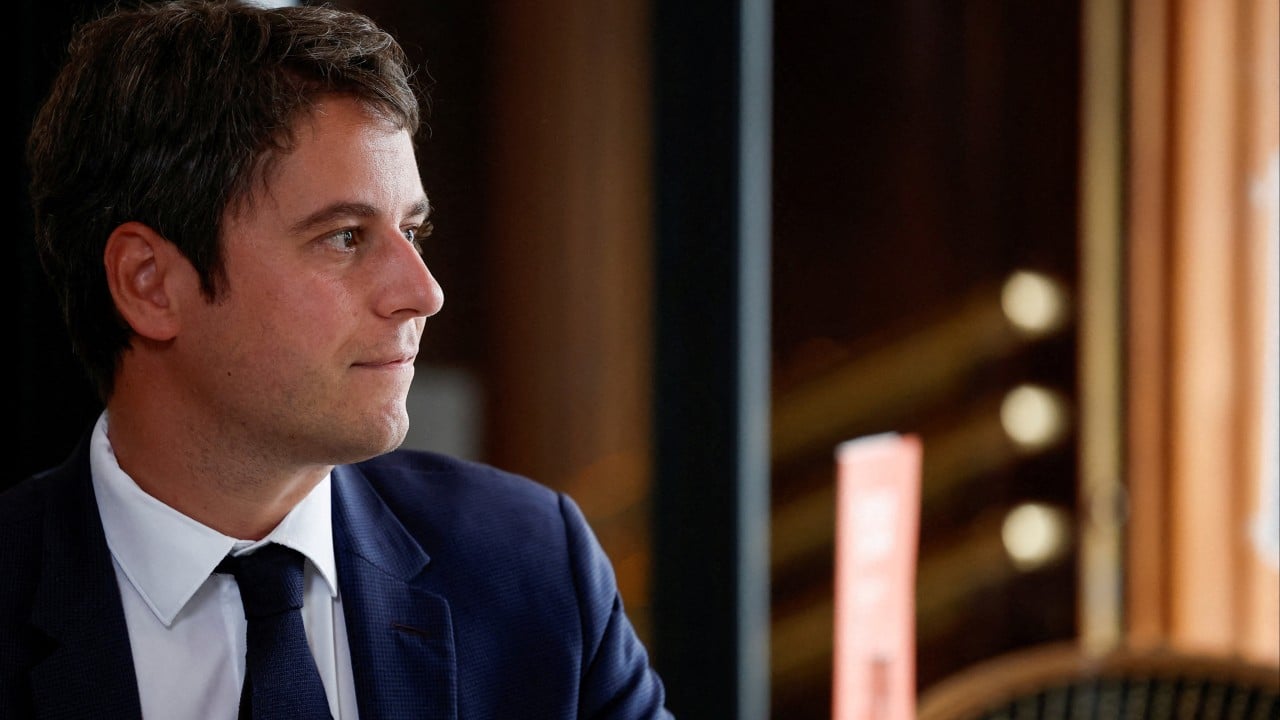
The political establishment is falling over itself to crown Gabriel Attal. The narrative is as predictable as it is lazy. Every mainstream outlet is running some variation of the same breathless headline: France’s youngest Prime Minister is gearing up for a presidential run, representing a bold, modern leap forward for a fractured republic. They look at his age, his slick communication style, and his meteoric rise under Emmanuel Macron, and they see the future of European governance.
They are fundamentally misreading the board.
The media consensus is treating Attal’s youth and his status as a Macron protégé as his ultimate strengths. In reality, these are his terminal flaws. Attal does not represent a break from the status quo; he is the distilled, hyper-concentrated essence of the very technocratic isolation that has driven voters into the arms of political extremes. The assumption that placing a younger face on a broken system somehow fixes the system is a delusion.
The Optics of Innovation vs. The Reality of Inexperience
Mainstream political analysis routinely confuses media savvy with structural competence. Attal is undeniably a master of the modern press cycle. He knows how to deliver a soundbite, how to project authority in a television studio, and how to look comfortable walking the halls of the Élysée Palace. But look closer at the actual mechanics of his resume.
Before becoming Prime Minister, Attal served as the Minister of National Education. During his brief tenure, his most notable policy interventions were not systemic overhauls to address declining literacy rates or teacher shortages. Instead, they were highly publicized culture-war decrees, such as banning the abaya in public schools. This is governance by press release. It is a strategy designed to generate immediate headlines and placate conservative voters in the short term, while leaving the deep, structural decay of the state apparatus completely untouched.
When political commentators ask, "Is Gabriel Attal ready to lead France?" they are asking the wrong question. The real question is: Can a political system survive when its leadership is entirely populated by career operatives who have never functioned outside the bubble of elite state machinery?
I have watched political organizations and state departments throw away billions trying to rebrand unpopular institutional ideas with younger, more photogenic spokespeople. It fails every single time. It fails because the public can sense the difference between a genuine structural pivot and a mere cosmetic update. Attal is the ultimate cosmetic update.
The Prodigé Trap: Why Macronism Cannot Outlive Macron
To understand why an Attal presidency is a flawed premise, you must understand the structural design of Macronism itself. Emmanuel Macron did not build a durable political party; he built a centralized, highly personalized vehicle for his own ambition. Renaissance (formerly En Marche) is not a traditional political movement rooted in a coherent ideological tradition or a deep grassroots network. It is an umbrella organization for technocrats who agree with Macron’s specific brand of top-down, managerial governance.
Imagine a scenario where a founder-led tech startup tries to transition leadership to a mid-level manager who has only ever known the founder's playbook. The manager knows the jargon. They know the routines. But they lack the original founder's raw, chaotic authority that kept the disparate factions of the company from tearing each other apart in the first place.
That is Gabriel Attal. He is a pure product of the Macron laboratory.
Without Macron’s personal leverage and unique historical positioning in 2017, the entire centrist coalition crumbles. By presenting himself as the natural heir to the throne, Attal inherits all of the baggage of the current administration—the pension reform protests, the accusations of democratic deficit, the economic anxiety—without any of the personal political capital that Macron used to survive those crises.
Dismantling the "People Also Ask" Delusions
The public debate around Attal is cluttered with flawed premises. Let us dismantle the most common assumptions guiding the current narrative.
Does Attal’s high popularity mean he can beat the populist right?
No. Attal’s popularity is a superficial metric derived from his contrast with an increasingly unpopular Emmanuel Macron. He functions as a screen onto which voters project their hopes for change simply because he is a new face. The moment he steps into the arena as a definitive presidential candidate, that vague goodwill evaporates.
The populist right, led by Marine Le Pen and Jordan Bardella, thrives on a narrative of the "corrupt, detached Parisian elite." Attal—born in Clamart, educated at the ultra-exclusive École Alsacienne, and fast-tracked through Sciences Po—is the literal embodiment of that stereotype. He is a caricature of the elite class that the working-class electorate is desperate to reject. Putting him up against a populist movement is not an antidote; it is gasoline on the fire.
Will a young leader appeal to France's disillusioned youth?
This is perhaps the most out-of-touch assumption of all. Youth voters do not vote based on shared demographics; they vote based on economic reality and systemic alignment. France’s younger demographic is deeply polarized, split largely between the radical left of La France Insoumise and the nationalist right of the National Rally. They are defined by a shared rejection of the centrist, neoliberal status quo. Attal represents the absolute pinnacle of that status quo. To a 22-year-old gig worker or a struggling student in Marseille, Gabriel Attal does not look like them; he looks like the boss who refuses to raise their wages.
The Cost of the Counter-Intuitive Approach
If the establishment wants to save center-left and center-right democratic institutions from total collapse, the solution is not to look for younger, sleeker versions of the elite. The solution is a brutal, uncomfortable return to ideological clarity and structural accountability.
Admittedly, rejecting the "young savior" narrative carries a massive short-term risk for political strategists. It means abandoning the easy media wins. It means admitting that the centrist project has deeply alienated large swaths of the population. It requires leaning into older, perhaps less telegenic leaders who actually possess deep ties to local municipalities, labor unions, and regional industries—the connective tissue of French society that Macronism systematically dismantled.
It is far easier for party elites to rally behind Attal, book him on prime-time television, and pretend that the youth vote will magically materialize out of generational solidarity. It is a comfortable lie.
The Structural Inevitability of a Vacuum
True executive leadership requires the ability to command authority during a structural crisis without relying on the institutional script. Attal has spent his entire adult life reading from a script written by Emmanuel Macron’s inner circle. He has never run a major city, he has never managed a major industrial crisis outside the safety net of the Prime Minister’s office, and he has never had to define a political philosophy independent of his mentor.
When the presidential campaign begins in earnest, the script will burn. The superficial charm of the youngest Prime Minister will face the raw, unpolished anger of an electorate that feels completely abandoned by the Parisian technocracy.
Stop looking at his age as an asset. Stop treating his media performance as competence. Gabriel Attal is not the savior of the political center; he is its final, beautiful, hollow symptom.