Languages die quietly. They do not shatter all at once with a grand explosion or an institutional decree. Instead, they recede room by room, kitchen table by kitchen table, until the words used to describe a cold morning or the warmth of a grandmother's embrace are replaced by the convenient shorthand of a larger, louder neighbor.
Cymraeg, the Welsh language, has danced on that razor's edge for centuries. It survived industrial upheaval, political suppression, and the slow, grinding machinery of cultural homogenization. Yet survival is not the same as thriving. To survive is to keep a dying ember shielded beneath cupped hands. To thrive is to watch that fire catch the roof timbers and illuminate a room full of people who thought it had gone out forever.
Enter a farm boy from Tatooine.
Think about what it means to experience a story for the very first time. Not just to watch moving images on a silver screen, but to recognize the shape of your own soul inside the myth. For generations of Welsh speakers, that recognition came with a quiet asterisk. You could love the space opera, you could wear out the VHS tapes, you could quote the scoundrel in the vest or the wise old hermit in the desert, but you did it in a borrowed tongue. English carried the stormtroopers, the rebellion, and the moisture farms.
Until now.
To mark a monumental anniversary, Lucasfilm did something extraordinary. They translated A New Hope entirely into Welsh.
Listen to that sentence again. A billion-dollar, culturally defining space epic, rooted deeply in American mythmaking and samurai cinema, now breathes in the guttural poetry of a Celtic tongue.
Picture a living room in Gwynedd. The rain is drumming a steady, percussion-heavy rhythm against the slate roof, blurring the green hills outside into grey watercolor. A grandfather sits in an armchair that has known three generations of family history. Beside him sits a ten-year-old child whose school curriculum touches on Welsh, but whose social life, internet consumption, and video games belong entirely to English.
The title card rolls. The brass fanfare hits.
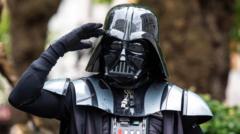
And then, Darth Vader speaks. Not with the booming mid-Atlantic baritone James Earl Jones immortalized, but with a fierce, resonant gravity that sounds like it was born from the slate quarries of Bethesda.
The child freezes. The grandfather looks up from his tea, a slow, disbelieving smile breaking across a face lined with weather and years.
That is not mere localization. That is cultural reclamation.
Language is not a sterile dictionary of vocabulary words and grammatical rules. It is an emotional geography. It holds the specific cadence of grief, the exact pitch of humor, and the unspoken weight of a landscape shaped by mountains and sea. When a child hears their native tongue used to describe hyperdrives, galactic empires, and mystical energy fields, something fundamental shifts in their internal architecture. The language stops being something trapped in a dusty textbook or restricted to the playground. It becomes modern. It becomes expansive. It becomes vast enough to hold the entire universe.
Skeptics might shrug. Why bother? It is just a movie. Millions have already seen it. The plot has been dissected to atomic dust across countless forums and fan wikis.
Those skeptics misunderstand the machinery of culture.
Mythology must be worn like old clothes to fit comfortably. If a language cannot describe starships and rebellion, people will eventually abandon it for a language that can. By forcing the ancient vocabulary of the Mabinogion to bend, stretch, and embrace the high-tech mythology of George Lucas, translators performed a linguistic alchemy. They proved that Welsh is not a museum piece preserved under glass for tourists and linguists. It is a living, bleeding, adaptable organism capable of reaching the stars.
Consider the sheer logistical hurdle of this endeavor. How do you translate terms that carry decades of pop culture weight without losing their punch? How do you render "May the Force be with you" into a language that predates electricity, let alone space travel, while retaining the gravity of a blessing and a battle cry?
You do not rely on machine translation. You rely on artists who understand the heartbeat of both worlds.
The voice actors stepped into recording booths knowing the eyes of a proud, protective linguistic community were upon them. Every inflection mattered. Every sigh carried the weight of preservation. When they shouted commands across simulated cockpit radios, they weren't just reading lines from a script. They were planting a flag.
And the timing could not be more poignant.
Languages in the British Isles have long fought a defensive war against cultural hegemony. In an era dominated by algorithmic feeds and hyper-concentrated global media streams that flatten local identities into a monocultural paste, interventions like this are acts of quiet defiance. They say: We are still here. Our words still matter. Even in a galaxy far, far away.
Imagine the classroom discussions the following Monday. Imagine teenagers who normally roll their eyes at language lessons suddenly arguing passionately about whether the translation of a specific sci-fi idiom hit the mark. Engagement cannot be manufactured by curriculum boards; it is sparked by moments of genuine cultural electricity.
This milestone anniversary release is more than a nostalgic nod for die-hard fans. It is a bridge. It connects the deep, ancient roots of a Celtic heritage with the boundless horizons of speculative fiction. It tells every child who speaks Welsh that their heritage is not an anchor holding them in the past, but a rocket ship capable of launching them into the future.
The screen fades to black. The credits roll to a familiar, triumphant march, now humming softly with a different linguistic resonance.
The rain continues outside. But inside, the room feels a little larger. The history feels a little deeper. And the stars, somehow, feel closer than they did before.