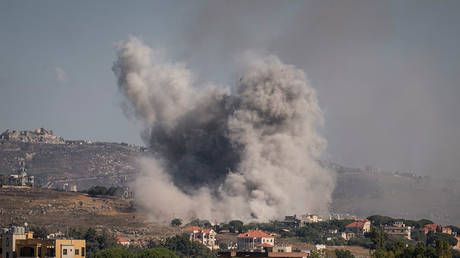
Applying the Gaza model to Lebanon shifts asymmetric warfare from temporary punitive deterrence toward structural spatial clearance, prolonged population displacement, and degraded local governance. Standard commentary treats threats of a "Gaza model" as rhetorical escalation or a simple replay of the 2006 Dahiya doctrine. That framing misses the operational mechanics: clearing physical space, severing civilian-militant logistics, and stretching reconstruction timelines so long that pre-war political order cannot easily snap back.
Deconstructing the Competitor Argument
A typical headline about Israel threatening to impose a "Gaza model" on Lebanon relies on three implicit premises. First, it assumes a clean linear transfer of tactics from the Gaza Strip to southern Lebanon and Beirut. Second, it treats military rhetoric as synonymous with executed policy. Third, it merges humanitarian strain, military strikes, and diplomatic stagnation into a single undifferentiated shock.
Deconstructing that logic exposes two analytical gaps. The first is doctrinal conflation. Historically, the 2006 Dahiya doctrine emphasized rapid, high-intensity destruction of infrastructure and neighborhoods tied to Hezbollah to impose high political costs on the Lebanese state and the group's social base. The Gaza model—referenced publicly by Israeli officials during the regional escalation that widened into Lebanon in March 2026—adds sustained ground clearance, protracted access restrictions, and systematic dismantling of civilian and administrative continuity rather than relying solely on a short, sharp air-and-artillery shock.
The second gap is causal compression. A headline treats a warning or a doctrine label as an automatic outcome. In reality, turning a doctrinal threat into durable ground conditions requires force availability, munitions throughput, diplomatic room to maneuver under broader regional pressures—such as the 2026 confrontation involving Iran—and local resistance or state friction. Without separating intent, capability, and friction, observers mistake threats for completed transformation.
Three Pillars of the Gaza Model
To analyze what "Gaza model" means operationally in Lebanon, break the concept into three interacting pillars: Spatial Clearance, Infrastructure and Logistics Denial, and Governance Fragmentation.
Spatial Clearance and Demographic Friction
The first pillar targets physical geography along contested borders and dense urban pockets. Rather than treating every village solely as a temporary firing point to be evacuated and immediately re-entered, spatial clearance aims to empty designated zones—such as a deep border security strip—and delay civilian return until strict security conditions are met.
In Lebanon, following the March 2026 escalation, displacement surged into the hundreds of thousands, with broader conflict estimates pointing to over one million displaced people and severe pressure on southern towns and agricultural land. Even when formal ceasefires or framework understandings are announced, indefinite conditions on return turn temporary flight into prolonged demographic friction.
Infrastructure and Logistics Denial
The second pillar degrades the physical systems that sustain both everyday life and armed operations. Asymmetric forces like Hezbollah rely on dispersed tunnel networks, weapons caches, communications lines, and local supply chains embedded within built-up and rural terrain.
Heavy strikes and demolitions target structures, roads, utilities, and farmland. The operational mechanism is twofold:
- Mobility degradation: Damaged roads, rubble-choked streets, and cleared corridors slow militant movement, resupply, and counter-attacks.
- Sustainment drag: Damage to housing, water, power, and agriculture forces local authorities and aid agencies to spend scarce resources on basic survival rather than rebuilding defensive networks.
Governance Fragmentation
The third pillar weakens civil authority so no coherent actor can quickly restore order or enforce unified rules. Lebanon already entered 2026 with a fragile state apparatus, economic strain, and deep sectarian and political divisions. When mass displacement coincides with heavy physical destruction, municipal services strain, local economies contract—with the World Bank projecting a 6.4 percent contraction in 2026—and food insecurity rises above one million people.
When formal state institutions lack funding and enforcement reach, power defaults to armed factions, local patrons, or occupying forces on the ground. That fragmentation makes disarmament frameworks and border security arrangements harder to implement even when diplomatic text exists on paper.
Facts Versus Educated Hypotheses
Rigorous strategy requires separating verified facts from analytical hypotheses, especially in active conflicts where figures are contested and narratives move faster than verification.
Known facts include the March 2026 escalation in which Hezbollah rocket fire and Israeli airstrikes and ground operations produced mass displacement in Lebanon, heavy damage to housing and infrastructure, a self-declared Israeli security zone along the southern border, and stalled implementation of a US-sponsored framework tied to Hezbollah disarmament, Lebanese Armed Forces deployment, and Israeli withdrawal. Humanitarian agencies and the World Bank have also documented severe economic contraction, agricultural disruption, and acute food insecurity affecting over a million people in Lebanon.
Educated hypotheses concern long-term political intent and durability. One hypothesis holds that Israeli officials use the "Gaza model" label primarily as coercive signaling to force Hezbollah's retreat and extract concessions from Beirut and Washington without committing to permanent formal annexation. A competing hypothesis argues that prolonged buffer control and slow reconstruction risk creating a de facto long-term partition along the border regardless of initial diplomatic intent. Both hypotheses fit observable actions, and neither is proven merely by public statements.
Cause-and-Effect Chains Missed in Surface Coverage
Standard reporting often lists events side by side without tracing the feedback loops that govern escalation and stalemate.
The Escalation-Displacement-Recruitment Loop
Heavy strikes and ground clearance can degrade Hezbollah's organized formations and weapons infrastructure in the short term. The second-order effect is different: mass displacement and ruined livelihoods deepen economic desperation among affected communities. When the central state cannot deliver rapid compensation or housing—evidenced by slow reconstruction and limited housing aid—displaced households often remain dependent on armed patrons or political networks that promise protection and stipends. Thus, tactical attrition can coexist with social grievances that replenish local recruitment over time.
The Diplomatic Stalemate Bottleneck
Framework agreements in Lebanon typically link three moves: militant disarmament, deployment of the Lebanese Armed Forces, and Israeli withdrawal. This creates a sequencing bottleneck. If Hezbollah refuses to surrender weapons while Israeli forces remain in a southern security zone and conduct strikes, the Lebanese state faces domestic political paralysis if it tries to disarm the group by force. Conversely, if Israeli forces withdraw before verifiable disarmament or credible state control is established, military planners fear militants will rebuild tunnels and rocket positions. Each side treats the other's step as a prerequisite rather than a simultaneous trade.
Regional Spillover and Attention Bandwidth
Lebanon does not operate in isolation. Broader regional conflict involving Iran shapes both military resource allocation and diplomatic leverage. When major powers focus on regional containment or broader ceasefires, local Lebanese reconstruction and enforcement can fall into a policy blind spot. Underfunded humanitarian appeals—where pledges lag needs—leave civilian recovery slow, prolonging the instability that keeps military friction alive.
Operational Trade-Offs and Strategic Limits
No military model or diplomatic formula removes structural constraints. Applying a Gaza-style clearance and attrition approach to Lebanon carries sharp trade-offs.
- Terrain and depth: Lebanon's geography combines rugged southern hills, dense urban belts extending north toward Beirut, and porous eastern supply routes—a very different operating environment from the enclosed Gaza Strip.
- State fragility versus state capacity: Pushing a weakened Lebanese government to enforce disarmament can trigger internal political crisis rather than compliance.
- International and fiscal cost: Sustained ground presence, ongoing strikes, and prolonged displacement carry reputational, diplomatic, and economic costs that compound over months.
A practical example illustrates the trap. Suppose a security zone is cleared of structures and held by troops to block cross-border fire. Without a credible local security partner capable of policing the area and a funded reconstruction plan that lets civilians return safely, holding the line requires continuous military presence—turning a supposed exit strategy into an open-ended commitment.
Strategic Play for Decision-Makers
Treat threats of a "Gaza model" in Lebanon as a warning of protracted spatial denial and stalled stabilization, not a quick decisive fix. Policymakers and analysts should anchor any response to verifiable milestones rather than headline rhetoric: tie phased troop withdrawal and border calm to concrete, monitored steps on weapons control and Lebanese state deployment, front-load transparent reconstruction and food-security funding so civilian recovery does not stall behind diplomatic talks, and track displacement return rates and infrastructure repair as the true leading indicators of whether Lebanon is moving toward durable calm or long-term partition.


