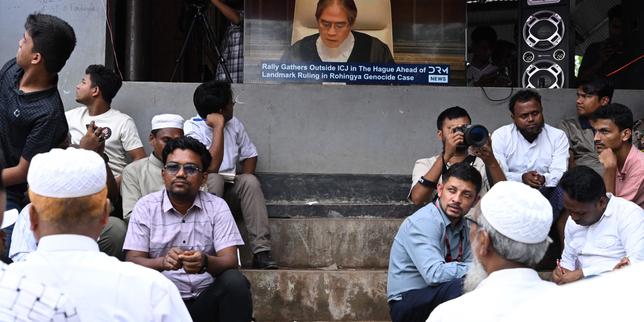
Walk through the sprawling bamboo and tarpaulin maze of Kutupalong in Cox’s Bazar, Bangladesh, and you’ll quickly realize that legal declarations from thousands of miles away don't patch a leaking roof during monsoon season. Yet when formal genocide determinations finally drop, the air inside the world's largest refugee settlement shifts immediately. People gather around cracked smartphone screens and battery-powered radios. They aren't celebrating a sudden ticket home, because they know better than anyone that international diplomacy moves at a glacial pace. Instead, the reaction is quieter, heavier, and deeply personal—it's a collective pause to grieve the people who didn't make it out of Myanmar alive.
The gap between Western headlines and lived reality in the camps is massive. Outsiders often treat the formal recognition of the Rohingya genocide—whether by the United States in 2022, human rights bodies, or proceedings at the International Court of Justice (ICJ)—as a finish line. Inside Cox's Bazar, it’s barely a starting block. It’s validation. For decades, the Myanmar military, known as the Tatmadaw, didn't just burn villages in Rakhine State; they systematically tried to erase the very word "Rohingya" from official maps, censuses, and history books. Hearing global powers finally call the 2017 atrocities by their true legal name means the gaslighting has officially failed. Meanwhile, you can explore similar stories here: Stop Calling the Senegal Boat Tragedy a Migration Crisis.
Why the Word Genocide Changes the Psychology of Exile
Words matter when you've been rendered stateless. Under Myanmar’s 1982 Citizenship Law, the Rohingya were stripped of their legal identity and labeled "Bengali" interlopers, laying the groundwork for decades of apartheid-like restrictions before the August 2017 military crackdown forced over 700,000 people across the Naf River into Bangladesh.
When you talk to survivors in the camps, the immediate relief isn't about geopolitics. It’s about memory. In Islam, properly burying and mourning the dead is sacred, yet thousands of families fled while watching relatives gunned down, burned inside homes, or swept away in river crossings. There were no graves to visit. No death certificates. Formal recognition acts as an international headstone for those missing loved ones. To understand the complete picture, we recommend the detailed article by The New York Times.
Honestly, most outsiders underestimate how exhausting it is to constantly prove your own trauma. Before official determinations were made, Rohingya activists and camp elders spent years repeating their stories to UN fact-finding missions, journalists, and NGO workers, often wondering if anyone was actually listening. Calling it genocide shifts the burden of proof. The world has finally admitted that what happened in villages like Tula Toli and Inn Din wasn't "communal violence" or "clearance operations." It was a calculated attempt to destroy an ethnic group in whole or in part.
The Harsh Daily Reality That Legal Labels Don't Fix
Let's be brutally honest about what recognition doesn't do. It doesn't put extra rations on the table when the World Food Programme (WFP) is forced to slash monthly food vouchers down to $8 or $10 per person due to donor fatigue. It doesn't stop the armed gangs—like the Arakan Rohingya Salvation Army (ARSA) and the Rohingya Solidarity Organization (RSO)—from fighting turf wars in the dark alleys of the camps at night.
If you've ever followed humanitarian crises closely, you know that international attention spans are painfully short. Once a major legal milestone hits the front page, donor governments often pat themselves on the back and pivot their budgets to the next global emergency. Meanwhile, roughly one million Rohingya remain confined behind barbed-wire fencing erected by Bangladeshi authorities, barred from formal employment, higher education, or free movement outside the camps.
Consider the daily friction refugees face right now:
- Aid dependency by design: Because Bangladesh refuses to integrate the Rohingya locally—fearing permanent demographic and economic strain—refugees cannot legally work. A skilled teacher, carpenter, or medic in Rakhine State is reduced to waiting in line for rice and lentils.
- The education bottleneck: While UNICEF and partner NGOs rolled out the Myanmar curriculum in camp learning centers, an entire generation of teenagers has grown up with severely interrupted schooling, making them prime targets for human traffickers and militant recruiters.
- Climate vulnerability: Cox's Bazar sits directly in the path of Bay of Bengal cyclones. Every year, landslides wash away fragile shelters built on deforested sandy hills, while massive fires periodically tear through densely packed blocks, leaving tens of thousands homeless overnight.
Accountability at The Hague vs. Reality in Rakhine State
People often ask what happens legally once the "G-word" is officially invoked. Under the 1948 UN Genocide Convention, states have a legal obligation not just to punish genocide, but to prevent it. That’s why The Gambia’s landmark case against Myanmar at the International Court of Justice in The Hague carries so much weight, alongside ongoing investigations at the International Criminal Court (ICC) and universal jurisdiction cases in Argentina.
Here is the catch. International courts operate on timelines measured in decades, not months. The ICJ issued provisional measures back in January 2020 ordering Myanmar to protect the remaining Rohingya population and preserve evidence of past crimes. A year later, in February 2021, the very same generals who orchestrated the 2017 genocide seized total power in a military coup, plunging Myanmar into a brutal nationwide civil war.
Today, the geopolitical map on the ground has completely shifted. The Myanmar junta is losing massive territory across the country, including in Rakhine State, where the ethnic Rakhine Arakan Army (AA) has seized major towns and border crossings. For Rohingya refugees watching from across the border, this creates a terrifyingly complex dilemma. The Tatmadaw is weakening, which sounds like good news, yet reports of forced conscription of remaining Rohingya by the desperate military—and renewed displacement amid clashes between the junta and the Arakan Army—show that the danger in Rakhine hasn't disappeared. It has just mutated.
What Repatriation Actually Requires (And Why Pilot Schemes Fail)
Every few months, headlines announce a new bilateral "repatriation pilot project" brokered between Myanmar and Bangladesh, often with Chinese mediation. On paper, these plans look tidy: verify a few thousand names, build model transit camps in Rakhine, and send families back.
In practice, these schemes repeatedly collapse because they ignore the single thing refugees demand—safety backed by rights. Refugees aren't stubbornly refusing to go home; they are refusing to walk back into open-air detention camps without citizenship, land restitution, or international protection. Sending people back to a regime that still denies their basic right to exist isn't repatriation. It's refoulement, which violates fundamental international law.
If you want to understand what genuine progress looks like, stop looking at bilateral photo-ops and look at the concrete benchmarks Rohingya civil society groups have laid out for years:
- Repeal or reform of the 1982 Citizenship Law: Without full citizenship restored, any returnee remains legally stateless and vulnerable to the next wave of state-sponsored violence.
- International monitoring on the ground: Refugees trust UN peacekeepers or independent international observers, not promises from the same military apparatus that burned their mosques and clinics.
- Inclusion of Rohingya voices in negotiations: For years, diplomats discussed the fate of a million people in closed rooms in Naypyidaw, Dhaka, and Beijing without a single Rohingya representative at the table.
How to Support Meaningfully Instead of Passively Reading Headlines
It’s easy to read a moving dispatch from Cox's Bazar, feel a brief surge of empathy, and scroll past. If you actually care about turning genocide recognition into tangible survival and justice for the Rohingya, direct your attention and resources where they bypass bureaucratic bottlenecks.
Start by backing refugee-led organizations operating inside the camps rather than relying solely on massive, slow-moving international agencies. Groups documented and run by Rohingya youth, educators, and women's networks—such as the Rohingya Women Welfare Society (RWWS) or community-led documentation initiatives preserving oral histories—stretch every dollar directly into classrooms, maternal health, and legal evidence gathering. Follow independent Rohingya journalists and poets reporting directly from Cox’s Bazar so your understanding isn't filtered exclusively through Western correspondents dropping in for forty-eight-hour press tours. Keep pressure on elected representatives to close the chronic WFP funding gaps in Bangladesh and enforce targeted aviation fuel and financial sanctions against the Myanmar junta, ensuring that remembering those who are no longer there translates into protecting those who are still fighting to survive.