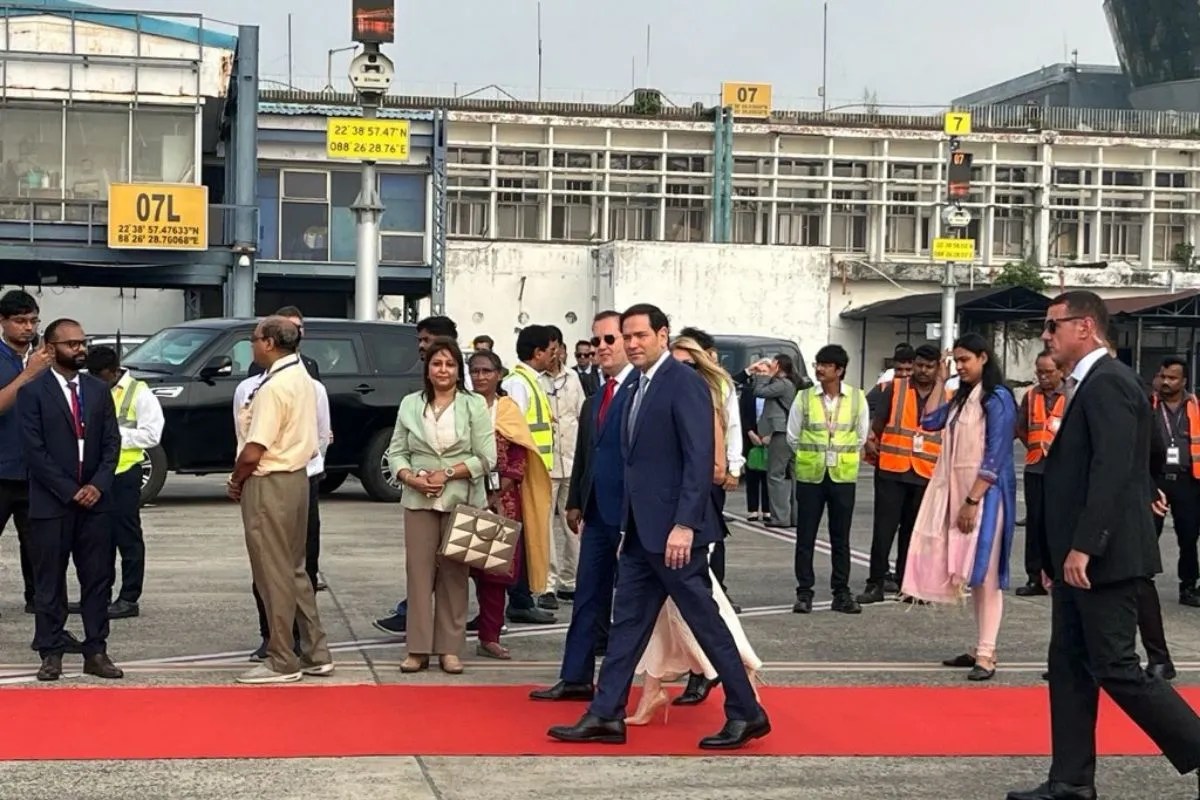
The arrival of US Secretary of State Marco Rubio in New Delhi for bilateral talks with Prime Minister Narendra Modi signals a shift from tactical engagement to institutionalized alignment. While standard diplomatic reporting treats such state visits as periodic diplomatic events, a structural analysis reveals a deeper mechanism: the systematic synchronization of trade, defense supply chains, and technological architecture across the Indo-Pacific axis. This relationship no longer operates on mutual goodwill; it functions on shared geopolitical risk mitigation.
The core objective of this diplomatic iteration is to establish a counterweight to regional supply chain dependencies while navigating the complex realities of non-aligned foreign policy. The success of this framework rests on three distinct pillars: structural defense interoperability, technological decoupling from autocratic spheres, and the realignment of critical maritime trade corridors.
The Strategic Triad Governing US India Relations
The interface between a Western superpower and a historically non-aligned South Asian power requires a specialized framework to understand. The relationship is governed by three operational variables that dictate the velocity and limits of bilateral cooperation.
1. The Technology-Security Transfer Mechanism
Historically, the primary bottleneck in US-India relations was the restriction on technology transfers, governed by strict US export control regimes like ITAR (International Traffic in Arms Regulations). The modern framework bypasses these legacy constraints through initiatives like iCET (Initiative on Critical and Emerging Technology).
This mechanism treats technology not as a commercial commodity, but as a security asset. The objective is to establish co-development and co-production pipelines in specific sectors:
- Semiconductor fabrication and supply chain packaging physics.
- Next-generation defense manufacturing, specifically jet engine co-production.
- Quantum computing architectures and secure cryptographic standards.
2. The Maritime Friction Vector
The Indian Ocean Region (IOR) represents the primary geographical chokepoint for global energy supplies and mercantile shipping. For the United States, maintaining an open Indo-Pacific requires an capable regional partner to distribute the net security burden. For India, preserving dominance in the IOR is an existential national security priority.
This convergence creates a functional division of labor. India acts as the primary maritime monitor from the Strait of Malacca to the Bab-el-Mandeb, while the US provides orbital intelligence, advanced anti-submarine warfare assets, and strategic depth via the Pacific fleet.
3. The Trade-Tariff Asymmetry
The economic friction point in this bilateral architecture is the divergence in trade philosophy. The US strategy prioritizes friend-shoring—redirecting manufacturing capacity away from geopolitical adversaries to trusted partners. India offers the necessary demographic scale but maintains a protective tariff structure designed to incubate domestic manufacturing via initiatives like Production Linked Incentives (PLI). The negotiation framework must reconcile US demands for market access with India’s structural economic protectionism.
Defense Interoperability and the Industrial Base Bottleneck
A critical deficiency in standard diplomatic commentary is the assumption that high-level defense agreements immediately translate into operational capability. In reality, the integration of US and Indian defense frameworks faces severe structural headwinds rooted in legacy infrastructure.
India’s defense inventory remains heavily reliant on Soviet and Russian-origin platforms. This creates a dual-system friction point:
[US Logistics / NATO Standard Hardware] ◄───(Incompatibility Interface)───► [Legacy Soviet/Russian Architecture]
To resolve this operational mismatch, the strategic roadmap avoids broad, system-wide integration, which is logistically impossible in the short term. Instead, it focuses on modular interoperability.
The immediate tactical focus centers on operationalizing foundational agreements like COMCASA (Communications Compatibility and Security Agreement) and BECA (Basic Exchange and Cooperation Agreement). These agreements allow for real-time data sharing and secure communications without requiring India to fully scrap its legacy hardware. The strategic payoff is clear: Indian maritime patrol aircraft can communicate securely with US naval assets in the Indo-Pacific, creating a unified operational picture despite mismatched physical fleets.
The Economics of Friend Shoring and Electronics Manufacturing
The economic agenda of the Rubio-Modi summit targets the vulnerabilities exposed by concentrated global supply chains. The relocation of manufacturing out of East Asia is not a organic market shift; it is a policy-driven re-engineering of corporate risk.
India’s value proposition relies on its labor arbitrage and demographic dividend. However, the country faces a critical infrastructure gap in electricity reliability, logistical velocity, and bureaucratic regulatory frameworks. The strategic calculus for US firms considering reallocation involves balancing these structural inefficiencies against the geopolitical risk of remaining concentrated in a single geography.
The bilateral strategy addresses this via targeted infrastructure corridors and joint investment funds designed to derisk private capital injections into Indian manufacturing zones. The focus is not on low-value assembly, but on ascending the value chain into advanced component manufacturing and testing facilities.
Limitations and Structural Friction Points in the Alliance
An objective analysis must delineate the structural boundaries of the US-India partnership. This is not a formal treaty alliance, and treating it as one miscalculates the behavior of both nations.
- Strategic Autonomy: India views its foreign policy through the lens of multi-alignment. New Delhi will not jeopardize its relationship with the Global South or its historic ties with Moscow to fit into a rigid Western alliance structure.
- Regulatory Divergence: US policy emphasizes data localization limits and cross-border data flows. Conversely, Indian regulatory frameworks favor strict state oversight of domestic data assets, creating a persistent friction point for Western technology firms operating in the subcontinent.
- Immigration and Human Capital Velocity: The transfer of high-tech capabilities requires the seamless movement of engineering talent. Current US visa caps and processing backlogs act as a regulatory tax on the integration of the two tech sectors.
Strategic Trajectory
The outcome of these high-level bilateral discussions will not be measured by the text of joint press statements, but by the capital expenditure commitments that follow. If the technology transfer mechanisms fail to yield concrete co-production milestones within the next twenty-four months, the relationship risks stalling into a series of symbolic diplomatic gestures.
The optimal play for corporate and state actors is to align investment strategies with the specific sub-sectors cleared by the iCET framework. Capital deployed into defense joint ventures, semiconductor packaging, and critical mineral supply chains will benefit from structural state subsidies and regulatory fast-tracking, while standard consumer goods trade will continue to face traditional tariff friction. The future of the Indo-Pacific balance of power rests on the speed at which these two bureaucratic apparatuses can industrialize their shared security anxieties.