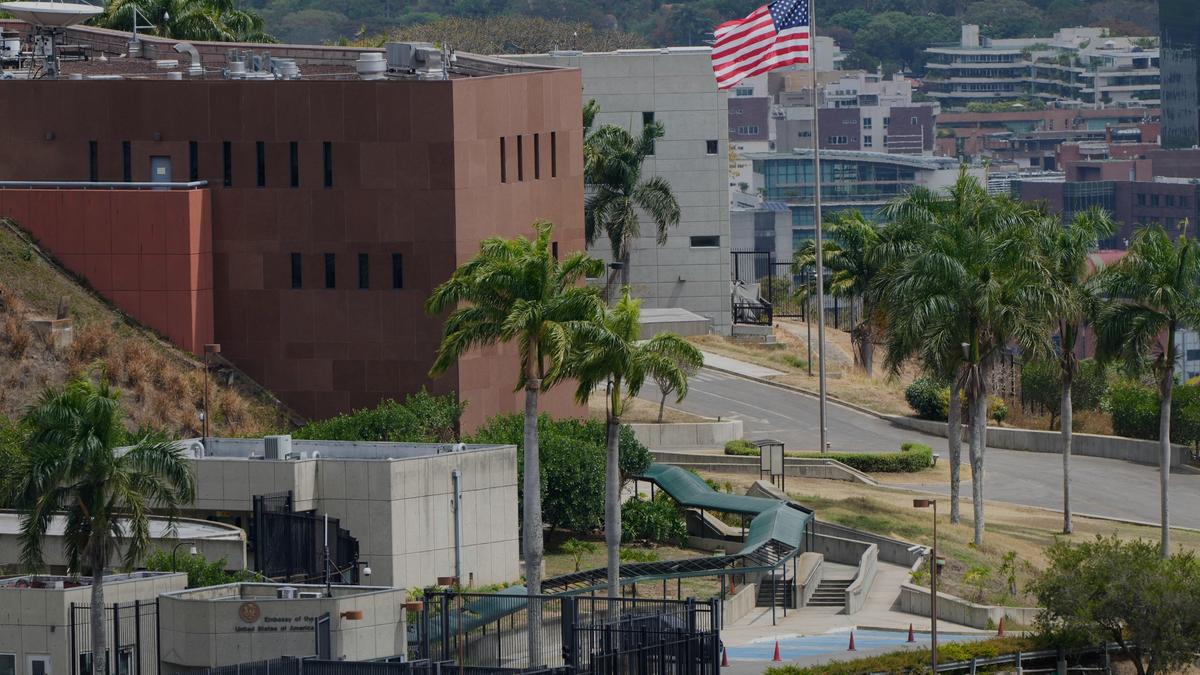
The hoisting of the American flag at the U.S. Embassy in Caracas on March 14, 2026, represents more than a symbolic restoration of diplomatic ritual; it marks the transition from a policy of maximum pressure to one of managed reintegration. After a seven-year hiatus initiated by the 2019 withdrawal, the resumption of on-site operations signals a strategic shift in how the United States calculates its influence over the Venezuelan state apparatus. This pivot is driven by the realization that "extraterritorial diplomacy"—managing Venezuelan affairs from Bogotá—created an information vacuum that was rapidly filled by adversarial capital and intelligence.
The Three Pillars of Diplomatic Re-entry
The decision to re-staff the Caracas mission rests on three functional necessities that remote operations could not satisfy. These pillars define the utility of a physical presence in a hostile or transitioning environment.
- Primary Intelligence Gathering: Remote monitoring relies on secondary digital signals and diaspora accounts. Physical presence allows for "proximity intelligence"—the ability to gauge the internal cohesion of the United States’ counterparts through direct observation of infrastructure, local market sentiment, and non-verbal political signaling within the Maduro administration.
- Consular Velocity and Economic Throughput: The suspension of visa and notary services in 2019 decapitated legal migration and hindered corporate legalities for U.S. firms remaining in the country (primarily in the energy sector). Restoring these services reduces the friction of human capital movement, which is a prerequisite for any eventual debt restructuring or private sector expansion.
- Adversarial Counter-Positioning: In the absence of a U.S. mission, the diplomatic vacuum in Caracas was occupied by expanded Russian, Chinese, and Iranian footprints. A physical embassy serves as a permanent sensor and a visible counter-weight, signaling to regional partners that the U.S. has not ceded its sphere of influence.
The Energy Elasticity Factor
The timing of this re-opening is inextricably linked to the global energy supply chain and the specific chemistry of Venezuelan crude. Venezuela holds the world’s largest proven oil reserves, largely comprised of heavy sour crude.
The Cost Function of Infrastructure Decay
While the flag is back, the flow of oil remains constrained by a "decay coefficient" that has compounded since 2019. The logic of re-entry assumes that U.S. presence will facilitate technical oversight for joint ventures, such as those involving Chevron. However, the return of diplomatic staff does not instantly repair the mechanical failures of the PDVSA (Petróleos de Venezuela, S.A.) infrastructure.
- Extraction Lag: Wells that have been shuttered or poorly maintained suffer from "formation damage," where the pressure required to restart flow exceeds the integrity of the wellbore.
- Refinery Bottlenecks: Without access to U.S.-produced diluents, Venezuelan heavy crude cannot be transported through pipelines or processed efficiently.
- Capital Risk Premium: Financial institutions still view Venezuelan transactions through a lens of high compliance risk. The embassy’s presence acts as a "de-risking signal," though it does not provide legal indemnity from remaining sanctions.
Mechanical Breakpoints in the Negotiation Framework
The resumption of diplomatic ties is not an endorsement of the status quo but a tactical adjustment to the negotiation framework. The "Bargaining Model of War" (and by extension, high-stakes diplomacy) suggests that parties reach an impasse when there is asymmetric information or a lack of credible commitment.
By placing staff back on the ground, the U.S. reduces the information asymmetry. It can now verify "on-the-ground" compliance with electoral or human rights benchmarks with higher fidelity. This physical presence creates a feedback loop:
Verification → Incremental Sanctions Relief → Infrastructure Reinvestment → Political Concessions
If any link in this chain breaks, the U.S. retains the "Exit Option," though the reputational cost of a second withdrawal acts as a stabilizer for the current engagement.
Strategic Limitations and the "Embassy Trap"
It is a fallacy to assume that a flag-raising ceremony equates to a return to pre-2019 stability. The mission operates under a "constrained mandate." The primary risk is the "Embassy Trap," where the physical facility becomes a liability rather than an asset—a target for state-sponsored protests or a "hostage" to local legal maneuvers.
Security protocols for the Caracas mission are likely at the highest tier, requiring significant budgetary allocation for the Bureau of Diplomatic Security. This creates a high "maintenance cost" for the diplomatic signal. Analysts must weigh the operational expenditure of the embassy against the projected delta in regional stability. If the presence does not yield a measurable increase in democratic transparency or a decrease in migration surges within 18 months, the mission may be viewed as a sunk cost.
The Debt Restructuring Bottleneck
Venezuela’s external debt, estimated at over $60 billion in defaulted bonds, remains a hard wall against total economic normalization. The re-opening of the embassy provides a conduit for "Creditor Diplomacy."
- Identification of Stakeholders: Determining the current holders of "zombie bonds" (debt that has traded in secondary markets during the sanctions era).
- Legal Venue Stabilization: Providing a local point of contact for legal service and negotiation between the Venezuelan Finance Ministry and U.S.-based bondholder committees.
- The Default Paradox: As long as the U.S. does not recognize the legitimacy of the debt issuer’s authority to restructure, the assets remain frozen. The embassy’s presence suggests a move toward "de facto" recognition of the administrative reality, even if "de jure" recognition of the regime remains withheld.
Geopolitical Displacement Effects
The U.S. return forces a recalibration from other global powers.
- China: Beijing has historically played a long game, trading infrastructure loans for future oil shipments. A U.S. presence introduces competition for these future "oil-for-debt" swaps.
- Russia: Moscow’s influence has been primarily through military cooperation and security consulting. The U.S. presence serves as a constant monitor of this "grey zone" activity.
- Regional Neighbors: For Colombia and Brazil, the U.S. presence in Caracas reduces the "security externalities" of a collapsed neighbor. It provides a centralized node for coordinating regional responses to the migration crisis, which has seen over 7 million Venezuelans leave the country.
Quantification of the Migration Signal
Data from the U.S. Department of State and the UN International Organization for Migration (IOM) indicates that migration flows are inversely correlated with local economic hope and directly correlated with the availability of legal pathways.
The reopening of the consular section is a "pressure valve" strategy. By processing legal entries in-country, the U.S. reduces the volume of "unmanaged" migration at the southern border. The success of this strategy will be measured by the reduction in the number of Venezuelan nationals encountered between ports of entry, offset by the number of visa applications processed in Caracas.
The Institutional Inertia Problem
Diplomatic missions are notoriously slow to pivot. The current Caracas mission is likely operating with a "skeleton crew" focused on facilities and communications. The transition to a full-service embassy will take months, if not years, due to the need to vet local staff and rebuild local supply chains that were severed in 2019.
The "Institutional Memory" of the previous mission was largely lost. New officers are entering a landscape that has shifted significantly; the Caracas of 2026 is a dollarized economy with a fragmented opposition and a more entrenched ruling elite than that of 2019. This "New Reality" requires a different set of diplomatic skills—less focused on supporting an alternative government and more focused on "adversarial engagement."
The Immediate Strategic Play
The U.S. must now move from the symbolic "Flag Phase" to the "Audit Phase." This involves a 90-day technical assessment of all joint-venture oil sites where U.S. interests are present. Simultaneously, the State Department should initiate a "Consular Surge" to clear the seven-year backlog of citizen services.
The primary objective is not a sudden restoration of democracy, but the stabilization of a regional volatility source. Success is defined by the containment of adversarial influence and the creation of a predictable environment for U.S. energy and security interests. The embassy is the necessary infrastructure for this containment strategy; its value lies in its function as a laboratory for transactional diplomacy rather than a pulpit for ideological change.
Direct all available resources toward establishing a "Trilateral Working Group" involving the U.S. Department of the Treasury, the Department of State, and the Venezuelan Ministry of Petroleum. The immediate goal: establish a clear, transparent mechanism for the "Escrow of Oil Revenues" to be used for humanitarian relief and infrastructure repair, monitored by the newly re-established mission. This removes the "sanctions-as-an-excuse" narrative and places the burden of proof for reform squarely on the Venezuelan administration.