The United States maintains a structural dominance in Latin America that functions as a closed-loop system of economic dependency and security integration. This dominance is not a static state of "power" but a dynamic equilibrium maintained through the management of three critical variables: credit access, security export, and infrastructure standards. Resistance to this system by Latin American states occurs when the internal political cost of alignment exceeds the external economic penalty of divergence. Analyzing this relationship requires moving beyond historical sentiment toward a quantitative assessment of the "Resistance Threshold"—the point at which a sovereign state decides to decouple from the Northern orbit.
The Mechanics of Structural Asymmetry
The relationship between the U.S. and Latin America is defined by a power differential that is baked into the financial architecture of the region. This is not merely about diplomatic influence; it is about the "Cost of Capital Differential." Most Latin American economies rely on dollar-denominated debt and U.S.-led multilateral lending institutions.
The Financial Chokepoint
The primary mechanism of U.S. influence is the governance of liquidity. When a state in the region shifts toward a "resistance" posture, the immediate friction is not military but fiscal.
- Risk Premium Inflation: Sovereign credit ratings are tethered to alignment with global (U.S.-centric) transparency and property rights standards. Divergence triggers a spike in borrowing costs.
- Currency Volatility: Local currencies often function as derivatives of the U.S. Dollar. Political friction leads to capital flight, which devalues the local currency and increases the real-world cost of servicing external debt.
This creates a feedback loop where resistance leads to economic contraction, which then fuels internal political instability, often forcing a return to the status quo or a total state collapse.
The Three Pillars of Regional Integration
To understand why resistance often fails or remains performative, one must deconstruct the U.S. presence into three functional pillars. These are the logistical realities that any "resistance" movement must replace if it wishes to achieve true autonomy.
Pillar I: The Security Umbrella and Interoperability
U.S. power is codified through the professionalization of Latin American military and police forces. This is achieved through IMET (International Military Education and Training) programs and hardware sales.
- Standardization: Most regional militaries use U.S. or NATO-standard equipment. Switching to a Chinese or Russian supply chain requires a total overhaul of logistics, maintenance, and training—a multi-decade capital expenditure that most developing economies cannot afford.
- Intelligence Sharing: The U.S. provides the satellite and signals intelligence necessary for counter-narcotics and border security. A state that "resists" loses access to this data, immediately increasing the domestic cost of maintaining internal order.
Pillar II: Trade Gravity and Supply Chain Integration
Geographic proximity dictates a gravity model of trade. The U.S. is the primary destination for high-value exports from Mexico, Central America, and the Caribbean.
- The Value-Added Gap: Latin America largely exports raw materials (lithium, copper, petroleum, soy) while importing high-value technology and refined goods from the U.S.
- Nearshoring as an Anchor: The recent shift toward "nearshoring" further binds regional manufacturing to U.S. demand. This creates a powerful domestic lobby within Latin American states—the export-oriented elite—who act as a natural brake on any radical shift in foreign policy.
Pillar III: Legal and Regulatory Export
U.S. power is exerted through the "Extra-Territoriality of Law." Because the majority of regional transactions touch the U.S. banking system (Fedwire/CHIPS), the U.S. Treasury can exercise de facto regulatory control over Latin American corporations. Compliance with the Foreign Corrupt Practices Act (FCPA) or Office of Foreign Assets Control (OFAC) sanctions is not optional for any firm that wishes to participate in global trade.
Quantifying Resistance: The Divergence Equation
Resistance is rarely an ideological choice; it is a calculated gamble. A state's tendency to resist can be expressed as a function of its alternative options for capital and security.
The Rise of Alternative Liquidity
The most significant threat to U.S. hegemony is the entry of "Non-Systemic Capital," primarily from China. This alters the cost-benefit analysis for regional leaders.
- Conditionality Comparison: U.S./IMF loans often come with requirements for structural adjustment (austerity, privatization). Chinese "Belt and Road" capital typically focuses on infrastructure-for-resources swaps with fewer transparency requirements.
- Strategic Hedging: States like Brazil or Chile do not seek to replace the U.S. with China; they seek to play the two powers against each other to drive down their own "Cost of Alignment."
The Ideological Variable vs. Structural Reality
While "Bolivarianism" or "Pink Tide" movements provide the rhetorical framework for resistance, their success is strictly capped by their ability to manage the "Fiscal Gap."
- The Resource Curse Bottleneck: States that resist U.S. influence often rely on a single commodity (e.g., Venezuelan oil). When commodity prices drop, the state lacks the diversified tax base to sustain its "resistance" infrastructure, leading to the eventual erosion of its geopolitical leverage.
- Institutional Inertia: Even under left-leaning governments, the "Permanent State"—the central banks, the judiciary, and the military—often remains aligned with U.S. institutional norms because those norms provide the most stability for those specific bureaucracies.
The Logistics of Counter-Hegemony
For a Latin American state to successfully resist U.S. pressure, it must solve three simultaneous problems that current "resistance" movements have failed to address:
- Energy Independence: Most regional states are net importers of refined fuel or depend on U.S. technology for extraction. True autonomy requires a sovereign energy grid.
- Alternative Payment Systems: Until a state can settle international trade without using the SWIFT system or the U.S. Dollar, it remains vulnerable to "Sanction Shock."
- Internal Security Autonomy: The state must be able to manage domestic threats without relying on U.S. intelligence or hardware.
The Cost of Decoupling: A Case Study in Friction
The case of Venezuela serves as a cautionary data point for the region. The attempt to decouple from the U.S. financial system resulted in a 75% contraction of GDP over a decade. This was not solely due to sanctions but to the "Maintenance Deficit." When a state exits the U.S. orbit, it loses access to the proprietary software, spare parts, and management expertise that keep its primary industries functioning.
Resistance, therefore, is not a binary switch but a spectrum of friction.
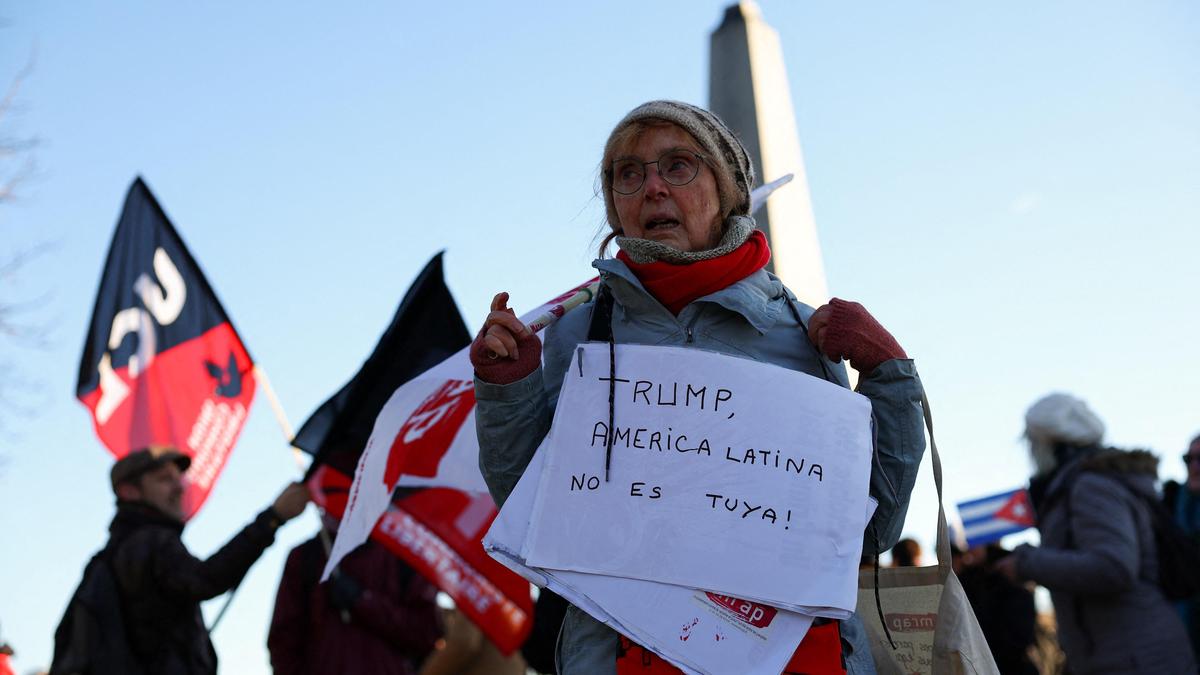
- Level 1: Rhetorical Resistance: High-level criticism in international forums (UN, OAS) with zero structural change. This is the regional norm.
- Level 2: Strategic Divergence: Voting against U.S. interests or joining alternative trade blocs (BRICS+) while maintaining deep financial ties.
- Level 3: Full Decoupling: Total rejection of U.S. security and financial norms. This level currently carries a near-100% failure rate due to the "Integration Debt" accumulated over the last century.
The Evolution of Influence: From Coercion to Standards
The U.S. is shifting its strategy from "Direct Intervention" to "Standards-Based Control." Instead of using military force to ensure alignment, the U.S. uses:
- Digital Infrastructure: Building 5G networks and data centers that utilize U.S. hardware, ensuring that the region's "Data Stack" is compatible with Northern security protocols.
- Green Finance: Tying future lending to "ESG" and carbon standards that are defined in Washington and New York. This forces Latin American industries to reform their production methods to maintain access to capital.
Resistance in this new environment requires a level of technological and regulatory sophistication that most regional states currently lack. You cannot resist a system if your entire digital and financial architecture is built on that system's proprietary code.
Strategic Forecast: The Fragmented Alignment
The future of the region is not "Resistance" in the traditional 20th-all-or-nothing sense. It is a "Fragmented Alignment" where states will be:
- Financially aligned with the U.S. (for stability).
- Commercially aligned with China (for growth).
- Diplomatically non-aligned (for domestic political consumption).
This "Triangulation Strategy" is the only viable path for middle-income Latin American powers. The U.S. will likely tolerate this as long as the "Red Lines" of security—specifically the exclusion of foreign military bases and the protection of the dollar's role in energy markets—are respected.
The primary risk to this equilibrium is the "Internal Institutional Decay" within the U.S. itself. If the U.S. can no longer provide the "Public Goods" of the regional system—liquidity, security, and a stable consumer market—the cost of resistance will drop, not because the resistance grew stronger, but because the benefits of alignment evaporated.
The strategic play for Latin American states is to build "Modular Autonomy." This involves diversifying the technical standards of their infrastructure—using a mix of U.S., European, and Asian technology—so that no single external power can "deactivate" their economy through sanctions or supply chain cutoffs. For the U.S., the challenge is to move from a model of "Dominance" to a model of "Indispensability," ensuring that the cost of leaving the system remains prohibitively high even as the ideological desire to leave increases.