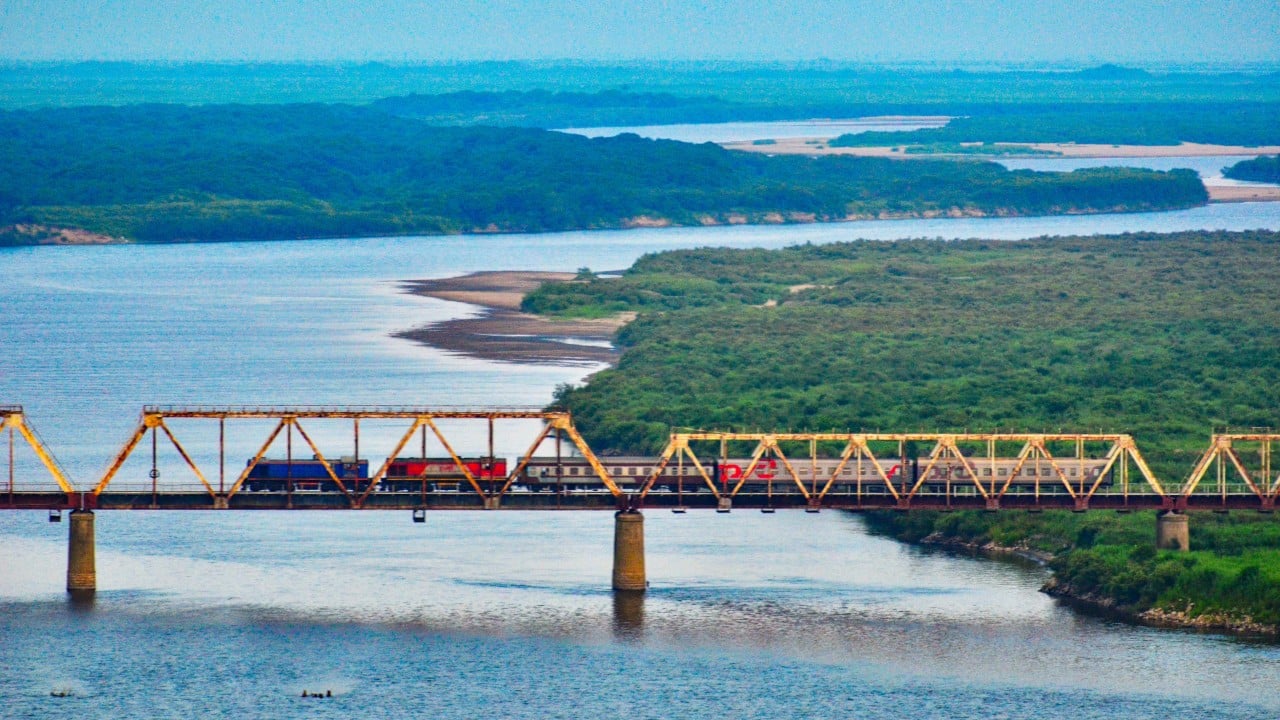
The final 17 kilometers of the Tumen River constitute a structural bottleneck that dictates the limits of Eurasian integration. While conventional analysis views this tripoint—where China, Russia, and North Korea converge—as a localized border dispute, it operates as a sophisticated lever of asymmetric deterrence. The fundamental friction centers on Beijing’s pursuit of maritime access to the Sea of Japan, a strategic objective structurally checked by the physical and legal architecture maintained by Moscow and Pyongyang.
The Tripoint Architecture: Physical and Hydrographic Constraints
To understand why a narrow, shallow waterway can disrupt continental strategy, one must calculate the exact material constraints of the Tumen River basin. The core operational challenge is not merely legal; it is infrastructural and hydrographic.
The Low-Clearance Infrastructure Bottleneck
The primary physical barrier to Chinese maritime transit is the Korea-Russia Friendship Bridge, a rail link completed during the Soviet era. Located less than 2 kilometers from the Russian settlement of Khasan, the bridge features a vertical clearance that severely restricts the air draft of passing vessels.
- Maximum Vessel Capacity: Due to the low clearance of the bridge superstructure, the waterway can currently accommodate only small, low-tonnage rivercraft or shallow-draft tourist vessels.
- The Structural Shield: For Moscow and Pyongyang, this bridge functions as a permanent physical constraint on foreign naval and large-scale commercial power projection. Altering or raising this infrastructure requires bilateral engineering approval, giving both capitals an absolute veto over the scale of upstream maritime activity.
The Hydrographic Deficit
The Tumen River is a highly dynamic, low-discharge waterway characterized by heavy sedimentation and variable seasonal flows.
- The Siltation Problem: Approximately 70% of the river’s flow originates within China, carrying substantial alluvial silt down the 549-kilometer course. As the river slows approaching its delta, this sediment drops, continuously shallowing the thalweg (the deepest continuous channel).
- Dredging Requirements: For the lower reaches to support commercial cargo vessels, oil tankers, or modern naval assets, intensive and continuous capital dredging is mandatory.
- The Engineering Asymmetry: While China possesses the capital and advanced cutter-suction dredging fleets capable of rapidly deepening the channel, it cannot legally operate these vessels within the 17-kilometer Russo-Korean segment without formal, trilateral administrative protocols.
The Strategic Cost Functions of Trilateral Navigation
The geopolitical math governing the Tumen River does not align perfectly for any of the three actors involved. Each state operates on a distinct cost-benefit matrix, resulting in a complex game-theoretic deadlock.
China: Economic Optimization vs. Sovereign Vulnerability
For Beijing, securing unrestricted navigation rights through the Tumen River estuary yields a highly quantifiable economic dividend. It fundamentally alters the logistics of Northeast Asia.
- The Jilin-Heilongjiang Logistics Bottleneck: Currently, the landlocked landmass of Northeast China must route its manufacturing and agricultural exports through distant yellow sea ports like Dalian, incurring significant domestic rail and road transport costs. Direct access via the Tumen River would shave hundreds of nautical miles off shipping routes to Japan, South Korea, and the Arctic Northern Sea Route.
- The Sovereignty Premium: Re-establishing a maritime foothold in an area ceded to Tsarist Russia under the 1860 Treaty of Peking carries immense nationalist weight. It resolves a historical geographic denial that Beijing classifies as part of its historical territorial truncation.
Russia: The Primorsky Krai Protection Model
Moscow’s strategic calculus is governed by the protection of its Far Eastern maritime monopoly and defensive depth.
- Port Competition and Revenue Cannibalization: If China transforms the Tumen River into a high-capacity commercial corridor, it creates an immediate competitor to Russia’s established deep-water ports in Primorsky Krai, specifically Vladivostok and Nakhodka. Russian regional strategy depends on charging transit fees and managing logistics for cargo moving across its territory.
- Erosion of Hegemonic Influence: A permanent Chinese maritime presence in the Sea of Japan, emerging directly from a shared river boundary, alters the local balance of naval power. It introduces Chinese coast guard and commercial assets into a maritime theater traditionally dominated by the Russian Pacific Fleet.
North Korea: Regime Insulation and Lever Maximization
Pyongyang views the Tumen River through the prism of asymmetric survival and border security.
- The Physical Buffer Asset: The dense, heavily monitored riverine border acts as a critical security barrier. Allowing foreign-dominated commercial shipping corridors to cut directly along its northern flank introduces uncontrollable vectors of intelligence gathering, economic interdiction, and border instability.
- The Inter-State Arbitrage Strategy: Kim Jong-un’s regime maximizes its leverage by keeping China and Russia slightly misaligned. If Pyongyang grants China unrestricted maritime passage, it surrenders an irreplaceable economic chip that it can otherwise barter for Russian military technology, food security, or energy subsidies.
The 2024–2026 Policy Shifts: Tactical Concessions Under Geopolitical Duress
The baseline structural deadlock experienced a series of recalculations following shifts in global alignment, specifically the intensification of western sanctions on both Moscow and Pyongyang. This systemic pressure forced a reassessment of the Tumen River cost functions.
The Joint Statement Framework
During the bilateral summits between Xi Jinping and Vladimir Putin, official communiqués explicitly revived the Tumen River navigation issue. The states declared an intent to engage in "trilateral consultations" with North Korea under the framework of the 1991 Sino-Soviet border agreement.
This diplomatic phrasing signaled a tactical shift: Russia, highly dependent on Chinese economic insulation and dual-use technology supply chains, could no longer maintain a flat refusal of Beijing’s maritime ambitions.
The New Cross-Border Infrastructure Hedge
Simultaneously, a distinct contradiction emerged in the execution of regional infrastructure. Plans moved forward for a new cross-border road bridge connecting Russia and North Korea over the Tumen, supplementing the existing rail link.
Chinese policy analysts and regional strategists noted that the structural specifications of this proposed automobile bridge did not inherently account for the high vertical clearances required for modern, large-scale commercial maritime vessels.
This infrastructure choice demonstrates the enduring nature of the Russo-Korean hedge. While Moscow and Pyongyang pay lip service to trilateral dialogue in high-level joint statements, their hard physical engineering projects continue to lock in structural limitations that prevent a rapid expansion of Chinese naval or commercial shipping capacity.
The Strategic Calculus for Regional Security
The Tumen River tripoint cannot be resolved through simple bilateral trade trade-offs because any adjustment to its operational rules reverberates across the entire maritime theater of Northeast Asia. The strategic play is slow, structural, and defined by concrete constraints rather than diplomatic rhetoric.
The first limitation of current analysis is the assumption that a trilateral agreement will instantly trigger a massive infrastructure boom. Even if political clearance is granted, the timeline required to execute complex dredging operations, negotiate the dismantling or raising of international rail links, and construct competitive port facilities at the river's mouth will span years, if not decades.
This creates a structural lag that allows outside powers, including the United States, Japan, and South Korea, to adjust their maritime posturing in the Sea of Japan. An open Tumen River would convert a historically secure northern enclave into a direct point of contact with Chinese maritime power, forcing an immediate reallocation of naval reconnaissance and defensive assets to monitor the waters off the coast of Primorsky Krai.
The final strategic variable remains the degree of economic leverage China is willing to deploy. If Beijing chooses to make full maritime access to the Sea of Japan an absolute condition for its continued financial and diplomatic underwriting of the Russian and North Korean economies, the current physical and institutional barriers will inevitably yield to material reality. Until that threshold of pressure is crossed, the low-clearance bridges and silted channels of the Tumen River will continue to serve their historical purpose: quietly capping the geopolitical reach of the world's rising superpower at the precise point where three empires meet.


