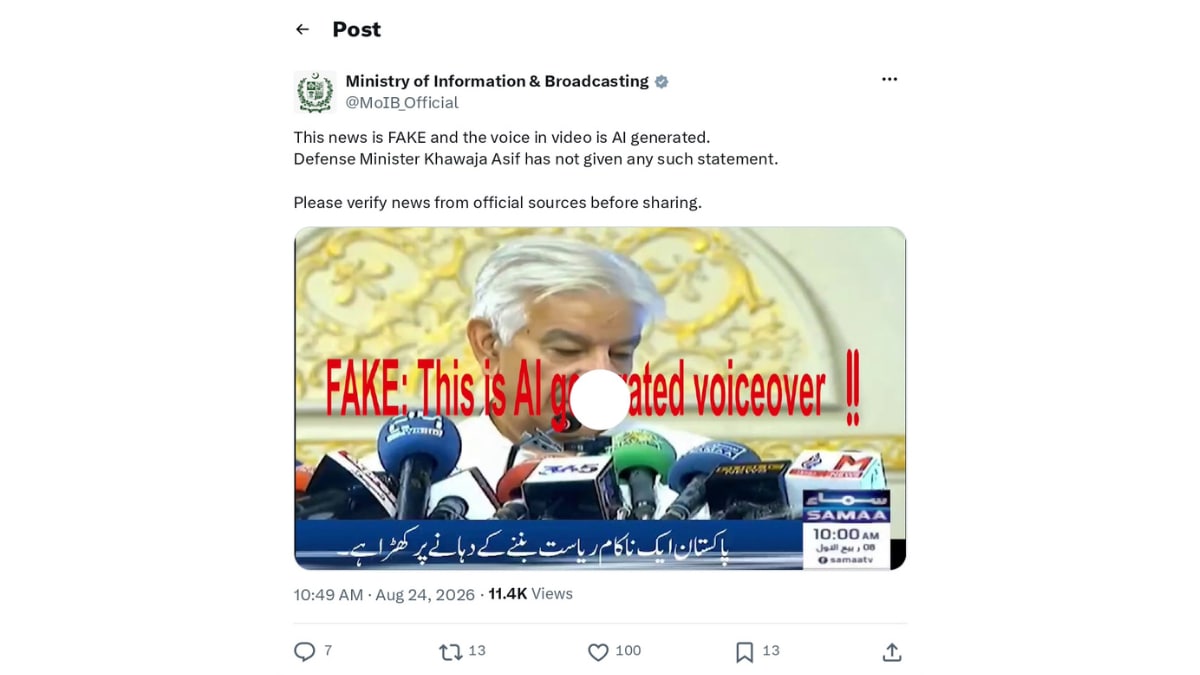
The recent diplomatic friction between New Delhi and Islamabad—triggered by General Asim Munir’s remarks suggesting Shia citizens "go to Iran"—reveals a profound breakdown in the Pakistani state's social contract. This is not merely a rhetorical lapse; it is a manifestation of Strategic Sectarian Outsourcing. By framing a domestic minority as an ideological extension of a foreign power, the Pakistani military leadership is attempting to offload the internal cost of governance and security onto an external neighbor. This maneuver creates a high-probability risk of state fragmentation while simultaneously providing India with a significant asymmetric advantage in international human rights forums.
The Tripartite Architecture of Sectarian Marginalization
To understand why the "Go to Iran" rhetoric is a structural pivot rather than a random outburst, one must examine the three pillars that sustain the current Pakistani internal security doctrine.
1. The Sovereignty Export Model
Pakistan’s military-intelligence complex operates on the premise that internal stability is best achieved through homogenization. When a group—in this case, the Shia population, which comprises approximately 10% to 15% of the 240 million citizens—resists this homogenization or maintains cross-border cultural ties, the state adopts a policy of Sovereignty Export. By telling a demographic to seek refuge or political alignment elsewhere, the state effectively renounces its duty to protect, thereby reducing its own "governance overhead." This creates a vacuum that non-state actors and extremist groups quickly fill.
2. The Defensive Realism of Identity
From a pure power-dynamics perspective, General Munir’s statement serves as a signaling mechanism to the Sunni hardline base. By positioning the Shia minority as "the other," the military aligns itself with ultra-conservative elements to secure domestic legitimacy during periods of economic instability. However, this creates a Negative Sum Outcome. The more the state alienates its minority taxpayers and professional classes, the more it erodes its own tax base and intellectual capital.
3. Asymmetric Information Warfare
India’s response—labeling the situation as "systemic victimization"—is a calculated move in the theater of international relations. By highlighting these remarks, New Delhi shifts the global narrative from bilateral territorial disputes to internal human rights violations. This forces Pakistan into a defensive posture at the United Nations and other multilateral bodies, where the threshold for "systemic" abuse is often the trigger for economic sanctions or reduced foreign aid.
Quantifying the Vulnerability The Shia-State Friction Coefficient
The volatility of this sectarian divide can be mapped through specific friction points that dictate the stability of the Pakistani state.
- Demographic Concentration: Shias are heavily concentrated in Gilgit-Baltistan and urban centers like Karachi and Lahore. This geographic clustering means that any state-sponsored or state-ignored violence has a high "Impact Density."
- Economic Contribution: The Shia community holds significant positions in the civil service, healthcare, and the judiciary. Forcing or suggesting an exodus results in a "Brain Drain" that Pakistan’s struggling economy cannot absorb.
- Legal Scaffolding: The expansion of blasphemy laws serves as the primary tool for structural victimization. These laws are rarely about theology; they function as a mechanism for property seizure and political silencing.
The Logical Fallacy of Foreign Alignment
The state’s argument relies on the assumption that religious affinity equals political subservience to Tehran. This is a fundamental misreading of Sociopolitical Identity Theory. While religious ties exist, the Shia of Pakistan are linguistically, culturally, and historically rooted in the South Asian subcontinent. By ignoring this, the Pakistani leadership commits a category error that leads to flawed policy:
- The Iran-Pakistan Pipeline Paradox: While the military tells Shias to go to Iran, the state simultaneously struggles to manage the security of the Iran-Pakistan border (the "Goldsmid Line").
- Sistan-Baluchestan Spillover: Alienating the Shia population complicates the security situation in Balochistan. If the state creates a hostile environment for one group, it incentivizes cross-border insurgent movements to coordinate, creating a multi-front internal security crisis.
India’s Strategic Leverage and the Evolving Narrative
New Delhi’s decision to "slam" the remarks is not merely an act of neighborly concern. It is a strategic utilization of Normative Power.
The Transversal Conflict Shift
For decades, the India-Pakistan conflict was framed as a zero-sum game over territory (Kashmir). By focusing on the systemic victimization of minorities, India is pivoting the conflict toward a Values-Based Framework. This is a superior strategic position because it aligns India’s interests with those of Western liberal democracies. When the Pakistani Army Chief suggests a minority "go to Iran," he provides the empirical evidence required for India to argue that Pakistan is a "Theocratic Volatility Risk" rather than a stable state actor.
The FATF and IMF Implications
Economic stability in Pakistan is currently tied to external lifelines. International financial institutions increasingly incorporate "Social Stability Markers" into their risk assessments. Public statements from high-ranking military officials that threaten the safety of 30 million citizens increase the country’s Sovereign Risk Premium. This makes borrowing more expensive and foreign direct investment (FDI) nearly impossible, as capital avoids regions prone to sudden demographic upheavals.
Structural Constraints and the Failure of Reform
There are three primary bottlenecks that prevent Pakistan from correcting this trajectory:
- The Mullah-Military Nexus: The military relies on religious parties for political mobilization, making it impossible to genuinely crack down on sectarian violence without losing a key pillar of support.
- Educational Stagnation: The curriculum in many state-funded and private madrasas continues to propagate exclusionary narratives, ensuring that the "Othering" process begins at the foundational level.
- Lack of Judicial Independence: When the state fails to prosecute leaders of banned sectarian outfits, it signals Implicit Endorsement, which emboldens further rhetoric of the kind displayed by General Munir.
The Geopolitical Forecast
If the Pakistani state continues to use the "Go to Iran" doctrine as a pressure valve for internal tensions, it will face a Bifurcated Security Failure.
On the western front, Iran will likely view these statements as a threat to its regional influence and a precursor to humanitarian spillover. Tehran is unlikely to remain a passive recipient of a displaced population and may increase its support for proxy elements within Pakistan to ensure its own security. On the eastern front, India will continue to weaponize these diplomatic lapses to isolate Pakistan.
The strategic play for Pakistan is a total decoupling of national identity from sectarian purity. This requires a transition from a Security State to a Developmental State. However, the current incentives within the Pakistani military hierarchy favor short-term populist signaling over long-term structural stability.
Moving forward, the primary metric of Pakistan’s stability will not be its GDP or its nuclear arsenal, but its Inclusion Index. As long as the state’s top leadership views a significant portion of its citizenry as an exportable commodity or a foreign fifth column, the internal cohesion required to survive its current economic crisis will remain unreachable. The immediate tactical move for international observers is to monitor the legislative activity regarding blasphemy law amendments, as these will serve as the "Leading Indicator" for whether General Munir's remarks were an outlier or the new official directive.
Would you like me to analyze the specific impact of these sectarian tensions on the security of the China-Pakistan Economic Corridor (CPEC) projects?