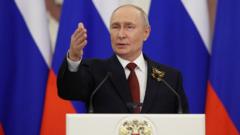
The shift in Kremlin rhetoric regarding the duration of the Ukraine conflict signals a transition from a war of attrition to a phase of strategic positioning for a negotiated freeze. When the Russian executive branch suggests an "end" is in sight, it is not an admission of military failure or a sudden pivot to pacifism; it is a calculated signaling of the marginal utility of further territorial gains versus the escalating costs of domestic economic overheating. Understanding the true trajectory of this conflict requires looking past political soundbites and analyzing the convergence of three critical pressure points: industrial throughput limits, the depletion of Soviet-era hardware reserves, and the shifting calculus of Western fiscal endurance.
The Marginal Utility of Attrition
The conflict has entered a stage where the cost-to-benefit ratio of territorial acquisition has flattened. In the early phases, rapid maneuvers sought high-value political objectives. Current operations, however, are characterized by "positional warfare," where kilometers gained are measured against thousands of lost units and months of industrial output.
For the Russian Federation, the "end" of the conflict is a function of reaching a point of maximum leverage before the structural decay of its heavy equipment reserves becomes a tactical liability. While Russia has successfully transitioned to a war economy, there is a fundamental difference between manufacturing new high-tech hardware and the current practice of refurbishing T-62 and T-72 tanks from deep storage.
- The Refurbishment Bottleneck: Current Russian tank delivery numbers often conflate "new production" with "refurbishment." Satellite imagery of storage depots indicates that the stock of viable hulls for refurbishment is finite. Estimates suggest a "peak refurbishment" point will occur between late 2025 and mid-2026.
- The Labor Deficit: Shifting millions of workers into the defense sector has created a vacuum in the civilian economy. With unemployment at record lows and inflation persistent, the state cannot indefinitely prioritize shells over bread without risking internal social friction.
- The Revenue Ceiling: Despite the failure of Western price caps to fully halt oil revenue, the increased costs of "shadow fleet" logistics and the steep discounts offered to Asian buyers create a diminishing return on energy exports.
The Asymmetric Equilibrium of Western Support
Ukraine’s ability to continue the fight is entirely decoupled from its own GDP, relying instead on the political volatility of the G7. The "end" mentioned by Russian leadership is predicated on the assumption that Western resolve follows a predictable decay curve. This creates an asymmetric equilibrium where Russia needs to survive its own internal economic pressures long enough for Western electoral cycles to trigger a reduction in aid.
The Fiscal Fatigue Hypothesis
Western support functions on a "replacement cost" basis. Initially, aid consisted of surplus equipment—items already slated for decommissioning. As these stockpiles dwindle, support transitions to "new procurement," which requires direct taxpayer funding and competing with domestic priorities. The Russian strategy hinges on the belief that the West will eventually refuse to move from "clearing the attic" to "buying new furniture."
Strategic Signaling and the Psychology of the Freeze
When Putin speaks of an end, he is addressing three distinct audiences with a unified message of inevitability.
- The Domestic Audience: The message serves to reassure the populace that the "Special Military Operation" is not a permanent state of being, thereby tempering anxiety about future mobilization waves.
- The Global South: By framing Russia as the party ready for peace, the Kremlin reinforces its standing with "neutral" partners like India and Brazil, positioning the West and Ukraine as the primary obstacles to global stability.
- Western Hardliners: The rhetoric is designed to empower "realist" factions in Western governments who argue for a cessation of hostilities to prevent further economic disruption.
The Three Pillars of a Forced Settlement
Any movement toward a cessation of hostilities will be governed by a specific set of non-negotiable variables. These are not based on international law, but on the physical realities of the front line and the economic realities of the participants.
1. Territorial Consolidation vs. Sovereignty
The core deadlock remains the status of the "four oblasts" and Crimea. Russia’s definition of an "end" involves the recognition of these territories as federal subjects. Ukraine’s definition remains the 1991 borders. A "freeze" suggests a Korean Peninsula scenario where the line of contact becomes a de facto border without a formal peace treaty. This allows both sides to claim they haven't surrendered their long-term goals while stopping the kinetic drain on resources.
2. Security Guarantees and the NATO Proxy
Russia’s primary strategic objective remains the prevention of Ukrainian integration into Western security architectures. For Ukraine, any end to the conflict without ironclad security guarantees (Article 5 or equivalent) is merely a "rearmament pause" for Russia. The "end" described in recent statements likely envisions a "neutralized" Ukraine—a condition that remains a non-starter for Kyiv after the failures of the Budapest Memorandum.
3. The Sanctions Decoupling
A cessation of fire does not guarantee a return to the pre-2022 economic order. The "end" of the war will likely see the continuation of a "Cold War 2.0" economic structure. Russia has redirected its energy infrastructure toward the East; Europe has diversified its LNG sourcing. These are multi-decadal capital investments that will not be reversed by a mere ceasefire.
The Industrial Attrition Curve
The intensity of artillery usage—at times exceeding 10,000 rounds per day—has forced a global reassessment of industrial capacity. The side that can maintain a consistent supply of 155mm (West) or 152mm (Russia) shells dictates the tempo of the war.
The current Russian advantage in shell volume is being countered by Western advantages in precision. However, precision weapons (HIMARS, ATACMS, Storm Shadow) are high-cost, low-volume assets. The "end" becomes a reality when one side’s "high-volume/low-precision" strategy is no longer countered by the other’s "low-volume/high-precision" strategy due to depletion.
Identifying the Inflection Point
We can quantify the proximity to an actual end by monitoring three leading indicators:
- The Interest Rate Divergence: If the Russian Central Bank is forced to keep rates significantly above 15% to combat inflation, the domestic cost of the war is becoming unsustainable.
- The Subsidy Shift: Watch for when the Russian state budget begins to pivot funds away from veteran benefits and defense contracts back toward social infrastructure.
- The "Third Party" Pressure: Direct intervention or shifts in the diplomatic stance of China regarding "dual-use" exports will be the most reliable signal that a conclusion is being forced behind the scenes.
The rhetoric of an "ending" conflict is a tactical tool used to manage expectations and influence the political landscape of the adversary. A true conclusion remains tethered to the cold mathematics of industrial output and the political endurance of the supporting coalitions.
The immediate strategic priority for any observer is to ignore the diplomatic posturing and focus on the "burn rate" of Soviet-era armored reserves. When the storage depots at Omsk and Primorsky are empty, the conflict will end, not because of a change of heart, but because the mechanical means of offensive warfare have been exhausted. This exhaustion is the only metric that truly matters in a war of this scale.
The most probable outcome is not a comprehensive peace treaty, but a "high-tension freeze" where the kinetic conflict stops while the economic and political warfare continues indefinitely. Stakeholders should prepare for a world where "peace" is merely the absence of active artillery fire, while the structural divisions of the global economy remain permanently fractured.

