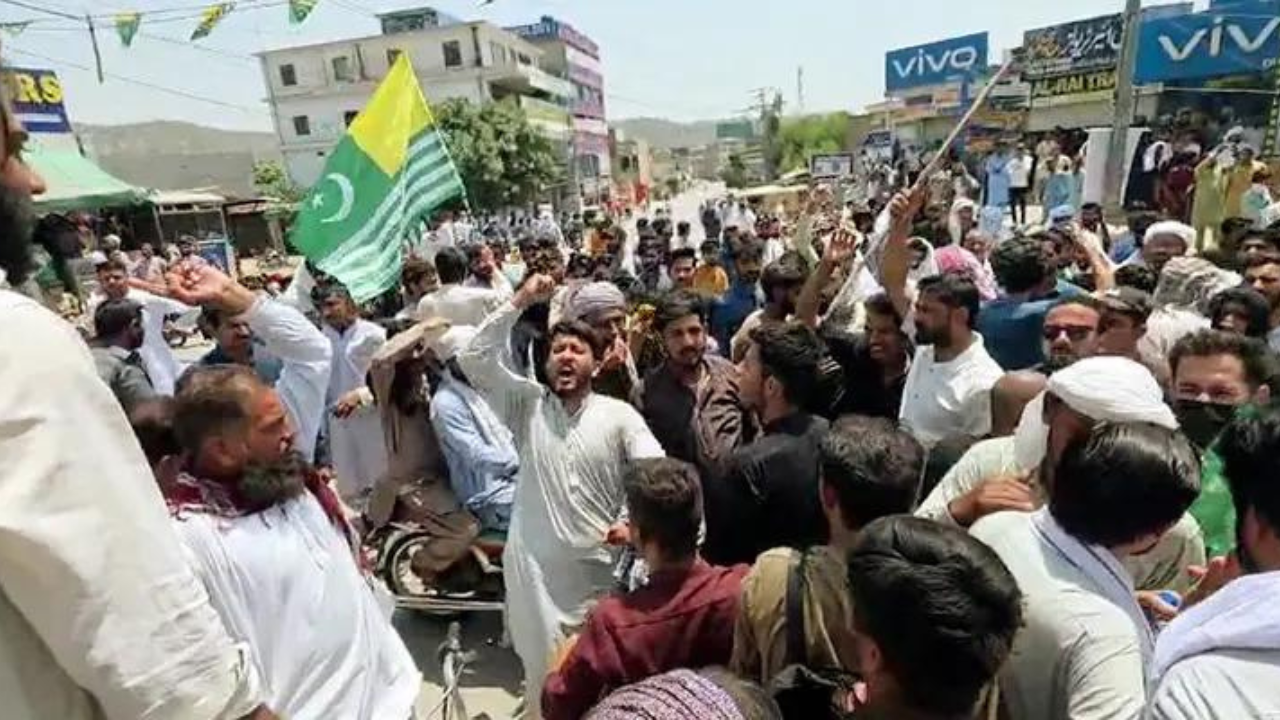
Mainstream media coverage of the recent unrest in Pakistan-administered Kashmir—often referred to as Azad Jammu and Kashmir (AJK) or Pakistan-occupied Kashmir (PoK)—has fallen into a predictable, lazy trap. When a prominent Baloch nationalist leader voices support for the Kashmiri protests, commentators rush to declare a unified, cross-regional uprising against Islamabad. They paint a picture of a collapsing state facing a synchronized revolution from its eastern borderlands to its southwestern deserts.
This analysis is not just shallow; it is entirely wrong. For a deeper dive into this area, we suggest: this related article.
The narrative of a grand, shared resistance between the Kashmiri protestors and the Baloch insurgency ignores the fundamental economic, political, and historical realities of these two distinct movements. Lumping them together misses the actual mechanics of state power in Pakistan. It misunderstands why people are on the streets in Muzaffarabad, and it completely misinterprets the strategic calculations of the Baloch leadership.
The False Equivalence of Bread and Bombs
To understand why the "unified resistance" narrative fails, we must look at the structural drivers of each movement. For further context on the matter, in-depth reporting is available on NBC News.
The recent volatility in Pakistan-administered Kashmir is driven by a highly specific, localized economic crisis. It is a civil advocacy movement, not a separatist insurgency. The Joint Awami Action Committee (JAAC), which spearheaded the demonstrations, rallied people around clear, material grievances: soaring electricity tariffs, the elimination of wheat subsidies, and the elite privileges enjoyed by government bureaucrats.
These are citizens demanding a better deal from the state, operating within the constitutional ambiguities of AJK’s special status. They are fighting for governance reform and economic relief.
+-----------------------------------------------------------------------+
|                       THE GEOPOLITICAL DIVIDE                         |
+-----------------------------------------------------------------------+
| PAKISTAN-ADMINISTERED KASHMIR          | BALOCHISTAN                  |
| (Economic Civil Advocacy)              | (Ethno-Nationalist Conflict) |
+-----------------------------------------------------------------------+
| • Drivers: Electricity tariffs, wheat  | • Drivers: Sovereignty, land |
|   subsidies, governance reform.        |   rights, resource extraction.|
|                                        |                              |
| • Methods: General strikes, sit-ins,   | • Methods: Armed insurgency, |
|   marches, civil disobedience.         |   guerilla warfare, boycotts.|
|                                        |                              |
| • Goal: Economic equity and better     | • Goal: National liberation,  |
|   integration/autonomy rights.         |   complete self-determination|
+-----------------------------------------------------------------------+
Now contrast this with Balochistan. The conflict in Pakistan’s southwest is a deep-seated, decades-long ethno-nationalist struggle. It is characterized by a low-intensity armed insurgency, enforced disappearances, and a fundamental rejection of the Pakistani state's sovereignty over the region's vast natural resources.
The Baloch movement is about land, identity, and extraction rights regarding projects like the Gwadar Port and the Reko Diq mine.
Calling both of these movements "suppression of political rights" is an oversimplification that helps no one. The protestors in Muzaffarabad want cheaper roti and fair electricity bills from Islamabad. The insurgents in Balochistan want Islamabad out entirely. Treating them as the same phenomenon is a analytical failure.
The Opportunism of Rhetorical Solidarity
Why, then, did a prominent Baloch chief issue a statement backing the Kashmir resistance?
In international relations and domestic political maneuvering, the enemy of my enemy is a temporary talking point. For Baloch nationalist figures, endorsing the Kashmir protests is a low-cost, high-visibility tactic to pressure the federal government. It is a rhetorical tool designed to exploit a moment of state vulnerability and signal to international observers that Islamabad is facing widespread domestic discontent.
I have watched regional analysts misread these public statements for over a decade. They mistake tactical solidarity for operational synergy.
In reality, there is no structural alignment between the two movements. The leadership of the Kashmiri protest committees has deliberately avoided associating with armed separatist narratives. They know that the moment their economic grievances are branded as anti-state subversion or linked to foreign-backed insurgencies, the state's response changes from negotiation to absolute kinetic suppression.
The JAAC won major concessions from the federal government—including a multi-billion rupee subsidy package—precisely because they kept their focus tight, legal, and economic. If they had adopted the rhetoric of the Baloch nationalist movement, those negotiations would have collapsed instantly.
The Blind Spots in the "People Also Ask" Consensus
When people search for information on regional instability in Pakistan, the automated queries reflect the flawed assumptions of mainstream journalism. Let us dismantle two of the most common premises.
Does the unrest in PoK signal a breakdown of Pakistan's control?
No. It signals a breakdown of Pakistan's fiscal capacity, which is a very different problem. The state was forced to slash subsidies across the board to meet the stringent structural benchmarks of the International Monetary Fund (IMF). The protests in Kashmir were the direct result of an austerity regime imposed by a cash-strapped federal capital, not a sudden loss of administrative or military control over the territory. The moment Prime Minister Shehbaz Sharif allocated 23 billion rupees to appease the region, the immediate crisis cooled. The state's leverage remains intact; its wallet is just empty.
Are the grievances in Kashmir and Balochistan identical?
Absolutely not. To argue they are identical is to ignore geography, demographics, and constitutional history.
AJK has traditionally enjoyed a higher standard of living, better literacy rates, and more significant remittance inflows from the diaspora than rural Balochistan, which remains one of the most underdeveloped regions in South Asia despite its resource wealth. The Kashmiri grievance is that their high output of hydroelectric power is sent to the national grid while they are charged exorbitant tariffs. The Baloch grievance is that their natural gas and minerals are extracted while the local population lacks basic clean drinking water. One is a dispute over utility billing and governance; the other is a existential battle over resource colonization.
The Real Winner of Regional Instability
If you want to know what is actually happening in a geopolitical flashpoint, look at who benefits from the chaos.
The real consequence of the synchronized headlines regarding Kashmir and Balochistan is the justification it provides for the militarization of local governance. When external commentators and regional adversaries hype up these protests as a unified civil war, they hand the Pakistani security apparatus the perfect excuse to crack down on legitimate, peaceful civil advocacy.
Imagine a scenario where a local union in Muzaffarabad marches for better school funding. If that march is framed by international media or neighboring states as part of a wider, coordinated dismantling of the Pakistani federation, the state will treat those union leaders as national security threats rather than citizens exercising civic rights.
The lazy consensus among analysts doesn't just misinform the public; it actively harms the very people on the ground by escalating the stakes of their local protests into existential geopolitical conflicts.
Stop Looking for a Revolution Where There is Only a Budget Dispute
The international community needs to stop viewing every provincial protest in Pakistan through the romanticized lens of a brewing revolution.
The Pakistani state is complex, highly fragmented, and deeply resilient in its survival mechanisms. It manages crises through a cycle of financial co-optation and targeted political engineering. The unrest in Kashmir was resolved—temporarily—the way most economic disputes are resolved: with a checkbook, however strained that checkbook might be.
The Baloch struggle will continue on its own bloody, protracted trajectory, driven by entirely different historical currents and structural realities. The two paths do not cross, they do not merge, and they do not share a command structure.
Those who write about a unified front against Islamabad are selling a narrative that exists only on paper and in social media echo chambers. If you want to understand the future of Pakistan's stability, stop reading the press releases of regional chiefs and start reading the terms of the next IMF loan agreement. That is where the real conflict is written.