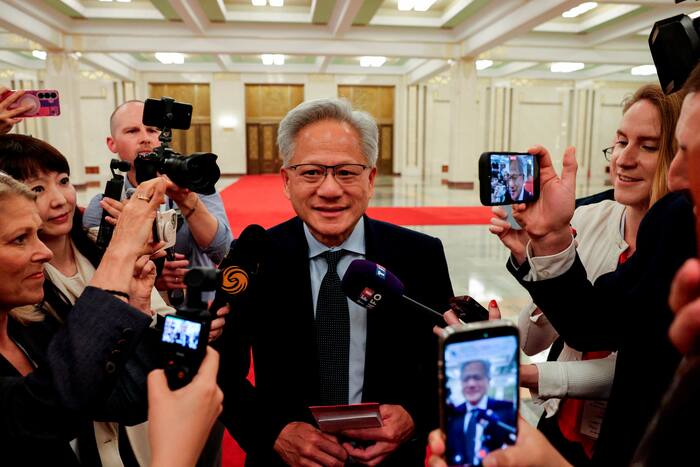
The public reception of Nvidia CEO Jensen Huang in Taiwan illustrates a structural shift in how semiconductor supply chains interact with geopolitical optics, personal branding, and domestic political expectations. When an executive transitions from an operational leader into a symbol of national pride, any personal controversy or strategic realignment immediately triggers reputational volatility. To understand why an executive loses public momentum in a core manufacturing hub, observers must separate emotional media narratives from the underlying economic and political mechanics governing Taiwan’s technology sector.
The Mechanics of Executive Myth-Making in Semiconductor Hubs
In high-concentration industrial ecosystems like Taiwan, the relationship between foreign technology executives and the domestic public operates differently than in standard consumer markets. Taiwan produces the vast majority of the world's most advanced logic semiconductors, creating an economy deeply tied to the capital expenditure cycles of a few dominant fabless designers. When a chief executive of a primary customer visits the island, local media and political actors frequently frame the visit as an endorsement of national security and economic vitality.
This dynamic relies on a specific feedback loop:
- Capital Allocation as Validation: Multi-billion-dollar commitments to local foundries, packaging facilities, and server manufacturers translate directly into domestic GDP growth and equity market appreciation.
- Cultural Proximity: Shared linguistic heritage and birthplace ties lower the barrier to media saturation, turning routine supply chain meetings into public spectacles.
- The Silicon Shield Narrative: Local commentary often equates high-profile executive presence with implicit geopolitical protection, assuming that deep commercial integration deters external aggression.
This cycle creates an artificially high baseline of public approval. Because the approval rests on symbolic alignment rather than purely commercial metrics, it remains vulnerable to sudden corrections whenever corporate behavior diverges from local expectations.
Deconstructing the Reputational Erosion Vector
A decline in public favor rarely stems from a single isolated incident; rather, it occurs when negative media coverage intersects with structural anxieties within the host market. In the case of a high-profile technology leader facing scrutiny, three distinct friction points accelerate reputational decay.
The Divergence of Corporate Governance and Public Image
When reports emerge regarding personal controversies, governance disputes, or executive conduct, the carefully curated image of the approachable, vendor-friendly founder fractures. In markets where the executive was previously treated as an infallible architect of national prosperity, the contrast between the heroic public persona and standard corporate friction generates disproportionate backlash. Media outlets that previously amplified every casual street-food appearance pivot toward scrutinizing executive compensation, tax structures, and personal alliances.
Supply Chain Diversification Anxiety
Taiwanese stakeholders monitor capital allocation with extreme sensitivity. While public appearances emphasize loyalty to local partners, rational corporate strategy requires geographic diversification to mitigate single-point-of-failure risks. When a dominant fabless designer expands research centers, assembly partnerships, or wafer allocation outside Taiwan—whether in the United States, Europe, or Southeast Asia—local observers interpret the move as a dilution of commitment. Public enthusiasm cools rapidly when celebratory rhetoric clashes with observable capital flight or capacity hedging.
The Politicization of Commercial Visits
In a polarized domestic political environment, a visiting executive cannot remain entirely neutral. Engaging with specific government administrations, attending state-backed forums, or making off-the-cuff remarks about sovereignty and trade policy forces the executive into local partisan crossfire. Once an executive is perceived as favoring one political faction—or conversely, as bowing to external regulatory pressures from Washington or Beijing—the unified public support fractures along domestic political lines.
The Cost Function of Over-Indexed Personal Branding
Treating a chief executive as a sovereign-level diplomat introduces measurable operational risks for a publicly traded hardware company. Standard corporate strategy dictates that supplier negotiations remain insulated from public sentiment, governed instead by yield rates, wafer pricing, and packaging capacity. Over-indexed personal branding breaks this insulation.
The first limitation of celebrity-driven supply chain management is negotiating leverage erosion. When an executive publicly declares an unbreakable bond with a specific manufacturing ecosystem, suppliers gain subtle pricing power. Walking away from price increases or demanding aggressive allocation priority becomes harder when the CEO has staked personal credibility on absolute partnership harmony.
The second limitation is asymmetric media risk. A traditional B2B semiconductor executive operates largely outside the tabloid cycle; negative press is confined to financial journals and affects only institutional investors. By cultivating mass-market celebrity status in a manufacturing hub, the executive exposes the company’s enterprise brand to retail-style scandal cycles. A personal controversy that has zero impact on GPU architecture or foundry yields can still dominate local headlines, distracting regional management and complicating regulatory approvals for local land acquisition or energy permits.
The third limitation involves geopolitical cross-contamination. High visibility in Taipei inevitably draws scrutiny from regulators in other jurisdictions. Every public statement made to appease local Taiwanese audiences is archived and analyzed by trade authorities in Washington and Beijing. Navigating export controls and antitrust inquiries becomes significantly harder when the CEO’s casual remarks are treated as geopolitical policy statements.
Separating Operational Reality from Media Sentiment
To evaluate the true impact of reputational shifts in Taiwan, analysts must distinguish between retail sentiment and institutional dependency.
Retail sentiment—measured through local press tone, social media engagement, and public reception at trade shows—is highly elastic. It reacts immediately to personal scandals, perceived slights, or shifts in political rhetoric. If a scandal hits the news cycle, the crowds thin out, and the tone of local commentary turns critical.
Institutional dependency, however, is rigid. It is governed by physics, capital expenditure, and multi-year engineering roadmaps. Regardless of public opinion in Taipei, the fundamental commercial reality remains unchanged:
- Leading-edge foundry capacity cannot be replicated overnight in alternative geographies.
- CoWoS (Chip-on-Wafer-on-Substrate) and advanced packaging ecosystems remain heavily concentrated on the island.
- Original Design Manufacturers (ODMs) handling server rack integration rely on deeply entrenched engineering teams located in northern Taiwan.
Public friction does not alter the transistor density of a 3-nanometer node, nor does it change the immediate unit economics of AI data center deployments. Therefore, a loss of public "shine" rarely translates into immediate order cancellations or foundry reallocations. The risk is medium-term rather than immediate: sustained reputational friction can slow down bureaucratic approvals for local R&D centers, complicate talent recruitment against domestic competitors, and harden local labor and environmental scrutiny.
Strategic Recalibration for Hardware Leadership
When an executive’s public standing in a critical manufacturing hub degrades due to controversy or strategic friction, attempting to win back the crowd through increased media appearances is counterproductive. Public relations campaigns amplify the exact visibility that created the vulnerability.
The optimal response requires systematically decoupling corporate operations from executive celebrity:
- Institutionalize Supplier Relations: Shift the public face of regional partnerships from the CEO to senior vice presidents of operations, supply chain management, and regional engineering leads. Ground all public communications in technical milestones, yield improvements, and capacity expansion rather than personal affinity.
- Restrict Unscripted Public Engagements: Eliminate informal media availabilities, night-market walkabouts, and unvetted political appearances. Confine executive presence in the region to closed-door operational reviews and formal industry keynotes focused strictly on product architecture.
- Standardize Geopolitical Messaging: Frame all global supply chain investments—both inside and outside Taiwan—through the lens of deterministic capacity scaling. Emphasize that geographic expansion is a function of total addressable market growth rather than a zero-sum reallocation away from existing hubs.
- Ring-Fence Governance and Personal Disputes: Handle legal, personal, or governance controversies strictly through formal corporate communications channels headquartered in the company's home jurisdiction, preventing regional media from turning localized reporting into a referendum on the company's regional commitment.
Execute a deliberate retreat from public spectacle back into pure operational execution, allowing engineering delivery and capital deployment to stabilize the regional relationship without relying on personal popularity.


