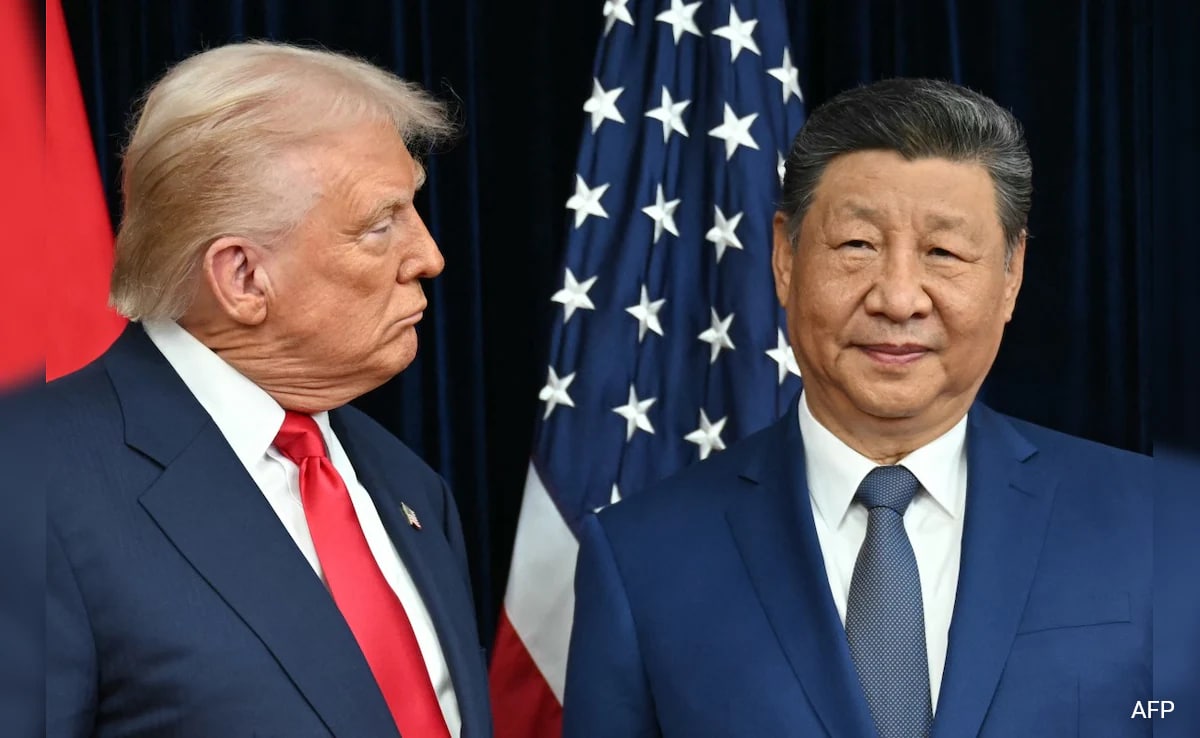
The prevailing narrative characterizing US-China relations as a high-stakes "chess match" fails to account for the fundamental divergence in how each superpower defines winning, calculates risk, and manages systemic stability. While the Chinese Communist Party (CCP) operates within a framework of long-term structural endurance and resource consolidation—classic game theory—the Trump administration’s approach introduced a deliberate "volatility premium." By weaponizing unpredictability, the United States shifted the engagement from a predictable exchange of concessions to a high-variance environment where the rules of the board are secondary to the survival of the players.
The Bifurcated Strategic Framework
To analyze the friction between Donald Trump and Xi Jinping, one must first identify the two distinct operational logics at play. The "Chessboard" model, favored by Beijing, relies on incrementalism, positional advantage, and the slow erosion of the opponent’s influence through economic entanglement (e.g., the Belt and Road Initiative). The "Board-Flipping" model, utilized by Trump, is a disruptive strategy designed to negate the opponent’s accumulated positional advantages by forcing a restart of the negotiation under new, undefined terms.
1. The CCP’s Positional Calculus
Beijing’s strategy is rooted in the concept of Shi—the alignment of forces and the exploitation of momentum. This involves:
- Time-Horizon Asymmetry: Utilizing 50-year planning cycles to outlast the four-to-eight-year electoral cycles of Western democracies.
- Deep Integration: Ensuring that the cost of US "decoupling" remains prohibitively high by embedding Chinese manufacturing into the foundational layers of global supply chains.
- Regulatory Capture via Market Access: Leveraging the size of the Chinese domestic market to force technology transfers from US firms, effectively subsidizing domestic innovation with foreign intellectual property.
2. The Trumpian Volatility Mechanism
Trump’s strategy functions by introducing systemic noise into a signal-heavy environment. He treats international relations not as a series of rules-based interactions, but as a series of bilateral transactional pressures.
- The Credible Threat of Irrationality: By signaling a willingness to impose tariffs that hurt both domestic and foreign interests, the US removes the "rational actor" assumption that Beijing uses to project future outcomes.
- Tactical Devaluation of Multilateralism: By bypassing the WTO and other international arbiters, the US forces China into one-on-one arenas where raw GDP and military spending power can be applied without the dilution of allied consensus.
The Cost Function of Economic Decoupling
Analysis of the trade war period reveals that "flipping the board" was not a singular event but a continuous application of economic friction. The primary tool—tariffs—functioned as a tax on the certainty of the global supply chain. This created a specific cost function for multinational corporations:
$Total Cost = (Input Costs + Tariff Impact) \times (Political Risk Multiplier)$
The "Political Risk Multiplier" is the variable Trump manipulated. When the US President can change trade policy via Twitter at 3:00 AM, the risk of long-term capital expenditure in China increases. This forces a diversification of supply chains not because the new locations are more efficient, but because they are less politically exposed.
Supply Chain Elasticity and Friction
The assumption that manufacturing would return to the US ignores the reality of labor costs and infrastructure. Instead, the "flipping of the board" triggered a migration of low-margin assembly to Southeast Asia and Mexico.
- The Vietnam Pivot: Between 2018 and 2022, Vietnam saw a significant surge in FDI, acting as a "middleman" for Chinese components re-labeled for the US market.
- Technological Containment: The focus shifted from generic trade deficits to high-spec hardware. The Entity List became a surgical tool to decapitate the growth of firms like Huawei and SMIC, moving the conflict from "selling sneakers" to "controlling the silicon."
The Breakdown of Traditional Diplomacy
Standard diplomatic engagement relies on "The Bureaucratic Layer"—the thousands of mid-level officials who maintain continuity between administrations. The Trump-Xi era largely bypassed this layer, concentrating power in the hands of two individuals with diametrically opposed psychological profiles.
The Institutional Vacuum
In a traditional "chess" environment, the State Department and the Ministry of Foreign Affairs manage the movement of pieces. In the "volatility" environment:
- Personal chemistry and direct summits (Mar-a-Lago, Beijing) replaced policy papers.
- Internal dissent within the US administration (e.g., Navaro vs. Mnuchin) served as a "Good Cop/Bad Cop" tactic, whether intentional or emergent, which kept Beijing in a state of reactive uncertainty.
The second limitation of Beijing’s response was its inability to mirror this volatility. The CCP’s legitimacy is tied to the perception of stability and "orderly" growth. If Xi Jinping were to adopt Trump’s unpredictable style, he would risk spooking the very state-owned enterprises and local party officials he needs to maintain internal control. Thus, the US gained a "flexibility advantage" by being the only player comfortable with chaos.
Measuring the Efficacy of Disruptive Strategy
Success in this context is not measured by the "Trade Deal" signed in January 2020, which was largely ignored during the ensuing pandemic. Rather, success is measured by the permanent shift in the global consensus regarding China.
Structural Realignment Metrics
- The End of Engagement: The pre-2016 consensus that "trade leads to democratization" has been effectively retired.
- Securitization of Trade: Commodities like semiconductors, rare earth minerals, and pharmaceutical precursors are no longer viewed through the lens of comparative advantage, but through the lens of national security.
- Bilateral Skepticism: Public opinion in the US moved from a split view to a bipartisan consensus that China is a "pacing threat," ensuring that even after Trump left office, the "board-flipping" mechanics (like the CHIPS Act) remained in place.
The Intelligence Bottleneck in Beijing
Beijing’s intelligence apparatus is optimized for tracking stable systems and identifying specific points of leverage within democratic institutions (e.g., lobbying groups, CEOs). Trump’s disregard for these traditional leverage points created a bottleneck in Chinese decision-making.
The Politburo Standing Committee struggled to differentiate between "negotiating bluster" and "actual policy shifts." This confusion led to a series of tactical errors, including:
- Overestimating the influence of the US agricultural lobby on Trump’s tariff decisions.
- Underestimating the speed at which the US could implement export controls on advanced lithography equipment.
The Long-Term Viability of Asymmetric Instability
While "flipping the board" successfully broke the status quo, it carries a high maintenance cost. The US dollar’s role as the global reserve currency relies on a perception of stability. If the US continues to use the global financial system as a weapon of tactical volatility, it risks incentivizing the creation of "non-aligned" financial architectures (e.g., BRICS+ payment systems).
The risk for the US is not that it loses the game, but that the game itself moves to a different board where the "volatility premium" no longer applies. China’s current strategy focuses on:
- Currency Internationalization: Reducing reliance on the SWIFT system.
- Resource Autarky: Securing direct ownership of lithium, cobalt, and nickel mines globally to bypass US-controlled maritime trade routes.
The Strategic Path Forward
The US must transition from "Board-Flipping" to "Structural Architecting." Chaos is a useful tool for breaking an unfavorable equilibrium, but it is insufficient for building a sustainable one. The objective must shift from merely disrupting China’s rise to establishing a competitive ecosystem where the US and its allies hold the "Primary Layer" of the technological and financial stack.
Tactical requirements include:
- The Decoupling of Critical Dependencies: Moving beyond broad tariffs to surgical, permanent domestic production mandates for essential components (Active Pharmaceutical Ingredients, high-density batteries).
- Allied Synchronicity: Re-engaging with G7 and Quad partners to present a unified regulatory front, ensuring that when the US "flips the board," there is a new, more favorable board waiting to be placed on the table.
- Counter-Escalation Readiness: Preparing for the inevitable "Resource Squeeze" that China will apply as a counter-move, specifically regarding processed rare earth elements.
The conflict is no longer about who wins a trade war. It is a fundamental competition to determine which operating system will run the 21st-century global economy. One side offers a centralized, state-driven model of efficiency; the other offers a decentralized, high-volatility model of innovation and power projection. The winner will be the one who can best manage the inevitable friction of the transition.