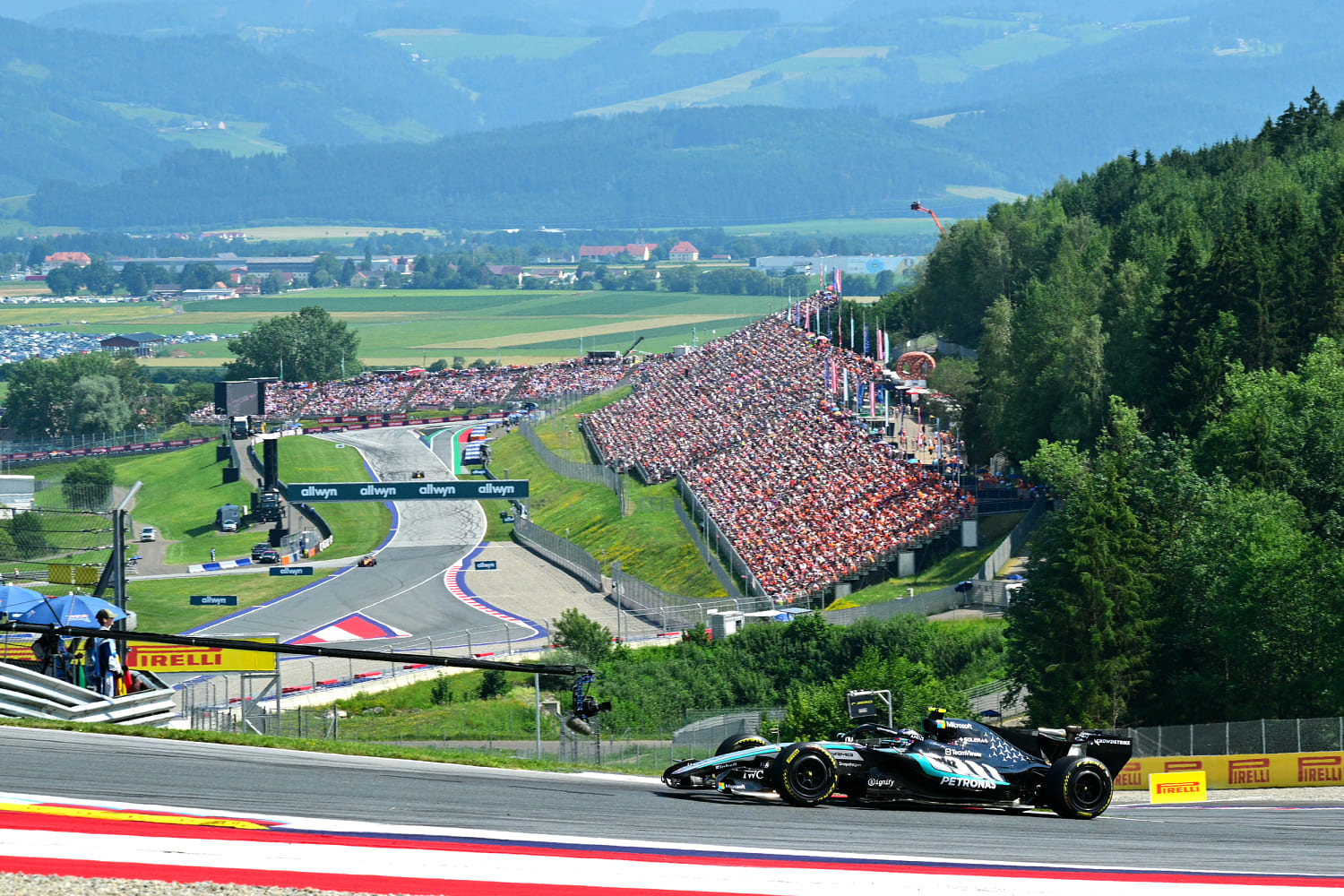
The mainstream motorsport media is currently drowning in its own lazy narrative. Following the drama at the Red Bull Ring, the headlines write themselves: "George Russell strikes back," "Mercedes enters the championship fight," and "A stunning victory for the Silver Arrows."
It is a comforting story. It suggests a three-way title fight and validates the millions spent on incremental front-wing upgrades.
It is also entirely wrong.
George Russell did not win the Austrian Grand Prix through superior race craft, tactical genius, or sudden mechanical dominance. He inherited a trophy because the two fastest drivers on the grid decided to engage in a high-speed game of chicken that ended in a double puncture. To frame this as a merit-based triumph for Mercedes is to misunderstand the fundamental mechanics of modern Formula 1.
If you look at the raw data, the reality is stark, brutal, and entirely counter to the hype.
The Myth of the Three-Way Title Fight
Let’s dismantle the "championship gap narrowing" illusion immediately. Prior to the collision on lap 64, Russell was floating in a lonely third place, roughly 15 seconds adrift of the lead battle. He was not closing the gap; he was managing a deficit.
To understand why this matters, we have to look at the concept of clean-air pace versus traffic management. For 60 laps, Max Verstappen and Lando Norris were pushing each other into the low 1:10s, utilizing every millimetre of track limits and depleting their battery reserves (ERS) to defend and attack. Russell, in clear air, was running a textbook, unbothered race—and he was still losing a quarter of a second per lap to the leaders.
- The Reality Check: Mercedes didn't close the gap to Red Bull or McLaren. Red Bull and McLaren simply removed themselves from the equation.
- The Delta: In the second stint on the hard compound tyre, Verstappen’s median lap time was consistently faster than Russell’s, despite the Dutchman complaining heavily about a sudden lack of rear grip and understeer.
I have spent years analyzing telemetry data from telemetry suites like Atlas and WTS, and if there is one universal truth in paddock engineering, it is this: you cannot fix a fundamental aerodynamic deficit with a lucky safety car or a rival’s collision. Mercedes is still missing the necessary downforce in medium-speed, long-radius corners—the exact type of turns that define the upcoming tracks like Silverstone and Spa-Francorchamps.
Dismantling the "People Also Ask" Flawed Premises
Whenever a race ends in chaos, the internet consensus immediately pivots to a set of flawed questions. Let's address them by correcting the premises entirely.
Is Mercedes officially back as a championship contender?
No. To call Mercedes a contender based on a race where they lacked the raw pace to challenge for pole or victory on pure merit is a delusion. Winning an F1 race because the cars ahead crashed is the motorsport equivalent of winning a marathon because the two lead runners tripped over the finish line tape.
The W15 chassis has certainly improved since its early-season balance issues—specifically regarding its narrow aerodynamic operating window—but it remains the third-fastest car on the grid. A genuine contender forces the mistake; Russell was simply the beneficiary of it.
Did Max Verstappen deserve a harsher penalty for the collision?
The debate surrounding the 10-second penalty given to Verstappen misses the point of hard racing entirely. Commentators screamed about "moving under braking," a clear infraction under Article 27.4 of the Sporting Regulations. But if you look at the onboard footage from Norris’s car, Verstappen wasn't reacting to Norris's moves; he was positioning his car to break the tow before the braking zone even began.
It was classic, uncompromising inner-circuit psychology. Verstappen knew that giving an inch to McLaren meant surrendering the psychological high ground for the rest of the summer. The penalty was statistically irrelevant to his championship lead anyway, which actually expanded because Norris scored zero points.
The Cost of the Counter-Intuitive Approach
There is a downside to acknowledging this uncomfortable truth. For Mercedes, celebrating this win as a fundamental breakthrough is dangerous. It breeds complacency. It allows the board of executives to look at a trophy and assume the technical trajectory is correct, when in reality, the underlying data suggests they are still vulnerable to Ferrari on hotter tracks and utterly outmatched by McLaren on high-speed rubber.
Imagine a scenario where Mercedes stops aggressively developing their floor layout because they believe they are now "in the mix." They will arrive at Silverstone and get soundly beaten by 20 seconds.
Actionable Advice for F1 Observers: How to Spot a Real Upgrade
Stop listening to team principals in the media pen. If you want to know who is actually fast, look at the following three metrics during Friday Practice 2:
- Tyre Degradation Slopes: Plot the lap times of a 10-lap consecutive run on the Medium tyre. The car with the flattest line (lowest degradation coefficient) will win the Sunday race, regardless of who qualifies on pole.
- GPS Overlays at Apex: Look at the minimum speed ($V_{min}$) in mid-speed corners. If a team claims their new front wing is working, but their $V_{min}$ in Turn 7 at the Red Bull Ring hasn't increased by at least 3 km/h relative to their rivals, the upgrade is an aesthetic exercise, not an aerodynamic one.
- Throttle Application Profile: Watch the driver’s telemetry on throttle exit. A unstable rear end forces a hesitant, staggered throttle application. True performance is found when a driver can smash the pedal to 100% linearly without micro-corrections.
George Russell drove a flawless race for the car he was given. He kept it on the grey stuff, avoided track limit penalties, and was in position to capitalize on the chaos. That is the job of a professional racing driver.
But let’s stop pretending this was a statement of intent from Brackley. It was a statistical anomaly wrapped in a silver racing suit. The championship gap didn't narrow because a new challenger emerged; it narrowed because the king of the castle had a temporary argument with his nearest neighbor.
Order will be restored next week, and the delusion will evaporate.