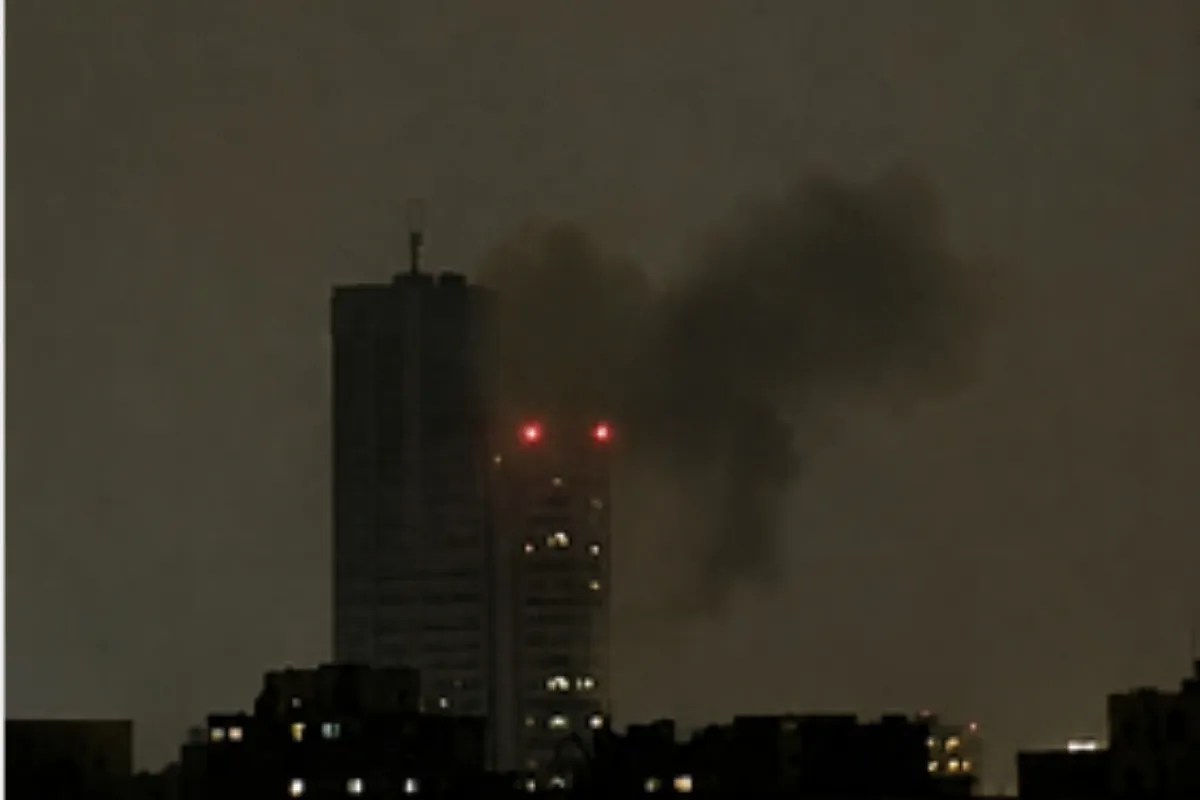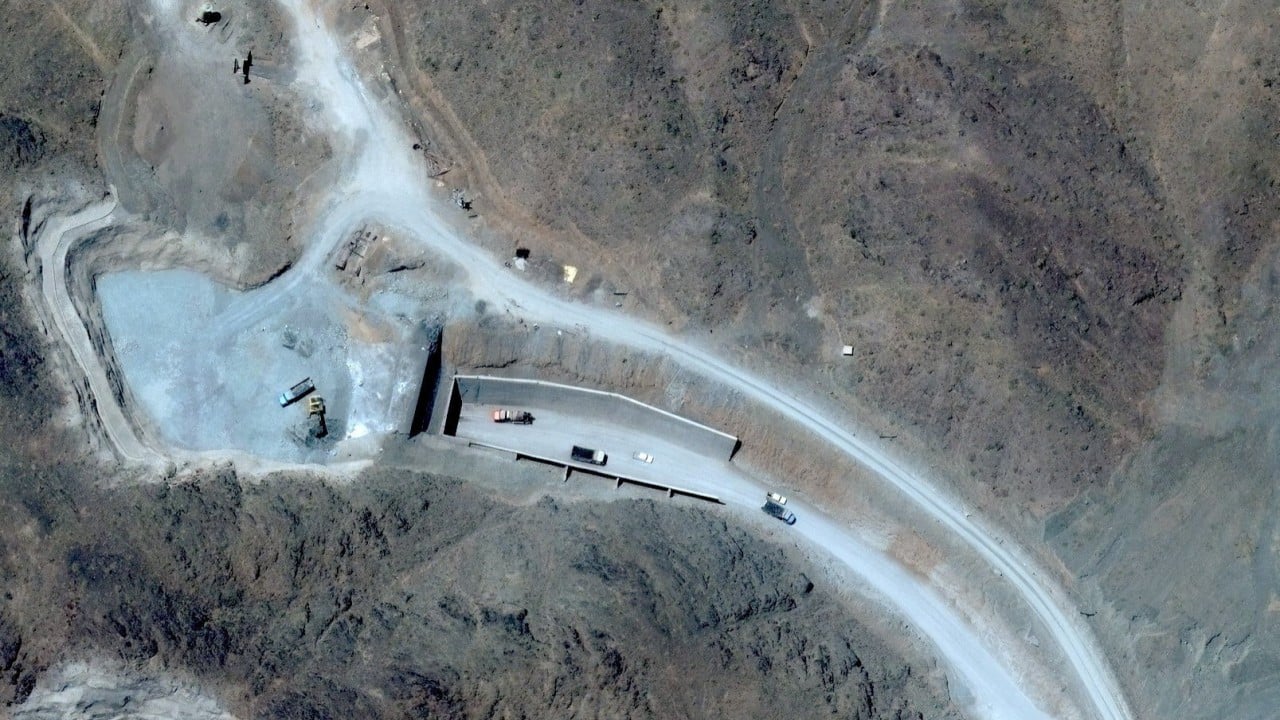
The strategic targeting of underground military infrastructure relies on an unstable physical premise: the assumption that conventional kinetic penetrators can outpace geotechnical hardening. The rhetoric surrounding the subterranean complex at Kuh-e Kolang Gaz La, colloquially known as Pickaxe Mountain, highlights a structural mismatch between air-delivered kinetic capabilities and deeply buried hardened targets. Evaluating this facility requires bypassing high-level political posturing to analyze the structural physics, operational bottlenecks, and macroeconomic trade-offs that define the current theater of operations.
Architectural Vulnerabilities and Depth Profile
Located approximately two kilometers south of the primary Natanz uranium enrichment site and 220 kilometers south of Tehran, Pickaxe Mountain represents an architectural shift in Iranian hardened facility design. Unlike the Fordow facility, which was constructed inside a mountain ridge rising to a moderate elevation, Pickaxe Mountain (Kuh-e Kolang Gaz La) offers a overburden peak reaching approximately 1,600 meters above sea level.
                                  [Summit Peak ~1,600m]
                                          /\
                                         /  \
  ~100m Bedrock Overburden              /    \
====================================== /      \ ======================================
                                      |        |
    [Portal 1] === (Hardened Tunnel) =| [Halls]|= (Hardened Tunnel) === [Portal 2]
                                      |        |
====================================== \      / ======================================
                                        \    /
                                         \__/
The operational footprint exhibits three critical structural characteristics:
- Bedrock Depth Profile: Critical underground halls are buried beneath approximately 80 to 145 meters of solid rock and reinforced concrete caps. This depth places the core infrastructure beyond the maximum effective penetration capability of standard inventory munitions.
- Redundant Access Portals: The complex utilizes at least four hardened, angled tunnel portals layered with earth and high-density concrete. This geometry minimizes the chance that a single strike vector can seal the subterranean system.
- Distributed Modular Vaults: Satellite analysis indicates a multi-tunnel network covering nearly one square kilometer, designed to isolate damage across compartmentalized halls.
The technical rationale for this site traces back to the July 2020 destruction of the above-ground advanced centrifuge assembly building at Natanz. The structural layout was explicitly designed to house centrifuge manufacturing and storage halls that could withstand high-yield aerial bombardment.
The Kinematics of Deep-Earth Penetration
Targeting deep subterranean facilities introduces severe mechanical constraints. The primary US operational tool for hardened targets, the GBU-57 A/B Massive Ordnance Penetrator (MOP), relies on a combination of precision guidance, structural mass (approximately 30,000 pounds), and a high-strength steel casing to breach rock overburden before fuse detonation.
+-------------------------------------------------------------------------------+
|                      KINETIC PENETRATION PERFORMANCE                          |
+----------------------------------------------------+--------------------------+
| Munition / Mechanism                               | Max Penetration (Rock)   |
+----------------------------------------------------+--------------------------+
| Standard BLU-109 / GBU-31                          | ~2 to 3 meters           |
| Advanced BLU-113 / GBU-28                          | ~6 meters                |
| GBU-57 A/B Massive Ordnance Penetrator (MOP)       | ~60 meters               |
| Structural Overburden at Pickaxe Mountain          | 80 to 145+ meters        |
+----------------------------------------------------+--------------------------+
The mathematical constraint governing deep penetration is expressed through hydrodynamic penetration theory, where total depth ($S$) is limited by the density of the penetrator ($\rho_p$), the density of the target material ($\rho_t$), the length of the projectile ($L$), and the dynamic yield strength of the target ($f_c'$):
$$S = L \left( \frac{\rho_p}{\rho_t} \right)^{0.5} \cdot f\left(v, f_c'\right)$$
Given that Pickaxe Mountain features an overburden ranging from 80 to over 100 meters of dense bedrock and reinforced concrete, a single aerial kinetic impactor faces a definitive physical barrier. The depth exceeds the mechanical limits of current air-delivered penetrators.
Achieving structural denial requires specialized tactical alternatives, each carrying distinct execution risks:
- Sequential Point-Impact Layering: Dropping multiple precision-guided penetrators into the exact impact crater sequentially to bore through the bedrock. This approach requires uninhibited air supremacy and prolonged loiter time over heavily defended airspace.
- Portal and Ventilation Denial: Shifting focus from destroying the main vault to collapsing the tunnel entrances, exhaust shafts, and utility lines. While this seals the site temporarily, clearing operations can restore access within weeks or months unless entry zones are continuously targeted.
- Special Operations Ground Sabotage: Direct insertion of specialized units to neutralize internal infrastructure or collapse critical nodes from within. This path introduces high personnel risks and requires real-time tactical intelligence on internal site layouts.
Supply Chain Interdiction vs. Infrastructure Destruction
Focusing purely on physical facility destruction misses a key structural vulnerability: the supply chain required to operationalize centrifuges. A nuclear enrichment system is not merely an underground room; it is an integrated engineering network that relies on highly specialized materials and continuous inputs.
[Raw Materials: Carbon Fiber / Maraging Steel]
                       │
                       ▼
[Precision Manufacturing & Balance Verification]
                       │
                       ▼
[Assembly inside Pickaxe Mountain Vaults]
                       │
                       ▼
[UF6 Gas Feed Infrastructure & Power Grid Integration]
                       │
                       ▼
[Operational Enrichment Cascades]
Interdicting this system effectively relies on three specific operational leverage points:
- Feedstock Material Bottlenecks: High-speed enrichment centrifuges require specialized rotor materials, including carbon-fiber filaments or high-strength maraging steel (grade 350). These materials face strict export controls and require specialized manufacturing plants that are far easier to target above ground.
- Frequency Converters and Power Stabilization: Advanced centrifuges operate at extreme rotational speeds, requiring precise electronic frequency converters and uninterrupted power feeds. Disruption of external power sub-stations or backup generator cooling systems causes immediate rotor crash events across operational cascades.
- Vacuum Systems and Valve Networks: Centrifuge cascades function under strict high-vacuum conditions. Disruption to foreign-sourced specialized vacuum pumps, bellows valves, or header piping disables enrichment capabilities regardless of whether the central subterranean hall remains intact.
Striking the surrounding industrial ecosystem yields higher operational disruption per weapon deployed than attempting to breach 100 meters of granite overburden.
The Macroeconomic and Strategic Trade-Offs
A prolonged military effort targeting hardened infrastructure alters the economic dynamics of the regional conflict. Continued aerial engagements demand significant logistical and financial expenditures while exposing wider global supply chains to systemic risk.
Direct Military Expenditure and Operational Friction
Extending operations into sustained subterranean target campaigns places strain on precision weapons inventories and defense budgets. Strategic munitions like the GBU-57 A/B are limited-production assets with high unit costs and lengthy manufacturing cycles. Deploying heavy bomber fleets (such as the B-2 Spirit) requires substantial tanker support, prolonged flight hours, and continuous maintenance cycles, drawing significant operational resources away from other global theatres.
Energy Market Volatility and Maritime Bottlenecks
The escalation of military operations in central Iran directly affects global energy logistics. Heightened military activity around critical transit corridors like the Strait of Hormuz—through which roughly 20 percent of global petroleum liquids pass—triggers immediate systemic friction:
- Crude Oil Price Surges: Disruption to maritime transit causes immediate spikes in benchmark crude prices, increasing global freight costs and feeding into broader inflationary pressures.
- Insurance Premium Escalation: War-risk insurance premiums for commercial tankers operating in the Persian Gulf rise exponentially during active military engagements, pricing smaller transit operators out of the region and reducing total effective shipping capacity.
- Inventory Depletion: Sustained reductions in transit volumes force importing nations to draw down emergency crude reserves, reducing global macroeconomic buffers against secondary market shocks.
+---------------------------------------------------------------------------------+
|                       REGIONAL CONFLICT IMPACT NETWORK                          |
+------------------------------------+--------------------------------------------+
| Operational Vector                 | Systemic Economic / Military Effect        |
+------------------------------------+--------------------------------------------+
| Deep Subterranean Strikes          | High inventory depletion of heavy weapons  |
| Transit Corridor Instability       | Maritime war-risk insurance spikes         |
| Energy Supply Interdiction         | Global inflation driven by crude spikes    |
+------------------------------------+--------------------------------------------+
Structural Limitations of the Hardened Target Strategy
Relying primarily on aerial bombardment against ultra-deep facilities presents fundamental strategic limits:
- Intelligence Asymmetry: Assessing internal damage to deeply buried structures via remote satellite imagery is notoriously difficult. Verifying whether centrifuges were destroyed, damaged, or simply uninstalled prior to an impact remains largely speculative without on-the-ground human intelligence.
- Regime Hardening: Kinetic strikes often incentivize target nations to dig deeper, pushing remaining research and development into smaller, unmapped sub-surface locations that are even harder to detect.
- Reconstitution Dynamics: While strikes disrupt current operations, they do not eliminate the technical expertise of engineers and scientists. Physical infrastructure can be rebuilt; tacit engineering knowledge persists.
The Strategic Path Forward
Achieving long-term neutralization of hardened facilities like Pickaxe Mountain requires shifting from pure kinetic strike strategies to an integrated denial matrix. Tactical planning must align military actions with supply chain interdiction, cyber operations, and economic pressure.
The most effective operational strategy avoids the brute-force attempt to penetrate 100 meters of bedrock. Instead, it systematically targets the fragile surface-to-subsurface interfaces: high-voltage power lines, specialized HVAC and air-filtration shafts, external transit routes, and industrial component manufacturing facilities. Neutralizing these critical dependencies renders the underground complex unusable for centrifuge assembly or uranium enrichment without requiring the physical destruction of the subterranean bedrock vaults.