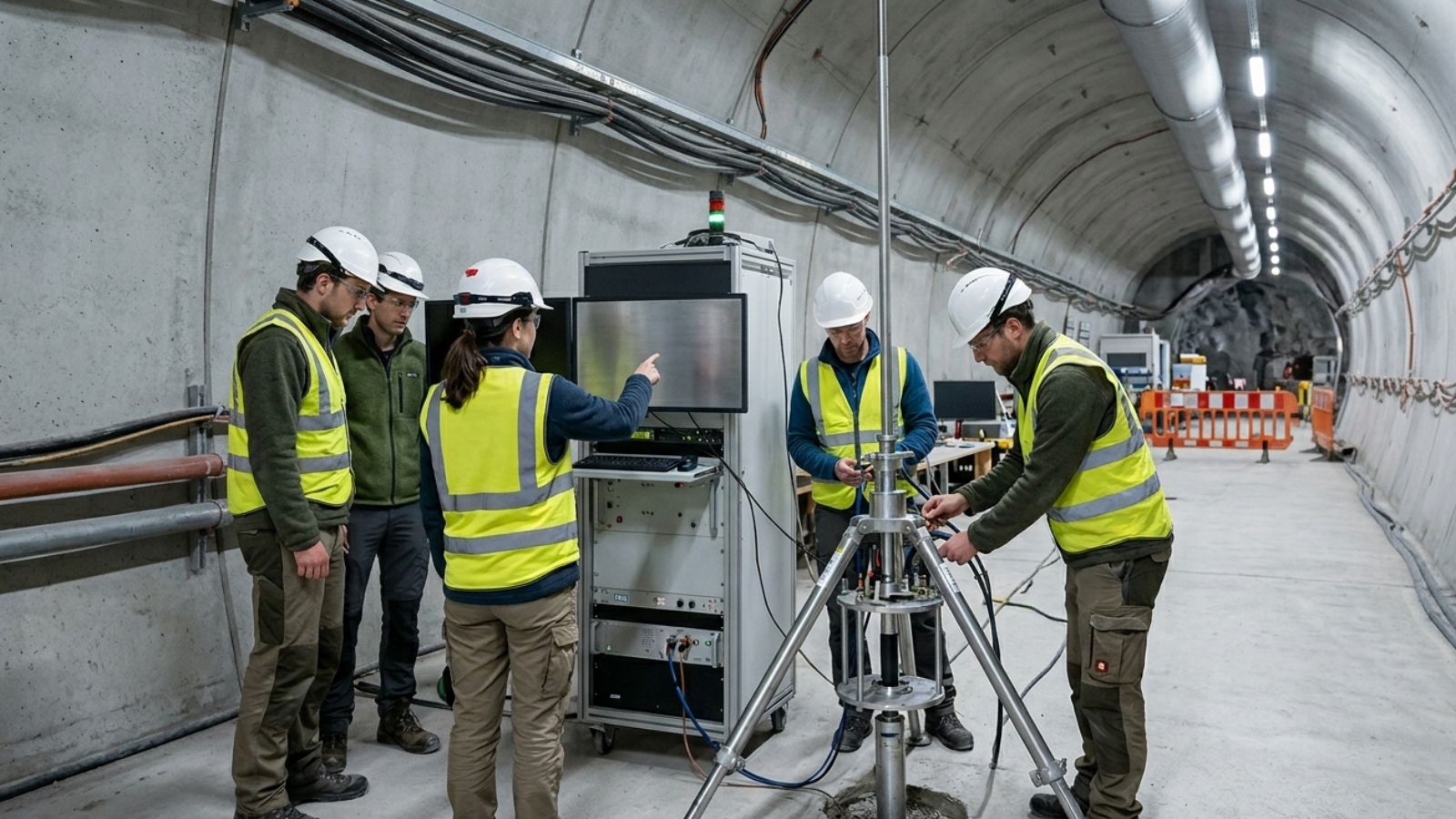
Energy independence has a price, and in the shadow of the Swiss Alps, that price is measured on the Richter scale. Scientists and engineers recently completed a high-stakes experiment in the Bedretto Laboratory, a tunnel buried two kilometers under the granite peaks. They didn't just study the earth; they broke it. By pumping high-pressure water into the bedrock, they triggered over 8,000 seismic events to map how we might harvest the planet’s internal heat. This is the brutal reality of Enhanced Geothermal Systems (EGS)—to save the climate, we are learning how to crack the crust of the earth without bringing the mountains down on our heads.
The Massive Heat Sink Under the Granite
The logic behind the Bedretto project is deceptively simple. The deeper you go, the hotter it gets. In Switzerland, the goal is to reach depths where temperatures hit $200°C$ or higher. If you can circulate water through that rock and bring it back to the surface, you have a perpetual motion machine for carbon-free electricity. Unlike solar or wind, geothermal provides baseload power, meaning it runs when the sun sets and the wind dies down.
However, the Swiss Alps are not a solid block of stone. They are a scarred, pressurized mess of tectonic history. To get the heat out, you need surface area. Natural rock at those depths is often too tight to allow water flow. Engineers use hydraulic stimulation—a cousin to fracking—to force open existing fractures or create new ones. Each time the rock slips or cracks, the earth shakes.
Why Eight Thousand Quakes Were Necessary
The sheer volume of seismic events sounds like a catastrophe in the making. In reality, most of these 8,000 "earthquakes" were micro-seismic pings, so faint that only the most sensitive borehole sensors could detect them. They serve as a biological sonar for the crust.
As the water pressure increases, the rock reaches a breaking point. Each pop and groan tells the researchers exactly where the fluid is moving. Without these thousands of tiny shocks, engineers are flying blind. They would have no way to know if they were creating a massive underground radiator or simply wasting water into a bottomless structural fault.
The Bedretto experiment focused on multi-stage stimulation. Instead of blasting the entire wellbore at once, they isolated small sections of the tunnel and cracked them individually. This controlled approach is designed to prevent a single, massive structural failure. It is the difference between a controlled demolition and an unplanned collapse.
The Shadow of Basel and St Gallen
Swiss history with geothermal energy is written in property damage and public outrage. In 2006, a project in Basel was permanently shuttered after a Magnitude 3.4 earthquake shook the city, causing millions in damages. A similar attempt in St. Gallen in 2013 was scrapped after a Magnitude 3.5 event.
These failures proved that the "brute force" method of geothermal stimulation is a non-starter in a country as densely populated and geologically sensitive as Switzerland. The 8,000 quakes in Bedretto represent a shift toward micro-management of the subsurface. Researchers are no longer just trying to break the rock; they are trying to tease it apart.
The Physics of Induced Seismicity
To understand the risk, one must understand the effective stress equation:
$$\sigma_{eff} = \sigma_n - P$$
Where $\sigma_{eff}$ is the effective stress holding a fault in place, $\sigma_n$ is the normal stress from the weight of the rock, and $P$ is the fluid pressure. When you increase $P$ by injecting water, you decrease the friction holding the fault together. If that fault is under tectonic tension, it slips.
The challenge is that we cannot see these faults until they move. The Bedretto team used a dense network of sensors to create a real-time 3D map of the "cloud" of seismicity. If the cloud started to migrate toward a known major fault line, they could kill the pumps before a micro-quake turned into a headline-grabbing disaster.
The Economic Wall
Even if the seismic risks are mitigated, the math of Alpine geothermal remains daunting. Drilling through several kilometers of crystalline basement rock is an expensive, slow process. A single deep well can cost upwards of $20 million, and there is no guarantee that the flow rate will be sufficient to turn a turbine.
We are currently seeing a gap between laboratory success and commercial viability. The Bedretto project proved that we can manipulate the rock with high precision. But moving from a controlled research tunnel into a commercial power plant requires a massive scaling of technology. You aren't just cracking a few meters of rock; you are trying to create a reservoir several cubic kilometers in size.
Comparing Energy Densities
- Solar PV: High surface footprint, intermittent.
- Wind: High visible impact, intermittent.
- Geothermal: Minimal surface footprint, 95% capacity factor, high geological risk.
The trade-off is clear. Geothermal takes up almost no space on the beautiful Swiss landscape, but it requires us to accept a level of managed risk beneath our feet.
Redefining the Safety Protocols
One of the most significant takeaways from the 8,000-quake study is the refinement of "Traffic Light Systems" (TLS). These are automated protocols that dictate when a project must stop based on seismic magnitude and frequency.
In the past, these systems were reactive. If a quake hit a certain threshold, you stopped. The new data suggests we need proactive TLS, using machine learning to analyze the "background noise" of the micro-quakes to predict when a larger event is brewing. It turns out the rock "talks" long before it breaks. If we listen closely to the thousands of tiny clicks, we can avoid the one big bang.
The Geopolitical Pressure Cooker
Switzerland is currently in a precarious energy position. As it moves away from nuclear power and seeks to reduce its reliance on imported natural gas, the pressure to make geothermal work is immense. The Alps are essentially a massive battery of thermal energy, and the technology developed in the Bedretto tunnel is being exported to the US, Japan, and Iceland.
The "why" behind these 8,000 earthquakes isn't just academic curiosity. It is a desperate search for a middle ground between the status quo and a carbon-heavy future. If we can't master the art of the "micro-crack," deep geothermal will remain a pipedream, buried under the weight of the very mountains we are trying to exploit.
The next phase moves from the Bedretto test site to full-scale pilot plants. The data is clear: the earth will shake. The only question remaining is whether we have become precise enough to keep those tremors beneath the threshold of human perception. We are effectively trying to perform surgery on the planet with a pressure washer.
Success means a future of invisible, endless power. Failure means another city shaking, another project shuttered, and a return to the drawing board while the glaciers above continue to melt.
Focus on the flow rate of the final production wells. If the volume of water recovered doesn't match the volume injected, the energy balance fails, regardless of how many quakes were triggered.

:max_bytes(150000):strip_icc():focal(749x0:751x2)/Arnold-Schwarzenegger-Joseph-Baena-032926-a90f8d3315fc44a6aebc6d7bb44bda01.jpg)