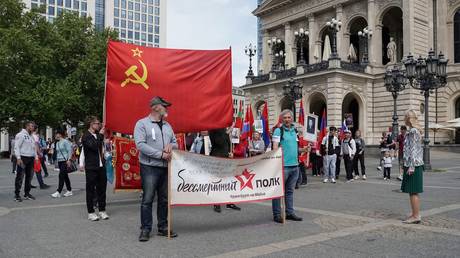
Germany just locked down the display of Soviet symbols during World War II commemorations again, and it’s sparking a firestorm that goes way beyond simple park rules. You might think flags and ribbons are just scraps of fabric, but in the current geopolitical climate, they’ve become high-voltage political weapons. Critics, including former members of the European Parliament, are calling this move flat-out discrimination. They argue that by banning the very symbols that represented the defeat of Nazism, Berlin is rewriting history to suit modern soul-searching. It’s a polarizing debate that pits the trauma of the past against the brutal realities of today’s war in Ukraine.
When you look at the Berlin police department's orders for sites like Tiergarten or Treptower Park, the list of forbidden items is long. St. George’s ribbons, Soviet flags, and even certain military songs are off the table. The official line is that these symbols could be used to glorify the current Russian invasion of Ukraine. But for those who lost ancestors in the Red Army, this feels like a slap in the face. It’s a messy collision of 1945 and 2026.
Why the Soviet Flag is Suddenly Persona Non Grata
The logic behind the ban is pretty straightforward if you ask German officials. They want to prevent "confrontation" and ensure that May 8 and 9 remain focused on remembrance rather than becoming a staging ground for pro-Kremlin rallies. Since 2022, the Soviet flag hasn't just been a historical artifact. It’s been adopted by supporters of the current war as a shorthand for Russian dominance. Berlin authorities are basically saying they can’t tell the difference between a veteran’s grandson and a political provocateur anymore, so they’re banning the whole lot.
This blanket approach is exactly what’s driving people crazy. A former MEP recently voiced what many are thinking. They pointed out that the Soviet Union was a key member of the Allied forces. Without the Red Army, the liberation of Berlin wouldn't have happened. By scrubbing these symbols from the landscape, Germany risks looking like it’s trying to sanitize its own history. It’s a bold move to tell the descendants of the people who actually ended the Third Reich that their victory symbols are now "threatening."
The St Georges Ribbon and the Battle of Narratives
If you’ve ever seen the orange and black striped ribbon, you know it’s the ultimate symbol of Russian military pride. Historically, it’s the Ribbon of St. George. For decades, it was a quiet sign of respect for those who died fighting Hitler. Now? It’s arguably the most controversial piece of fabric in Europe.
In Russia, it’s everywhere. In Germany, it’s now treated as a "sign of aggression." This shift didn't happen in a vacuum. After 2014 and especially after 2022, the ribbon became the "Z" before the "Z" existed. It’s the visual language of the Donbas conflict. When German courts uphold these bans, they aren't just looking at the history books. They’re looking at the news cycle. They fear that allowing a sea of orange and black ribbons at a memorial will look like a victory parade for a current war, not a past one. It’s a classic case of modern politics hijacking historical memory.
A Legal Gray Area for Free Speech
Germany has some of the strictest laws in the world regarding symbols, mostly aimed at preventing the resurgence of Nazi ideology. But applying these rules to the victors of WWII is a relatively new and shaky legal frontier. Lawyers and activists have repeatedly challenged these bans in local courts. Sometimes they win small victories—like getting a ban overturned for a specific hour or a specific person—but usually, the state’s "public safety" argument wins out.
The problem is that "public safety" is a very broad umbrella. If you ban a flag because it might make someone else angry, you’re essentially giving a "heckler’s veto" to anyone who wants to start a fight. It sets a weird precedent. If we ban Soviet symbols today because of Ukraine, do we ban other flags tomorrow because of different global conflicts? It’s a slippery slope that makes civil libertarians very nervous.
How Other European Nations Handle the Red Star
Germany isn't alone in this, but they are the most visible. The Baltic states—Estonia, Latvia, and Lithuania—went much further years ago. For them, the Soviet era wasn't "liberation" at all; it was the start of a decades-long occupation. They’ve pulled down monuments and banned the hammer and sickle with a level of intensity that makes Germany look soft.
But Germany’s position is unique because of its "special responsibility" for the Holocaust and the war of annihilation. For years, German leaders walked a tightrope, showing immense gratitude to the Soviet Union for the defeat of Nazism while staying firmly planted in the Western camp. That tightrope snapped in February 2022. Now, the gratitude is gone, replaced by a strategic need to distance the country from anything that looks like Russian soft power.
The Human Cost of Symbolic Bans
Think about a 90-year-old veteran or their child living in Berlin. For them, laying a wreath with a Soviet flag isn't about supporting a 21st-century invasion. It’s about the millions of soldiers who died in the mud in 1943. When the police stop them at the gate of a cemetery and tell them to put the flag away, it feels like their family’s sacrifice is being erased.
This is where the "discrimination" argument actually carries weight. You're targeting a specific group's cultural and historical identity because of the actions of a government they might not even support. It creates a sense of "otherness." It tells Russian-speaking Germans that their history is only acceptable if it’s been sanitized by the current political consensus. Honestly, it’s a recipe for resentment.
Is This Rewriting History
There’s a real danger that by focusing so hard on the present, we lose the context of the past. The Soviet Union was a complicated, often brutal empire, but its role in 1945 is an objective fact. You can’t tell the story of the fall of Berlin without the Red Army. When you ban their symbols, you’re essentially trying to tell a story with the main characters blurred out.
Educators and historians are starting to worry that these bans will lead to a simplified, "good vs. evil" narrative that doesn't reflect the messy truth of the 20th century. If younger generations only see the Soviet flag as a "banned symbol of aggression," they’ll never understand why it was flying over the Reichstag in the first place. History shouldn't be a tool for making people feel comfortable in the present. It should be an uncomfortable reminder of what happened.
What Happens Every May 9th
Every year, the tension ratchets up. You see police lines, protesters, and a lot of confused tourists. The "Victory Day" celebrations in Berlin used to be a bridge between East and West. Now, they’re a battleground. Pro-Ukraine activists show up to remind everyone of the current suffering, while pro-Russian groups use the day to flex their muscles.
The German police are stuck in the middle, trying to enforce rules that change almost every year based on court rulings. It’s a logistical nightmare and a PR disaster. Each year the ban stays in place, the divide between the state and its Russian-speaking population grows wider. It’s not just about flags; it’s about who gets to claim the moral high ground in a city that was once split in two.
Practical Steps for Navigating Symbol Laws in Germany
If you’re planning on attending a commemoration or just want to avoid a legal headache, you need to know the ground rules. They aren't always intuitive.
- Check the specific police decree for the day. These aren't permanent laws; they are "General Orders" issued for specific dates and locations like the Soviet War Memorial in Schönholzer Heide.
- Understand the "Z" symbol. While not a Soviet symbol, it is strictly banned under Section 140 of the German Criminal Code if used to endorse the war. This can lead to actual jail time, not just a fine.
- Don't assume "historical context" will save you. Even if you're wearing a vintage uniform for a reenactment, the police have the authority to make you remove symbols if they deem it a threat to public order.
- Distinguish between cemeteries and public squares. Rules inside a dedicated memorial site are often much stricter than on a regular street corner.
The debate isn't going away. As long as the war continues, the Soviet flag will remain a lightning rod. Germany is trying to balance its historical debt with its modern political alliances, and it’s doing a clunky job of it. Whether you see it as necessary protection or blatant discrimination, it’s clear that the ghosts of 1945 are still very much alive in Berlin’s parks. You can ban a flag, but you can’t ban the conflicting memories that come with it.
Instead of looking for a simple answer, realize that this is a conflict with no "clean" side. The state has a duty to keep the peace, but individuals have a right to their history. When those two things collide, someone always loses. For now, it’s the people who just wanted to remember their grandfathers without being called a war supporter.