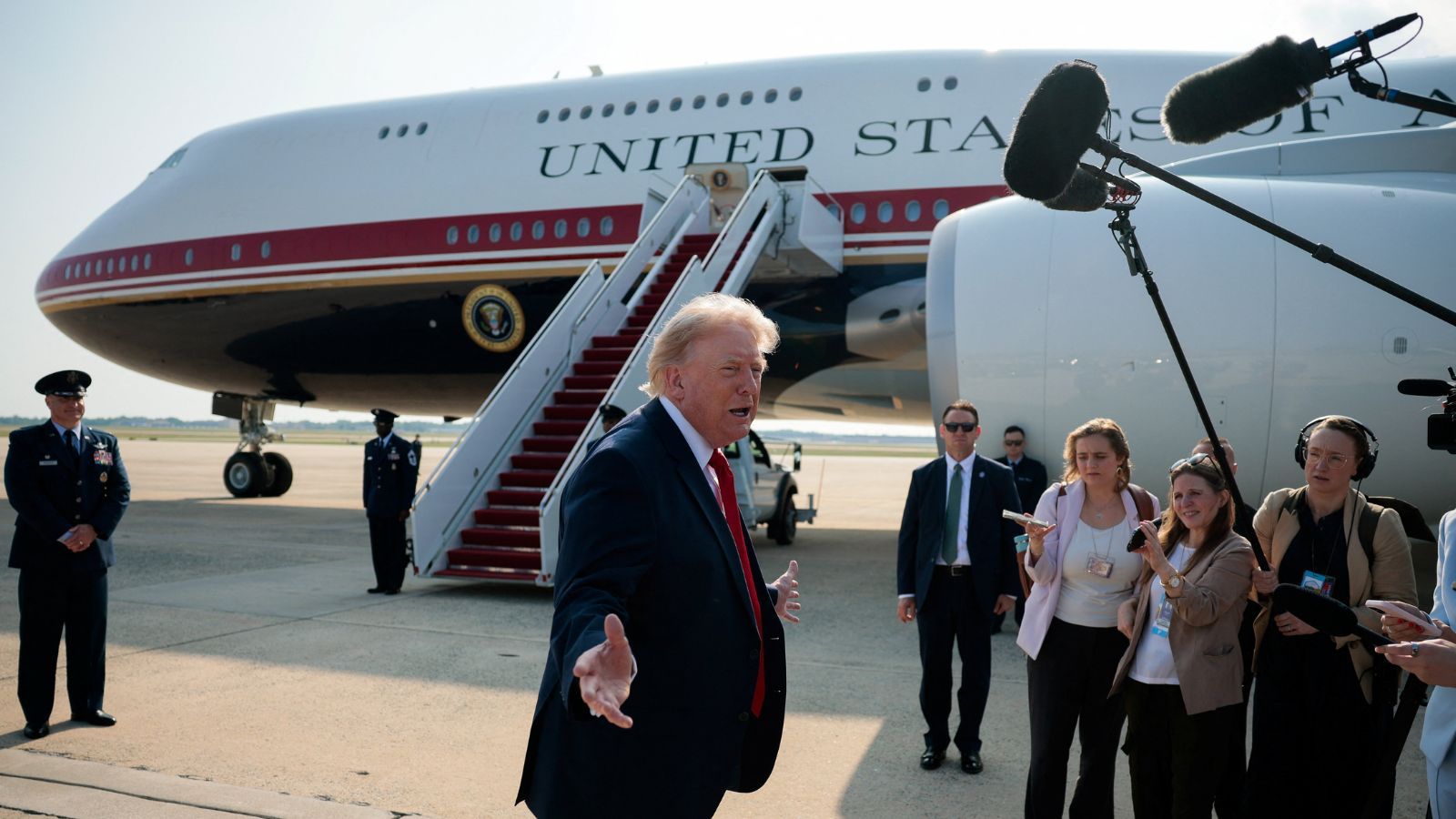
The tarmac at the military installation did not smell like politics. It smelled like JP-8 aviation fuel, ozone, and wet concrete. Night had already swallowed the horizon, leaving only the harsh, sodium-orange arc lamps to carve out sharp shadows against the fuselage of the waiting transport.
Security details do not panic. They tighten their jaws. They check the seating manifests a fourth time. They listen to the encrypted static whispering through an earpiece with the grim familiarity of an old friend.
Then came the order. Change the bird.
Not a routine mechanical swap. Not a minor delay for a hydraulic seal or a flickering sensor on the flight deck. A credible missile threat had materialized on a distant screen, cutting through the hum of standard protocol like a razor blade. Somewhere thousands of miles away, telemetry had aligned in a configuration that translated to an immediate, lethal danger. The aircraft painted on the public schedule—the familiar silhouette that reporters and well-wishers expected to see lifting into the dark—was suddenly a target.
Speed is a strange currency in high-stakes logistics. It demands absolute silence.
Imagine the sudden scramble inside the motorcade perimeter. Decisions made in seconds dictate whether history continues its normal crawl or shatters completely. The standard Boeing transport, large and recognizable, was quietly parked. Personnel scrambled. Luggage shifted in the dark with muffled thuds. The target profile had to vanish, replaced by a stealthier asset capable of slipping through the radar net without broadcasting a neon sign to hostile tracking systems.
This is the hidden underbelly of modern statecraft. We watch the speeches. We analyze the handshakes on television. We treat political movement like a sports broadcast, measuring success in applause lines and cable news chyrons. But beneath that thin veneer lies a terrifying machinery of threat matrices, counter-intelligence officers sweating through their shirts, and split-second geometry.
Risk is rarely abstract. It smells like hot metal.
Consider the mechanics of how a threat of that magnitude filters down. Intelligence streams do not arrive in neat, Hollywood-style dossiers. They arrive as fragmented digital whispers—raw telemetry from overhead assets, intercepted chatter, and automated warning systems blinking amber and red in underground command bunkers. Analysts comb through the noise, looking for the tiny spike in signal strength that separates background static from a locked-on guidance system.
When that signal points toward a former United States president, the calculus shifts instantly.
The switch to a less conspicuous aircraft wasn't just a logistical headache; it was an admission of a sobering reality. The airspace above our world is crowded with invisible dangers. We live in an era where kinetic hardware moves at hypersonic velocities, transforming the old geography of safety into a fragile illusion. Distance no longer guarantees sanctuary.
Security professionals often talk about the "threat envelope." It is a cold mathematical concept describing the zone within which an adversary can successfully project force. But inside that envelope, human beings are simply holding their breath.
Think of the pilot who sat in the cockpit of that replacement aircraft. Hours earlier, they had a routine flight plan. Now, they were flying a VIP whose very presence made the surrounding skies a geopolitical flashpoint. Every instrument cluster glowing green in the dim cockpit light carried the weight of national stability. One wrong vector, one undetected radar sweep, and the evening news would look entirely different.
We forget how close the edge is. We skate over the thin ice of global stability every single day, trusting that the unseen guardians doing math in windowless rooms will always get the equations right.
Intelligence officers are haunted by the threats they prevent. Success leaves no footprint. If a missile is never fired because an aircraft swapped its tail number under the cover of midnight, the public never knows how near the precipice they stood. There is no ticker tape parade for a catastrophe that failed to launch. There is only the quiet landing on a different runway, under a different call sign, in the freezing pre-dawn air.
The motorcade rolled out again. The doors thumped shut. The engines spooled up with a rising, subterranean howl that vibrated right through the soles of the boots standing on the flight line.
As the jet lifted off, banking hard toward the blackness to evade any predictable departure corridors, the men and women in the back sat in semi-darkness. No one spoke. They watched the cabin lights reflect off the curved plastic of their window shades. They knew what was out there in the dark.
And somewhere down below, on a glowing tactical display, a dot changed its designation, and the world kept turning.


