The cafe on Boulevard Mohammed V smells of scorched sugar, damp wool, and the electric hum of a television that no one is watching. Outside, the October rain is turning the Casablanca pavement into a mirror of neon signs and hurried feet. Inside, sitting at a corner table with a lukewarm mint tea, is Youssef.
Youssef is twenty-three. He holds a master’s degree in applied mathematics that he earned while working night shifts at a call center, translating French software complaints into exhausted apologies. He speaks three languages fluently, codes in Python, and knows the exact exchange rate of the euro down to the third decimal place. Read more on a related topic: this related article.
He also has never cast a ballot in his life.
When you ask him about the legislative elections, he doesn't get angry. He doesn't flip tables or launch into a fiery political manifesto. He just laughs—a short, dry sound that has no humor in it—and looks down at his cracked smartphone screen. Additional analysis by TIME delves into related views on the subject.
"To vote," Youssef tells me, stirring a mountain of undissolved sugar at the bottom of his glass, "you first have to believe that someone in that room knows you exist. Show me the man in Rabat who knows what it costs to buy a kilo of tomatoes today, and maybe I’ll walk down to the schoolyard. Until then, my vote is just a ghost story adults tell themselves to sleep better at night."
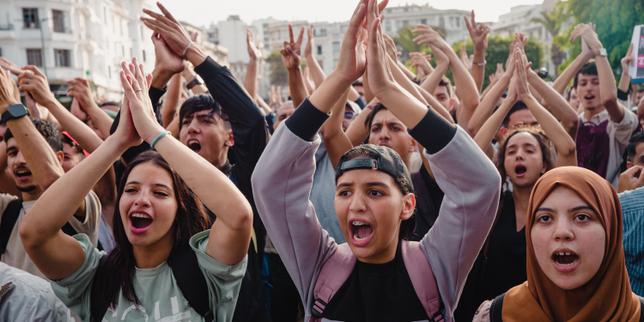
One year ago, the streets of Morocco’s major cities vibrated with a different kind of energy. It wasn't the tired, resigned energy of election day. It was the explosive, digital-first momentum of the GenZ movement. Armed with smartphones, algorithmic fluency, and an absolute refusal to be patronized by the old guards of political discourse, young Moroccans flooded social media feeds with critiques of economic stagnation, healthcare disparities, and a social contract that felt increasingly obsolete. They organized online. They trended. They forced the conversation into the open air.
Then came the ballot boxes. And silence.
The recent legislative elections rolled across the country like a quiet tide, leaving behind a stark reality that every political analyst in the capital is trying to parse with dry percentages and demographic charts. The youth—the very demographic that pulsed through the digital veins of the country just twelve months prior—remained the great absentee presence at the polling stations.
Why?
To understand that disconnect, you have to look past the official turnout figures and step inside the daily arithmetic of survival that defines contemporary Moroccan youth.
Consider what happens when a young graduate steps out of a university amphitheater in Fez, Marrakech, or Rabat. They are met by a labor market where structural youth unemployment hovers stubbornly high, and where informal work is often the only immediate shelter against total precarity. For years, the political establishment has offered variations of the same script: patience, structural reforms, long-term visions. But when rent is due on the first of the month, long-term visions taste like dust.
Politics, for many young people, has been reduced to a language they no longer speak. It sounds like archaic rhetoric, opaque party alliances formed in smoke-free backrooms, and faces that have populated campaign posters for decades. The GenZ digital wave proved that young Moroccans are intensely political—they care deeply about their country, their dignity, and their future. But their activism operates on an open-source, decentralized, peer-to-peer network. Traditional ballot-box politics, by contrast, feels like a closed-source, proprietary system designed to crash every time a user tries to access real change.
It is a profound crisis of translation.
In the neighborhoods of Sidi Bernoussi or Hay Mohammadi, you can feel this tension in the air. The walls are clean of campaign flyers long after the election dust has settled, but the walls are covered in something else: murals, graffiti, and shorthand codes that map out alternative economies, underground cultural movements, and digital survival strategies. The youth have not withdrawn from society; they have seceded from institutional politics. They have built an parallel universe of influence, mutual aid, and critique that operates entirely outside the traditional corridors of power.
And yet, abstention is a heavy weapon. It is a weapon that cuts both ways.
When an entire generation turns its back on the legislature, they do not make the system disappear. They simply abandon the steering wheel to those who already know how to drive the car off the cliff of stagnation. Every empty ballot is an ceded seat, an unvoiced demand, a blank check handed to a political class that learns, year after year, that it can win power with a shrinking fraction of the population's consent.
I watch Youssef finish his tea. The glass clinks against the chipped formica table.
"You think I'm cynical," he says, reading the expression on my face. It is not a question.
"No," I reply. "I think you're exhausted."
He looks back out the window at the rain, where a delivery driver on a battered scooter weaves dangerously through the Casablanca traffic, racing against a clock that doesn't care if he slips.
"Exhausted is a luxury," Youssef whispers. "We're just waiting for the green light that never turns on."
The rain keeps falling. In the offices of Rabat, the spreadsheets are updated, the coalitions are debated, and the analysis of the great youth absentee rate is filed away for another day. But out here in the streets, among the glowing screens and the cold glasses of tea, a generation is quietly writing its own history—waiting for the day when the world inside the ballot box finally catches up with the world outside.