The dry eucalyptus air of an Australian dawn smells of crushed oil and ancient dust. If you stand still long enough beneath the canopy, the forest begins to breathe. Shadows shift. Twigs seem to twitch. But most of what moves in that silent green world is not what it appears to be. For decades, scientists walking these very tracks looked at a particular lineage of stick insects and saw a single, uniform species. They cataloged it. They pinned it in museum drawers. They filed it away under a neat, tidy Latin name, satisfied that the story of this particular creature had been told.
They were entirely wrong.
Mistaken identity in the natural world is rarely a simple mix-up of physical traits. It is a failure of human imagination, a consequence of our desperate need to categorize the infinite complexity of life into boxes small enough to fit on a shelf. We see what we expect to see. When a creature’s primary evolutionary strategy is to erase itself—to become indistinguishable from a dead twig or a peeling piece of bark—it should not surprise us that human eyes, hurried and biased, walked right past a biological secret hiding in plain sight.
Consider what happens when researchers finally stop looking at insects as dead specimens and start looking at them as living chapters of a deep history.
The Anatomy of an Error
Taxonomy is an exercise in sorting chaos. For centuries, European naturalists arrived in Australia with preconceptions forged in temperate northern forests. They encountered an ecosystem so radically alien that their existing vocabulary strained to describe it. To a Victorian-era scientist, an insect that looked like a stick was an amusing novelty; an insect that looked like a slightly different stick was an administrative detail.
The recent revelation regarding Australian stick insects—specifically the unmasking of a cryptic species long lumped in with its cousin—did not happen in a vacuum. It was born from a collision of modern genetic technology and old-fashioned field persistence. Genetic sequencing does not care what a scientist thinks an insect should look like. DNA exposes the truth written in base pairs, whispering secrets that physical morphology guards with stubborn silence.
When researchers ran mitochondrial and nuclear DNA analyses on specimens gathered across distinct geographic pockets, the data revolted against the catalog. What looked identical to the human eye—the same spindly legs, the same mottled brown exoskeleton, the same defensive posture—belonged to entirely different evolutionary branches that had diverged millions of years ago.
This is the central irony of stick insects, known scientifically as phasmatodea. Their entire evolutionary genius is anti-recognition. They have spent tens of millions of years perfecting the art of being overlooked. They are masters of disguise, so committed to their anonymity that they fooled the very creatures assigned to decode them.
Life on the Branch
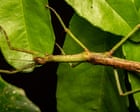
To understand the weight of this discovery, you have to drop down to the scale of the forest floor. Imagine a female stick insect clinging to the rough bark of a gum tree as the midday sun bakes the canopy. She is massive compared to her European counterparts—some Australian phasmid species grow to the length of a human forearm, heavy-bodied and prehistoric.
She does not run. She does not buzz or bite. Her survival hinges entirely on stillness. When a breeze sweeps through the eucalyptus leaves, she sways in rhythmic synchronization with the foliage, a masterclass in behavioral mimicry. To a predatory bird scanning the branches, she is just another piece of dead wood snapping in the wind.
For years, scientists assumed these populations were continuous, sprawling across vast swaths of the continent with casual uniformity. But Australia is not a monolith. It is a fractured continent of ancient mountain ranges, isolated river valleys, and sweeping arid zones that act as evolutionary islands. A population of stick insects isolated in a damp coastal gully for five million years will drift away from their cousins clinging to a dry ridge a hundred miles inland. They may keep the same outward costume—because the twig-and-leaf aesthetic works brilliantly—but beneath the surface armor, their genetic identity shatters into something entirely new.
The newly recognized species was there all along, whispering its existence through subtle shifts in breeding habits, minute variations in egg casing structure, and the cold arithmetic of molecular divergence. We just lacked the humility to listen.
The Cost of Overlooking the Small
Why does it matter that one stick insect species is actually two, or three, or an entire complex of hidden lineages?
Because conservation in the twenty-first century is fighting a war against extinction in the dark. We cannot protect what we do not know exists. If an entire species is misidentified as a common, widespread variant, its localized vulnerability goes completely unnoticed. A developer clears a tract of scrubland; a bushfire rips through a specific river valley. If we think the insects living there are common everywhere, we assume the population is safe. But if that localized population represents a distinct evolutionary branch—a million-year-old experiment in survival found nowhere else on Earth—its silent erasure goes unmourned because we never even knew it had a name.
Taxonomy is the foundation of ecology. Without accurate names, our maps of biodiversity are built on sand. Every time science corrects a case of mistaken identity among invertebrates, it acts as a stark reminder of how little we truly understand about the machinery of the biosphere. We live on a planet where macroscopic organisms—things you can hold in the palm of your hand—can hide under our noses simply because they are too quiet to demand our attention.
The Quiet Persistence of the Wild
Back in the eucalyptus forest, the sun dips below the horizon, painting the sky in bruises of purple and gold. The daytime stillness breaks. The canopy comes alive with a rustle of claws and the rasp of mandibles as the nocturnal world wakes up.
The stick insect adjusts her grip on the branch, her long antennae sweeping the cool night air. She has no concept of DNA sequencers, museum cabinets, or Latin binomial nomenclature. She does not care that a group of primates half a world away spent months arguing over her family tree in a peer-reviewed journal.
She simply exists, performing an ancient choreography of survival that predates human speech by tens of millions of years. The discovery of her true identity does not change her life; it changes ours. It forces us to acknowledge the limits of our perception, reminding us that the natural world is infinitely more complex, resilient, and strange than our neatest categories would ever dare to suggest.
Every branch holds a mystery. Every shadow has a history. And the most profound stories on this planet are often the ones whispered in absolute silence.