Silence.
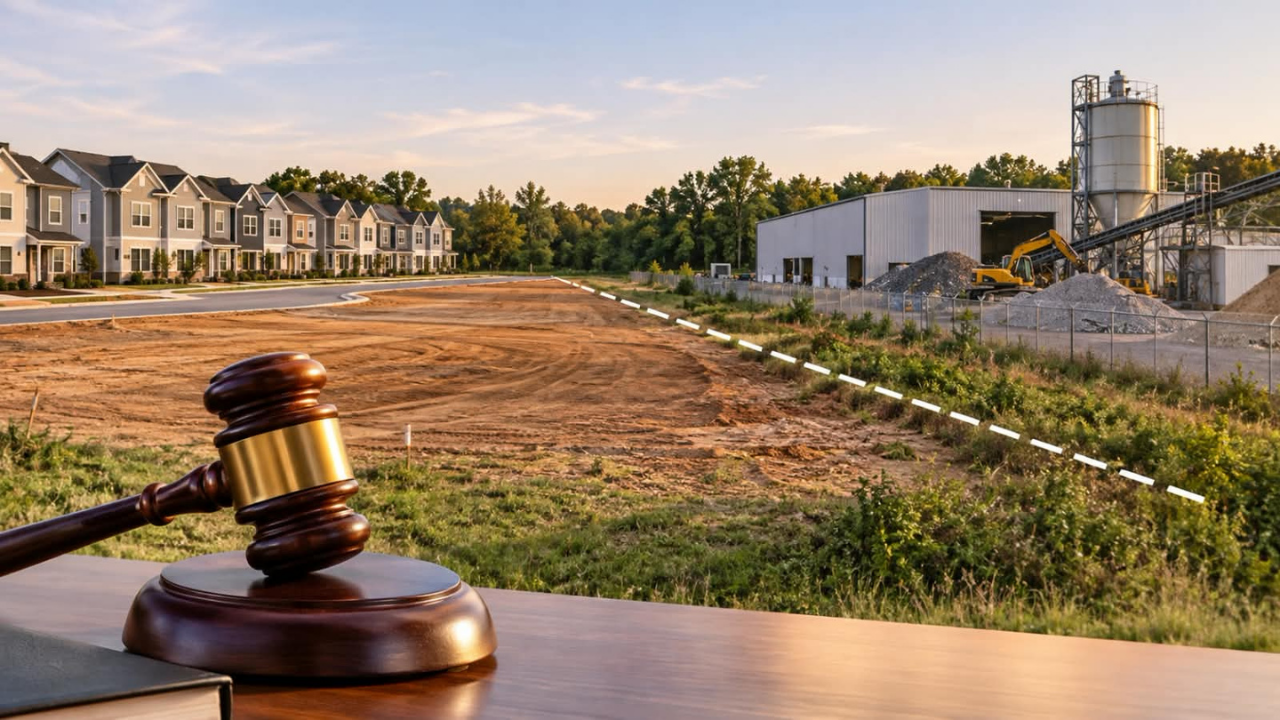
That is the first thing you notice when you stand on a plot of cleared red clay in suburban Georgia, holding a rolled-up set of architectural blueprints while the wind whistles through pine scrub that used to be a forest. You can almost hear the screen doors slamming. You can picture the cul-de-sac chalk drawings, the Saturday morning lawnmowers, the smell of charcoal lighter fluid drifting over cedar fences. Ninety-seven townhomes are supposed to rise right here, each one a brick-and-mortar promise of starter-home equity, good school districts, and quiet evenings on a back deck.
Except right now, there is no drywall. There are no driveways. There are only wooden stakes tied with faded pink surveyor’s tape, flapping weakly against the breeze.
And just across the property line, the trucks are already gearing up to roll.
A recent ruling out of the Georgia courts just delivered a gut punch to every developer, city planner, and hopeful homebuyer watching how the Peach State manages its explosive growth. By upholding a permit for a waste management facility right next to a planned 97-unit townhome community, the judges drew a razor-sharp legal line in that red Georgia dirt. Their reasoning was cold, precise, and entirely rooted in the calendar: at the exact moment the waste facility filed its permit application, those 97 townhomes were still unbuilt. On paper, they did not exist.
Legally, you cannot protect a neighborhood made of air.
The Trap of the Unbuilt Dream
If you have ever walked through a model home with fresh paint stinging your nostrils, imagining where your couch would go, you understand the emotional currency of real estate. People do not buy lumber and concrete; they buy a future. Developers operate on that exact same faith, sinking millions of dollars into land acquisition, soil testing, grading, and municipal approvals years before the first concrete foundation is ever poured.
To understand how a garbage transfer station or waste processing site can legally plant its flag beside a residential community, picture a crowded movie theater. Imagine you walk up to a row of empty seats, drape your winter coat over the armrest to claim your spot, and walk out to the lobby to buy popcorn. While you are standing at the concession stand, someone sits down in your chair, tosses your coat onto the floor, and refuses to move. When you call the usher over, the usher looks at the ticket stub, looks at the person sitting in the seat, and tells you that possession is nine-tenths of the law. Your coat was just fabric. You weren't actually sitting there.
That is precisely what just happened in Georgia administrative law.
Environmental and zoning regulations across the Southeast routinely include buffer zones—mandatory distances meant to keep heavy industrial operations, landfills, and waste transfer facilities away from schools, churches, and homes. These buffers exist because living beside an industrial waste site is not merely an aesthetic annoyance. It is a daily assault on the senses: the low-frequency diesel rumble of eighteen-wheelers braking at four in the morning, the sharp, metallic tang of leachate and rotting organic matter riding the summer humidity, the dust coating porch furniture, and the persistent, gnawing anxiety about what might be seeping into the groundwater or drifting into children's bedrooms.
Yet those buffer laws share a fatal blind spot. Almost universally, they measure distance from existing residential structures.
When the waste operator submitted its paperwork to state regulators, the townhome developer had plans, dreams, and perhaps even preliminary zoning blessings—but no roofs, no plumbing, and no certificates of occupancy. To the Georgia court reviewing the challenge, the math was painfully simple. Zero houses meant zero violations of the residential buffer rule. The permit stood.
Anatomy of a Zoning Collision
Let us step inside the shoes of a hypothetical couple—we will call them Maya and David—who represent thousands of families currently hunting for an affordable foothold in metro Atlanta’s outer ring. Maya is a pediatric nurse; David manages logistics for a regional freight company. After three years of watching mortgage rates climb and starter-home inventory evaporate, they finally put a deposit down on an end-unit townhome in a brand-new development. The marketing brochure promised walking trails, pocket parks, and a ten-minute commute to the highway.
Now imagine Maya and David driving past the construction site six months later, only to see heavy excavators clearing timber fifty yards away for a commercial waste facility.
"Wait," David says, pulling his truck onto the shoulder. "Isn't there a law against putting a dump next to houses?"
There is. Unless the houses aren't finished yet.
I have spent years watching land-use battles unfold across rapidly urbanizing counties, and the emotional whiplash never gets easier to witness. You sit in fluorescent-lit county commission chambers at ten o'clock on a Tuesday night, listening to terrified residents plead with officials whose hands are tied by statutory definitions written thirty years ago. You watch small-business builders realize that the forty million dollars they borrowed to construct middle-class housing just turned into toxic debt overnight, because nobody wants to pay $380,000 for a townhome with a view of a tipping floor and a parade of garbage trucks.
It is easy to cast the waste company as a mustache-twirling villain, yet doing so misses the real machinery at work. Cities and counties are drowning in their own trash. Every new subdivision, every Amazon warehouse, every coffee shop generates tons of municipal solid waste that has to go somewhere. Waste management companies operate on razor-thin logistical margins; hauling garbage an extra twenty miles burns millions of gallons of diesel and drives up municipal collection fees for everyone. So waste operators hunt aggressively for industrially zoned parcels near major highway corridors—the exact same cheap, accessible land corridors that residential developers are snapping up to build dense townhome communities.
Two unstoppable forces of modern American growth are colliding on the exact same acreage. And right now, the permitting clock favors whoever pours concrete—or files state environmental paperwork—first.
Why Paper Plans Lose to Legal Reality
The court’s decision in Georgia exposes a terrifying vulnerability in how modern communities are built. Housing does not happen overnight. Between buying raw land and handing a buyer the keys to a finished townhome, a builder must navigate a labyrinth of environmental impact studies, stormwater runoff approvals, utility easements, sewer tap allocations, and architectural reviews. That pipeline routinely stretches two to four years.
During that entire multi-year window, the land sits in a state of legal limbo. It is no longer untouched forest, yet in the eyes of state environmental permitting agencies, it is not yet a neighborhood.
Consider what happens next in this regulatory vacuum:
- The Race to the Filing Cabinet: Industrial operators monitor county planning dockets closely. When they see a massive residential project working its way through local zoning, they know that once the first model home gets a certificate of occupancy, a statutory buffer ring will snap shut around that parcel, locking industrial uses out forever. That creates a perverse incentive to rush industrial permit applications through state agencies before the framers can swing a single hammer.
- The Split-Brain Government: Local county commissioners might enthusiastically approve a 97-townhome development because it brings property tax revenue and addresses a severe housing shortage. Meanwhile, a separate state environmental agency—operating under narrow technical criteria that ignore local comprehensive land-use plans—reviews a waste permit purely on engineering specs and current physical land conditions. The left hand of government zones for families; the right hand permits garbage next door.
- The Uninsurable Asset: Once a waste facility secures a valid state permit, challenging it in court becomes an uphill sprint through quicksand. Appellate judges rarely substitute their own policy preferences for the technical judgment of state agencies. As long as the agency followed the literal wording of the statute—checking whether houses existed on the date of filing—the courts will uphold the permit almost every time.
Look closely at the trap that creates for regular people. Buyers rarely check state environmental permit dockets before signing a pre-construction purchase contract. Real estate agents are required to disclose known material defects on the property itself, not necessarily a pending permit application three parcels away that hasn't even broken ground yet. By the time the smell hits the cul-de-sac, the closing documents have already been signed, the escrow money has cleared, and the family’s life savings are locked into a home whose resale value just plummeted.
The Invisible Stakes of Suburban Sprawl
We tend to think of zoning and administrative law as dry, bloodless paperwork meant for lawyers in gray suits. We are wrong. Land-use law is the invisible architecture of daily happiness. It determines whether your kids can ride bikes without dodging commercial dump trucks, whether you can open your bedroom windows in April without inhaling diesel exhaust, and whether the single largest financial investment of your life actually grows in value.
For decades, Georgia—and the broader Sunbelt—has sold a seductive bargain: move out to the edges of the metro area, trade a longer commute for a bigger house, and watch your community bloom around you. Millions of people took that bet. Between 2010 and 2025, suburban counties ringing Atlanta absorbed hundreds of thousands of new residents, transforming quiet agricultural crossroads into dense networks of townhomes, retail plazas, and distribution hubs.
Yet our legal guardrails never caught up to the speed of the bulldozers. When state laws define a "residence" strictly as a completed structure rather than a locally approved, permitted residential development, they leave a multi-year gap wide enough to drive a fleet of refuse haulers right through.
Some will argue the court got the law exactly right, and strictly speaking, they have a point. Judges are supposed to read statutes as written, not rewrite them out of sympathy for slow-moving builders. If a developer buys land next to an industrial corridor without securing protective buffers or acquiring surrounding parcels, shouldn't that developer bear the financial risk? Free-market purists will tell you that buyer beware applies just as much to corporate homebuilders as it does to used-car shoppers.
Fair enough. Businesses take risks and sometimes lose.
Except developers do not live in those 97 townhomes. Once the units are finished, sold, and occupied, the developer packs up the sales trailer and moves on to the next county. The people left behind are the schoolteachers, the retirees, the young couples stretching every paycheck to afford their first mortgage, and the toddlers learning to walk on strips of sod thirty yards from a waste transfer wall. They did not gamble on regulatory loopholes. They trusted that a neighborhood approved by their local government would actually be protected like a neighborhood.
Rewriting the Rules Before the Concrete Pours
If this Georgia ruling teaches anything, it is that waiting for the courts to rescue unbuilt neighborhoods is a losing strategy. Judges apply the law on the books; if the books are broken, only lawmakers, local planners, and vigilant buyers can fix them.
State legislatures across the South face a clear choice. They can amend environmental and industrial permitting statutes so that residential buffer zones attach the moment a residential subdivision receives final local zoning approval and land-disturbance permits—not years later when the final shingle is nailed down. Tying buffers to approved development plans rather than completed roofs aligns state environmental permitting with local community planning, ending the absurd spectacle of state agencies approving heavy waste sites inside freshly zoned residential districts.
Until legislatures close that loophole, local governments hold more power than they often realize. County commissions can require mandatory industrial buffer overlays around approved residential master plans, or impose strict conditional-use restrictions on truck routing, operating hours, and enclosed tipping floors for any waste facility seeking local business licenses near planned housing.
And for anyone thinking about buying pre-construction real estate in a booming suburb, this case is a flashing red warning light. Never fall in love with a watercolor rendering in a sales office without pulling up the county’s GIS zoning map first. Look past the property line of your future neighborhood. Check the zoning of every vacant parcel within a half-mile radius. If the land across the creek is zoned heavy industrial or agricultural-industrial, assume the loudest, smellier allowable use under that code will eventually be built there—because the law will not protect your unbuilt house from it.
Stand back on that windswept patch of Georgia red clay for one more second. Look at those pink surveyor ribbons fluttering in the dirt, marking out ninety-seven front doors that do not exist yet, ninety-seven kitchen tables where families will one day argue over homework and celebrate birthdays. Right now, in the eyes of the law, that ground is empty.
Soon, the framing crews will arrive, the walls will go up, and families will carry cardboard boxes across those thresholds—only to discover that while their homes were still invisible on paper, their future had already been signed away next door.