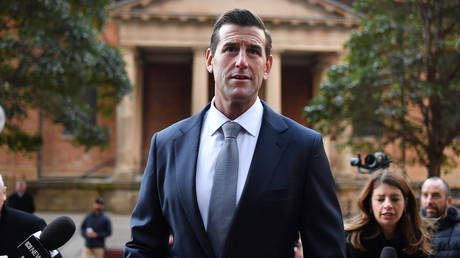
The medal is heavy. It is made of bronze or silver or gold, but its real weight comes from the stories we tell about it. When it hangs around a man’s neck, we stop seeing the man. We see a symbol. We see the embodiment of a nation’s courage, a walking shield that kept the darkness at bay while the rest of us slept in our soft, quiet beds.
But what happens when the shield cracks?
In the heart of a country currently tearing itself at the seams, there is a man whose name was once a shorthand for salvation. Let’s call him the Commander. For years, his face was the one you wanted to see on the evening news. He was the strategist who turned a losing tide, the soldier who stayed in the trenches when the politicians fled to their villas. To half the population, he is a saint in fatigues. To the other half, he is now something else entirely: a ghost haunting the conscience of a democracy.
The transformation didn't happen overnight. It leaked out in whispers, then in court documents, then in the cold, unblinking eye of cell phone footage. Accusations of "necessary" brutalities. Orders given in the heat of a blurred morning that resulted in the deaths of those who were never supposed to be targets. The war hero is being tried as a war criminal.
This isn't just a legal proceeding. It is a mirror. And the country is screaming because it doesn't like what it sees.
The Myth of the Untouchable
We have a desperate human need to believe that our protectors are fundamentally different from us. We want them to be purer, stronger, and governed by a moral compass that never jitters. We trade their humanity for our security. This is the unspoken contract of every society that sends its young to fight.
When the Commander sat in the dock for the first time, he didn't look like a monster. He looked like a grandfather who had forgotten where he parked his car. He wore a suit that fit him poorly, a stark contrast to the crisp, decorated uniforms of his past. The dissonance was the point. The prosecution saw a man hiding behind his age to escape the blood on his hands. The defense saw a patriot being sacrificed on the altar of modern sensitivity.
Statistics tell us that in polarized nations, over 70% of the populace will decide on a verdict before a single piece of evidence is presented. They aren't looking at the facts of the case; they are looking at their own identity. If the Commander is guilty, then the war was wrong. If the war was wrong, then the sacrifices made by every family in the country were for nothing.
The stakes are no longer about one man’s freedom. They are about the validity of a national soul.
The Dinner Table Divide
Consider a hypothetical family in the capital. Let’s call them the Aris. The father, Elias, fought under the Commander thirty years ago. He remembers the smell of cordite and the way the Commander’s voice stayed steady when the radio was screaming with reports of an ambush. To Elias, the trial is a betrayal. It is a "spit in the face" of every man who bled in the mud.
His daughter, Maya, belongs to a different era. She sees the world through the lens of international law and universal human rights. She sees the grainy footage of the village that the Commander’s unit "cleared," and she sees children who look like her own.
They don’t talk anymore.
The silence between Elias and Maya is the same silence that has settled over the parliament, the town squares, and the coffee shops. The country has stopped being a collective and has become two warring interpretations of history. One side believes that survival justifies any means. The other believes that if you lose your morality in the pursuit of survival, you have already lost the war.
This is the hidden cost of the hero narrative. When we build a person into a pillar of the state, the state collapses when that pillar is found to be hollow.
The Anatomy of a Blurred Line
War is not a laboratory. It is a chaotic, sensory-overloaded hellscape where the prefrontal cortex—the part of the brain responsible for logic and long-term planning—often shuts down in favor of the amygdala’s fight-or-flight response.
Think of it as a biological short-circuit.
In the courtroom, lawyers spend hours dissecting a three-second decision. They use high-definition slow-motion to analyze a movement made in a cloud of smoke and adrenaline. This is where the legal reality and the lived reality of combat diverge.
The prosecution points to the "Rules of Engagement." They are printed on laminated cards, neat and orderly. But the Commander’s defense argues that those cards don't account for the sniper in the window or the three days without sleep. They argue that "war crime" is a term invented by people who have never had to decide who lives and who dies in the space of a heartbeat.
Yet, the law must be blind. If we allow the "fog of war" to excuse every atrocity, we admit that we are no better than the chaos we claim to fight. This is the paradox that is breaking the country’s politics in half. To acquit is to endorse cruelty. To convict is to criminalize the very act of defense.
The Weaponization of Memory
Politicians are not known for letting a good crisis go to waste. In this fractured landscape, the Commander has become a pawn for both the far-right and the radical left.
The populists use his face on posters, casting him as a victim of a "globalist elite" that wants to weaken the nation’s borders. They don't care about the man; they care about the anger he generates. On the other side, activists use him as a symbol of systemic rot, demanding not just his head, but the dismantling of the entire military structure.
Lost in the noise is the truth of what actually happened on that Tuesday in the mountains fifteen years ago.
The truth is usually messy. It usually involves a man who was both brave and brittle. A man who saved a hundred lives in the morning and destroyed ten in the afternoon. We don’t like that story. We want the movie version. We want the hero or the villain. We are allergic to the gray.
The Weight of the Verdict
As the trial reaches its crescendo, the streets are lined with protesters. Some carry candles; others carry bricks.
The judges are in an impossible position. If they follow the letter of the law and find the Commander guilty based on the evidence of civilian casualties, they risk a civil uprising. If they find him innocent to preserve the peace, they destroy the credibility of the judicial system for a generation.
This is what it looks like when a country’s past catches up to its present. It is the sound of a thousand arguments happening at once, none of them actually listening to the other.
I remember talking to a veteran who had served in a similar conflict. He sat on his porch, his hands shaking slightly as he lit a cigarette. He didn't want to talk about the Commander. He wanted to talk about the dreams.
"The problem," he said, "is that the people judging don't understand that when you're there, you're not a hero or a criminal. You're just a person trying not to disappear."
We have forgotten how to see the "just a person" part. We are too busy looking for the symbol.
The Commander sits in his chair, his eyes fixed on a spot on the wall. He is a man who was once a god, now reduced to a file number. Whatever the verdict is, it won't heal the rift. It won't bring back the villagers, and it won't restore the innocence of the soldiers who followed his orders.
The medal is still heavy. It’s just that now, we can see the rust.
The judge raises the gavel. The room goes silent, but outside, the shouting is just beginning. The sun sets over a city that no longer knows how to tell its own story, leaving only the long, distorted shadows of a man who was once a shield and is now a sword turned inward.