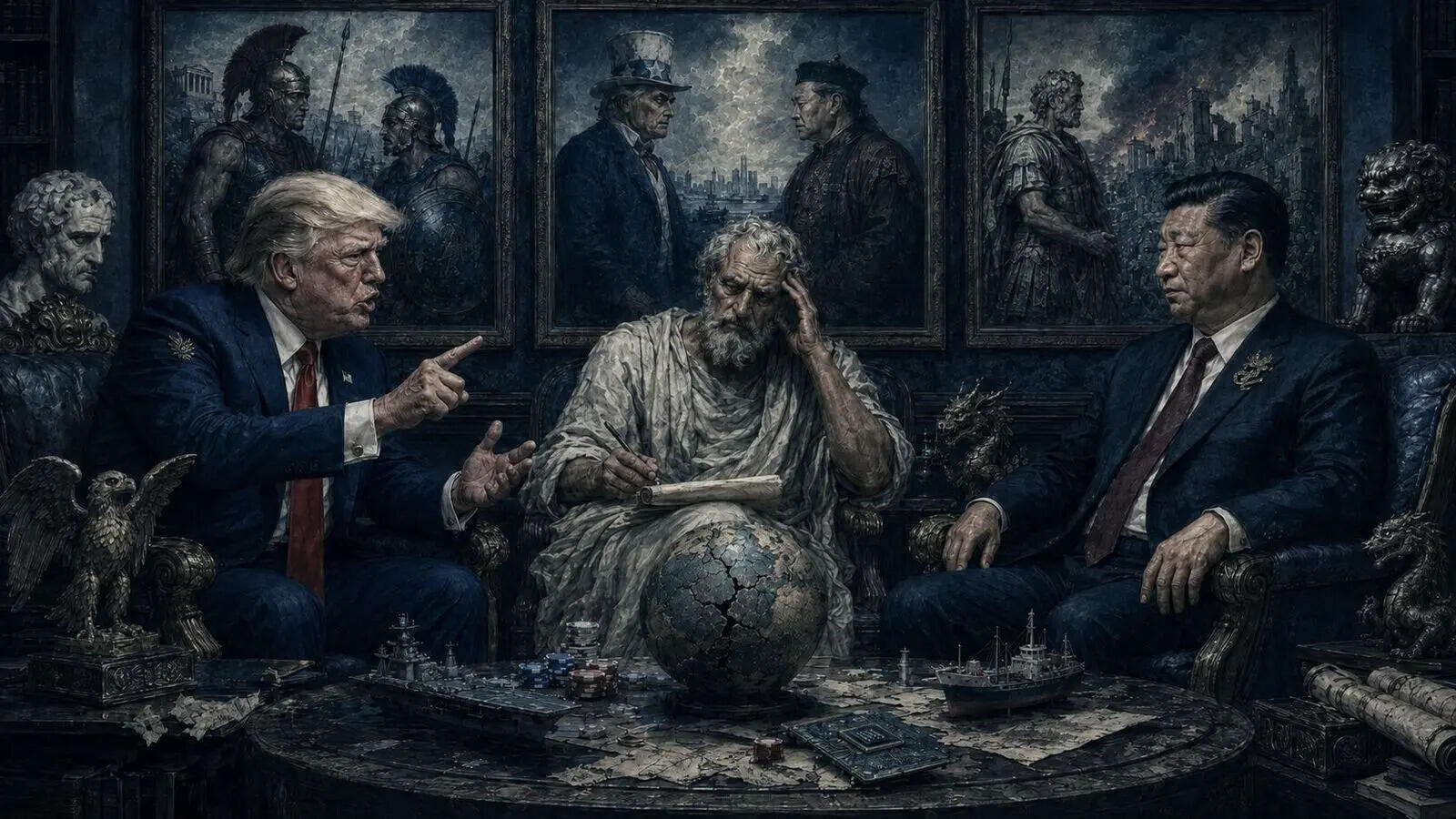
In a dimly lit corner of a Harvard faculty club, or perhaps a sterile briefing room in Beijing, the same word hangs in the air like a thick, suffocating fog. Thucydides. It sounds academic. It sounds safe. It evokes images of marble busts and crumbling scrolls from 2,500 years ago. But for the diplomats and generals currently staring across the Pacific at one another, this Greek historian is less a scholarly interest and more a recurring nightmare.
The "Thucydides Trap" describes a terrifyingly simple pattern: when a rising power threatens to displace an established one, the result is almost always blood. Of the sixteen times this has happened in the last five centuries, twelve ended in catastrophic war. On paper, the United States and China are the quintessential case study. One is the incumbent giant, the architect of the current global order. The other is the relentless challenger, reclaiming a status it held for millennia before a "century of humiliation" briefly knocked it off its feet. Meanwhile, you can read similar developments here: Strategic Impasse The Mechanics of the Lebanon Israel Attrition Cycle.
But the real danger isn't that we are fated to repeat the Peloponnesian War. The real danger is that we are so obsessed with the "Trap" that we are missing the far more likely, and perhaps more insidious, path to ruin.
The Mechanic in the Machine
Consider a hypothetical woman named Chen. She works in a high-precision semiconductor plant in Suzhou. She doesn’t think about Greek history. She thinks about the mortgage on her apartment and the cost of her daughter’s English lessons. Across the ocean, consider a man named Mark in a logistics hub in Ohio. He doesn't care about the hegemony of the dollar. He cares about why the cost of shipping a container has tripled and why the "Made in China" labels on his shelves are being replaced by "Made in Vietnam" or "Made in Mexico." To understand the full picture, we recommend the detailed analysis by Associated Press.
For decades, the invisible thread connecting Chen and Mark was the ultimate insurance policy against war. It was the "Gold Arches Theory" on steroids. We were told that two countries with a McDonald's would never fight. Then we were told that two countries whose supply chains were so deeply intertwined that they shared a nervous system would never fight.
The logic was sound: why would you shoot your customer? Why would you bomb your factory?
Yet, as we move deeper into the 2020s, that thread is being systematically frayed. It isn’t a sudden snap. It’s a slow, deliberate unspooling. When the U.S. restricts the sale of high-end chips, Chen’s factory loses its edge. When China subsidizes its own electric vehicle industry to the point of global dominance, Mark’s local manufacturing dreams feel like a fool’s errand. This isn't just "business." This is the weaponization of the everyday.
The Trap is a Choice
The problem with the Thucydides Trap is that it suggests inevitability. It treats nations like tectonic plates—massive, mindless slabs of rock destined to grind against each other until the pressure triggers a quake.
History disagrees.
Take the relationship between the United States and Great Britain at the dawn of the 20th century. Britain was the aging lion; America was the hungry young wolf. By every metric of Thucydides, they should have burned the world down to decide who sat on the throne. They didn't. They managed a "Great Rapprochement" because they shared values, language, and a mutual enemy in Imperial Germany.
The U.S. and China share none of those things. They don't have a common language of governance, and they certainly don't share a common enemy—unless you count the looming specter of climate change, which currently feels more like a bargaining chip than a unifying threat.
Instead of a trap, we are dealing with a drift. It is the steady accumulation of small, seemingly rational grievances that eventually create an irrational reality. It starts with a balloon drifting over Montana. It moves to a naval "close call" in the South China Sea. It hardens with a trade tariff on steel or solar panels. Individually, these events are manageable. Collectively, they build a psychological wall that makes cooperation look like treason.
The Warning We Are Ignoring
If the Thucydides Trap is the headline, the "Sleeper Effect" is the subtext. History’s most chilling warning isn't that rising powers fight; it's that wars often start because of a massive miscalculation about how long a conflict will last.
In 1914, the boys were supposed to be home by Christmas. In 1941, the Japanese high command believed a single, decisive blow at Pearl Harbor would force a "soft" America to the negotiating table. They misread the human element. They forgot that once you spill blood, the cold logic of economics evaporates. It is replaced by the hot, blinding necessity of pride.
We currently live in an era of "managed competition." It’s a polite term for a cold war that hasn't found its frost yet. The danger is that both Washington and Beijing believe they can dial the tension up to 9.5 without hitting 10. They believe they can "de-risk" or "de-couple" just enough to protect themselves without causing a total systemic collapse.
This is a gambler’s fallacy.
The global economy is not a series of LEGO bricks that can be pulled apart and reassembled. It is a biological organism. When you try to perform surgery on a heart while the patient is running a marathon, things go wrong. If a conflict breaks out over Taiwan or a disputed reef, it won't be a localized skirmish. It will be a global cardiac arrest. Chen’s factory stops. Mark’s logistics hub goes dark. The smartphones in our pockets become expensive glass bricks because the software updates stop coming and the components can no longer be sourced.
The Invisible Stakes
We often talk about "interests." National interests. Strategic interests. But interests are cold. Stakes are human.
The stakes are the thirty years of poverty reduction that could be wiped out in thirty days of maritime blockades. The stakes are the scientific breakthroughs in oncology or battery tech that will never happen because American and Chinese researchers are no longer allowed to speak to one another. The stakes are the millions of students who used to bridge the gap between these cultures, now looking at each other with suspicion fueled by TikTok algorithms and state-run news cycles.
The Thucydides Trap assumes that the leaders at the top are the only ones who matter. It assumes that if Xi Jinping and Joe Biden (or his successor) can just have a productive enough dinner, the ship will right itself.
But leadership is often a hostage to the environment it creates. When you spend years telling your population that the other side is an existential threat to your way of life, you lose the political capital required to be reasonable. You become a prisoner of your own rhetoric. You can’t back down because backing down looks like a betrayal of the national soul.
The Quiet Reality of the Third Way
There is a persistent myth that we are heading toward a bipolar world—a repeat of the U.S.-Soviet standoff. This is a misunderstanding of the modern map.
The Soviet Union was a closed loop. You could live your entire life in Moscow without ever touching an American product. That is impossible today. Even the most hawkish strategist in the Pentagon is wearing clothes made with Chinese textiles, and the most nationalist official in the Zhongnanhai is likely using a computer architecture designed in California.
Because of this, the "Trap" looks different. It doesn't look like a sudden invasion. It looks like a slow, painful degradation of the quality of life for everyone involved. It looks like "Fortress Economics," where every country tries to build everything itself, resulting in products that are twice as expensive and half as good. It looks like a world where the biggest problems—pandemics, AI safety, ocean acidification—go ignored because we are too busy counting how many missiles the other side has.
We aren't falling into a trap. We are walking into a maze.
In a trap, the exit is closed. In a maze, the exit exists, but it requires a level of patience and humility that is currently out of fashion. It requires admitting that "winning" is a 20th-century concept that doesn't apply to a world where our fates are fundamentally fused.
The Greek historian Thucydides wrote his masterpiece so that the future would not have to repeat the mistakes of the past. He didn't write a script; he wrote a warning. He wanted us to see the moment when fear starts to outweigh interest, and when "honor" starts to look like suicide.
If we want to avoid the trap, we have to stop looking at the map of the South China Sea and start looking at the people like Chen and Mark. We have to realize that the most powerful weapon in the world isn't a hypersonic missile. It’s the simple, boring, daily act of trade—the quiet, unglamorous reality that we are more useful to each other alive and prosperous than dead and "victorious."
The ghost of the Peloponnesian War isn't whispering that war is coming. It’s whispering that war is a choice, and it’s a choice we make every time we decide that the "other" is a monster instead of a neighbor.
The tragedy of the trap isn't the fall. It's the belief that there was never a way to stay standing.