The desert keeps its secrets under a hard, white crust. For ninety years, the town of St. Thomas, Nevada, existed only in yellowed photographs and the faded memories of children who grew up to become old men. It sat at the bottom of Lake Mead, buried beneath a hundred feet of cold, murky water. Fish swam through abandoned schoolrooms. Silt settled over the floorboards where families once ate dinner.
Then the water began to recede.
Step by step, foot by agonizing foot, the shoreline shrank. What was once a deep reservoir, engineered to feed the thirsty expansion of the American Southwest, started revealing its own drowning. Today, the ruins of St. Thomas are back in the sunlight.
To stand among those crumbling brick walls is to witness a strange kind of resurrection. The mortar is cracked and bleached by the harsh Mojave sun. Rusted iron bedframes poke through the dust. It looks less like an archaeological site and more like a crime scene where the victim has suddenly crawled out of the earth.
History tells us that St. Thomas was founded in 1865 by Mormon pioneers who thought they were building a permanent home in the Muddy River valley. They planted cotton, figs, and vineyards. They built stone houses and a brick schoolhouse. They wrestled a living out of the stubborn dust.
They did not know that decades later, a monstrous wall of concrete would rise miles downriver.
When Hoover Dam was completed in the 1930s, it created Lake Mead. The federal government gave the residents of St. Thomas very little choice. Pack what you can carry. Leave the rest. In 1938, the last resident, a man named Louis Bonelli, rowed away from his sinking hometown in a small boat. He looked back and watched the water swallow his front porch.
For nearly a century, that was the end of the story. Progress required a sacrifice, and St. Thomas was the price paid to light up Las Vegas and water the fields of California.
Climate change and relentless over-allocation changed the math.
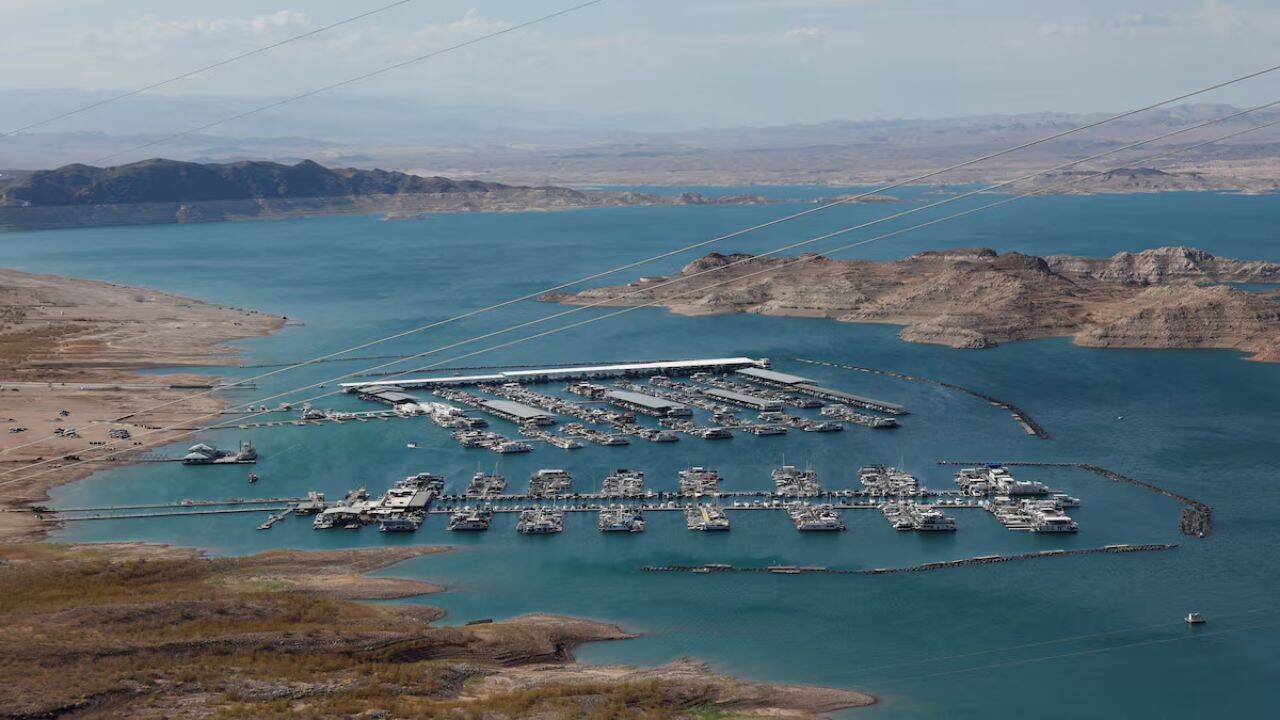
The bathtub ring is no longer just a metaphor. It is a blinding white scar etched into the canyon walls around Lake Mead, marking the historic high-water mark from decades ago. As prolonged drought chokes the Colorado River basin, the lake level has plummeted to historic lows.
Panic follows the waterline down.
When you walk through the ruins of St. Thomas now, you are not just looking at antique bricks. You are reading a warning written in stone and dirt. Every exposed foundation, every rusted Model A chassis, every broken bottle of patent medicine tells a story of human hubris meeting natural limits. We built an empire of air conditioning and green lawns in a place meant for lizards and creosote bushes, assuming the water would always be there to bail us out.
The mathematics of the Colorado River are unforgiving. More water is drawn out than nature puts back in. The reservoirs do not refill the way they used to. Every summer brings another wave of scorching heat that bakes the remaining moisture straight out of the soil.
St. Thomas is just the beginning. As the lake shrinks further, other ghosts are emerging from the deep. Boats that sank decades ago are surfacing. Marinas have had to be moved miles out into the shrinking basin. Intake valves that pull drinking water for millions of people are creeping closer to the surface.
Yet, tourists pull their cars off the gravel road to walk among the ruins. They take selfies next to the chimney of the old post office. They treat a tragedy as a roadside attraction.
They should be terrified.
Consider what happens when the water disappears entirely. The West was built on a legal agreement drafted in a wet century, promising more water than the river actually possesses. We treated a finite resource as an infinite inheritance. Now, the check is clearing, and the balance is overdrawn.
The residents of St. Thomas packed their wagons and left because they had no say in the matter. They were the casualties of a booming young nation that believed engineering could conquer geography.
We do not have that excuse. We can see the lake bed. We can read the gauges. We know precisely how many gallons are left in the tank.
When the wind blows across the dry flats of what used to be a bustling lake, it picks up fine silt and carries it toward the glittering neon of the valley below. It smells of old mud and dried salt. It is the breath of a town that refused to stay buried, whispering a warning to a world that refuses to listen.
:max_bytes(150000):strip_icc()/ar-American-Cheese-taste-test-horizon-4x3-54cc339550cd44b9a818c17bdfd5428d.jpg)