Cold.
That is the first thing you remember about winter in Hyesan, a border town pressed against the frozen Yalu River in northern North Korea. Not the crisp, invigorating chill of a ski resort, and not the manageable frost of a suburban driveway, but a marrow-deep, inescapable cold that seeps through cracked concrete walls, turns breath into stiff crystals on thin cotton blankets, and makes hunger feel like a physical blade twisting beneath your ribs. If you enjoyed this article, you should check out: this related article.
In a hypothetical kitchen in South Korea today—let us call the woman sitting at the table Mina, a composite drawn from dozens of real testimonies gathered from North Korean defectors in Seoul—the radiators hum softly, keeping the room at a steady seventy-two degrees. Mina is peeling a tangerine, the bright citrus oil misting the air, while a tablet rests against a mug of barley tea. On the screen, a high-definition photograph freezes a moment from a military parade in Pyongyang.
In the center of the frame stands Kim Jong Un. Beside him, holding his hand or standing a half-step forward in a tailored white winter coat, is a girl barely into her teens. Her cheeks are full. Her hair is pinned neatly back. Behind her, row after row of decorated generals—men in their seventies whose chests sag under the weight of brass medals—lean forward, clapping with frantic, synchronized devotion. For another perspective on this event, refer to the recent update from USA Today.
Mina stops peeling the fruit. Her thumb presses slightly too hard into the rind, releasing a sharp burst of juice. She does not see a teenager. She does not see a family portrait.
She sees a deity in training.
To understand why thousands of North Koreans who risked drowning in icy rivers or being shot by border guards look at Kim Ju Ae and see the undisputed fourth-generation ruler of a nuclear-armed state, you have to strip away every Western assumption about politics, succession, and childhood. In Washington, Seoul, and Tokyo, intelligence analysts debate whether a patriarchal Confucian society will accept a female supreme leader, or whether an older, unseen son waits in the wings. Those debates miss the visceral truth of how power actually operates inside the Hermit Kingdom.
Inside North Korea, the Kim family is not a political dynasty. They are not presidents, prime ministers, or even ordinary monarchs. As defectors repeatedly explain when pressed to translate the psychological reality of their former lives, the rulers of the Mount Paektu bloodline exist in a category entirely their own—like gods reigning over humans.
The Architecture of Divine Blood
When you grow up in a system where every room contains two portraits—and later three—that must be dusted with a special cloth kept solely for that purpose, reverence is not an opinion you hold. It is the oxygen you breathe. If a house catches fire, the law and the culture demand that you rescue the portraits of Kim Il Sung and Kim Jong Il before you save your own children. People have died doing exactly that, and their names are printed in the state newspaper as saints.
This is the theology of the Paektu bloodline, named after the volcanic peak straddling the Chinese border where state mythology claims Kim Jong Il was born beneath a double rainbow and a bright new star. In reality, Soviet records show he was born in a guerrilla camp in Siberia, a mundane fact scrubbed clean by decades of state hagiography. Truth in Pyongyang is whatever the bloodline decrees it to be.
For years, Western observers assumed that this divine mandate carried a strict gender requirement. North Korean society is deeply traditional, burdened by rigid expectations for women both at home and in the workplace. Yet when we look closely at how defectors interpret the rise of Kim Ju Ae—whose name was first revealed to the outside world not by a spy satellite, but by former NBA star Dennis Rodman after a 2013 visit to Pyongyang—a very different logic emerges.
Blood overrides gender. Every single time.
Consider the precedent already sitting at Kim Jong Un’s right hand: his younger sister, Kim Yo Jong. For years, she has insulted foreign heads of state, threatened nuclear retaliation, and ordered the demolition of inter-Korean liaison offices, all while graying four-star generals bowed low in her presence. Nobody in Pyongyang whispered that a woman had no business barking orders at the Korean People's Army. She carries the sacred blood of Kim Il Sung in her veins, and in the cosmology of the regime, that makes her superior to any mortal man, regardless of his rank or age.
Mina, our composite defector in Seoul, remembers the exact moment she understood this hierarchy as a child. During a neighborhood lecture session, an elderly war veteran—a man who had lost a leg fighting American troops in 1951—was brought in to speak to the schoolchildren. When the speaker mentioned the General's name, his voice cracked, and he bowed toward the portrait on the wall with the terrified humility of a peasant begging a thunder god for rain. Even then, watching a crippled hero abase himself before a painting, Mina realized that age, sacrifice, and masculinity meant nothing against the bloodline.
Now, apply that same psychological conditioning to the images broadcasting out of Pyongyang since November 2022.
The Theater of the Missile Launch
Before November 18, 2022, Kim Ju Ae was a ghost. Citizens inside North Korea did not even know Kim Jong Un had children, just as they had no idea Kim Jong Un himself existed until roughly a year before he took power in 2011. Secrecy had always been the regime's preferred armor for its heirs.
Then came the test of the Hwasong-17 intercontinental ballistic missile.
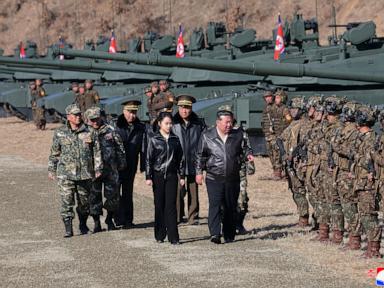
State media released photographs that sent shockwaves through intelligence agencies worldwide. There was the Supreme Leader, walking across the tarmac beside a massive, multi-wheeled transporter-erector-launcher carrying a missile capable of reaching the continental United States. Holding his hand was a young girl in a puffy white jacket and red shoes.
If you view that photograph through the lens of a Western politician taking his daughter to work, it looks like a bizarre attempt at softening a dictator's image. To a North Korean citizen—and to the defectors who know the exact grammar of Pyongyang’s propaganda—it was an earthquake.
Nothing in Rodong Sinmun, the ruling party's official newspaper, happens by accident. Every pixel is vetted. Every camera angle is a policy directive. Putting a child in front of the regime's ultimate nuclear weapon was not a casual family outing; it was a liturgical fusion of the nation's two most sacred pillars: the nuclear deterrent and the fourth generation of the Paektu bloodline.
Look at the language state media immediately adopted to describe her. First, she was called Kim Jong Un’s "beloved" child. Within months, the adjectives escalated with terrifying speed. She became his "most beloved" child, then his "respected" child—an honorific previously reserved exclusively for the Supreme Leader himself. By early 2024, state media used the Korean word hyangdo—meaning "great person of guidance"—a term historically applied only to top leaders and designated successors.
Let us pause on that word. In North Korean political vocabulary, hyangdo is not a compliment. It is a coronation.
Think of the regime like an ancient clockwork mechanism sealed inside a glass box. You cannot hear the gears grinding, and you cannot interview the clockmaker. The only way to tell what time it is inside the box is to watch which painted figure emerges from the little wooden doors at the top of the hour. When the figure holding the golden scepter steps out onto the balcony, you do not need a press release to know who runs the clock.
Defectors watching from South Korea saw the wooden doors swing open, and they recognized the choreography instantly.
Why Kim Jong Un Is Moving Early
Why now? Why parade a girl who is roughly thirteen years old—born around 2013—before artillery units, naval commanders, and aerospace engineers while her father is still in his early forties?
The answer lies in the trauma of Kim Jong Un’s own succession.
When Kim Jong Il suffered a massive stroke in August 2008, the regime plunged into a quiet panic. He had waited too long to anoint a successor. Kim Jong Un was in his mid-twenties, virtually unknown to the military elite, and lacking the decades of institutional apprenticeship his father had enjoyed under Kim Il Sung. When Kim Jong Il finally died in December 2011, the young heir had to consolidate power through brutal, rapid-fire purges—including the execution of his own uncle, Jang Song Thaek, who was dragged out of a Politburo meeting in front of television cameras, and the nerve-agent assassination of his half-brother, Kim Jong Nam, in a crowded Malaysian airport terminal.
Kim Jong Un knows better than anyone alive how fragile an unprepared throne can be.
And there is another, quieter variable that haunts every absolute dictatorship: health. Kim Jong Un is visibly overweight, chainsmokes, drinks heavily, and carries a family history riddled with fatal cardiovascular disease. Both his father and his grandfather died of heart attacks. Every time he disappears from public view for three weeks, global markets twitch and intelligence agencies scramble to check satellite imagery of his private hospital train.
By introducing Ju Ae now, while she is still a child and he is still firmly in command, he solves the exact vulnerability that nearly doomed him in 2011. He is giving the military brass a decade or more to internalize the sight of her. He is forcing seventy-year-old generals to kneel beside her, clap for her, and place her image in their subconscious long before she ever has to issue an execution order.
South Korea's National Intelligence Service has reached a similar assessment, briefing lawmakers in Seoul that Ju Ae is currently being treated as the most likely successor, even as analysts note that Pyongyang retains the flexibility to pivot if circumstances change. Yet among the defector community—people who actually lived inside the psychological pressure cooker of North Korean indoctrination—there is far less hedging.
To them, you do not elevate a child to the status of a living god in front of twenty-six million people and then casually put her back in a box. Once the aura of divinity is placed upon her shoulders, removing it would suggest the Supreme Leader made a mistake—and in North Korea, gods do not make mistakes.
The Invisible Stakes for Twenty-Six Million Lives
It is easy, sitting thousands of miles away, to treat the rise of Kim Ju Ae as a surreal piece of geopolitical theater. We look at the matching leather trench coats worn by father and daughter at missile tests, or the postage stamps bearing her likeness, and the mind reaches for dark satire.
That impulse is understandable, and it is profoundly dangerous.
Behind the pageantry of those photographs is a brutal, suffocating reality that shapes every waking second for twenty-six million human beings. When defectors look at Ju Ae’s rosy cheeks and luxurious coats, they cannot help contrasting her silhouette against the memories of their own childhoods—the stunted growth from chronic malnutrition, the scavenging for wild grass in the spring when winter grain rations ran out, the fear of saying a single careless word that could send three generations of a family into a political prison camp.
For those living inside the country, the message of Ju Ae’s public emergence is devastating in its clarity: There is no end to this.
Think about what happens to the human spirit when an authoritarian regime reveals its fourth generation. During the horrific famine of the 1990s—known euphemistically as the Arduous March, which killed hundreds of thousands, and by some estimates over a million, North Koreans—many ordinary citizens survived on a silent, forbidden hope. They whispered behind closed doors that the system was too broken to last, that after Kim Jong Il died, things might finally open up, borders might soften, and life might become bearable.
Then came Kim Jong Un, who briefly studied in Switzerland as a teenager, sparking naive hopes abroad and quiet prayers at home that a Western-educated leader might bring reform. Instead, he sealed the borders tighter than ever, built a forest of nuclear missiles, crushed private markets, and made defecting to South Korea nearly impossible.
Now, standing beside him on the review stand is a girl born in the twenty-first century. If she takes the throne in her twenties or thirties and rules into old age, the Kim dynasty will stretch well past the year 2080. A child born in Pyongyang today could live an entire lifetime, grow old, and die without ever knowing a world where the Paektu bloodline did not own their body, their thoughts, and their future.
The Question of the Unseen Brother
Still, honesty requires us to admit what we do not know. Intelligence gathering inside North Korea is notoriously difficult—a frustrating puzzle where analysts peer through a keyhole into a darkened room.
For years, South Korean intelligence believed Kim Jong Un’s firstborn child was a boy, born around 2010, based on fragmentary intercepts and accounts from visitors. Yet no boy has ever appeared in public. Not a single photograph. Not a single mention in state media. Some analysts wonder if an older son exists at all, or if he suffers from health issues that make him unsuitable for the ruthless demands of leadership. Others speculate that Kim Jong Un simply sees a sharper, more disciplined reflection of himself in his daughter.
In photographs from banquets and military inspections, Ju Ae does not shrink behind her father’s coat. She stands squarely beside him, absorbing the roar of crowds and the blinding flash of cameras with an eerie, practiced composure. At a February 2023 banquet marking the founding anniversary of the Korean People's Army, she sat in the center of the head table flanked by her parents, while top military commanders stood respectfully behind her chair.
In North Korean political iconography, spatial arrangement is everything. You do not put a spare child in the center seat while the Minister of Defense stands behind her. You put the future sovereign there.
Even the subtle shifts in protocol tell a story. In earlier appearances, Ju Ae walked slightly behind her father or held his hand like a dependent child. In more recent photographs, she walks abreast of him, sometimes even stepping half a pace ahead as they inspect troops or review new weapons systems. The visual grammar is shifting steadily from daughter of the leader to co-sovereign in waiting.
The Weight of the White Coat
Mina finishes peeling her tangerine in the warm Seoul apartment, placing the segments neatly on a ceramic plate. On the tablet screen, the video clip of the military parade loops silently. Fireworks burst over Kim Il Sung Square, illuminating the faces of tens of thousands of citizens weeping on cue, waving plastic bouquets in unison until their arms ache.
Down below, on the marble balcony, the girl in the white coat waves back.
She did not choose this life, any more than a child born into any ancient imperial house chose the crown placed upon their brow. She lives inside a gilded cage of unimaginable luxury, surrounded by Swiss watches, private yachts, and imported delicacies, while just beyond the barbed wire of Pyongyang’s perimeter, farmers still plow rocky hillsides with oxen because there is no fuel for tractors.
Yet in the unforgiving logic of North Korea, innocence is irrelevant. Once the machinery of deification begins turning, it crushes everything human inside the person it elevates, leaving behind only the symbol, the bloodline, and the terrible, absolute power over life and death.
The generals keep clapping. The crowds keep waving. And across the dark water of the Yalu River, a new god is learning how to wave back.