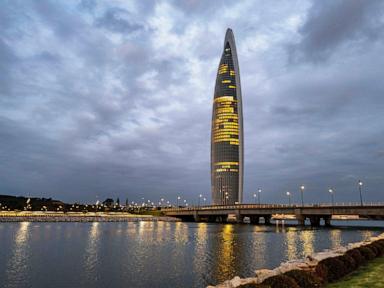
In the salt-heavy air of the Bouregreg Valley, where the Atlantic tide pushes back against the ancient stones of Rabat, something impossible has grown. It is not made of sandstone or history. It is made of $700 million, two hundred and fifty meters of steel, and the sheer force of a kingdom’s will.
Mohammed VI Tower stands alone.
To the local shopkeeper in the Salé medina, the tower is a gleaming sundial that marks the passage of a new era. To the global financier in London or Dubai, it is a vertical statement of intent. For decades, the skyline of North Africa was defined by the minarets of the past. Now, Morocco has planted a flag in the future. This is not just a building. It is a gamble on the sky.
The Architecture of Ambition
Standing at the base of the tower, you feel small. That is the point.
The structure tapers as it rises, a high-tech obelisk designed by Rafael de la Goya and Hakim Benjelloun. It is the tallest building on the continent, yet its weight feels secondary to its transparency. The glass reflects the changing moods of the Moroccan sun—burnt orange at dawn, a blinding silver at noon, and a deep, bruised purple as the sun dips into the ocean.
Inside, the stakes are physical. Imagine a businessman from Casablanca stepping into the high-speed elevator. He is here to close a deal that would have happened in Paris or Madrid ten years ago. As the floor numbers blur, the pressure in his ears shifts. He is rising above the old limitations of the Maghreb.
The tower houses fifty-five floors of luxury apartments, a boutique hotel, and high-grade office spaces. But the real commodity being traded here is confidence. By spending nearly three-quarters of a billion dollars on a single spire, Morocco is telling the world that it is no longer just a gateway to Africa. It is the destination itself.
A Bridge Built of Steel
The Bouregreg River separates the twin cities of Rabat and Salé. For centuries, this water was a barrier, a place for corsairs and fishermen. Today, the river reflects the tower's skeleton.
Consider the logistical nightmare of such a feat. The soil near the river is soft, silted, and prone to the whims of the tide. To anchor a skyscraper here, engineers had to drive piles deep into the earth, searching for a foundation that could support the weight of a nation’s pride. It required a level of technical precision rarely seen in the region.
They used high-performance concrete. They installed tuned mass dampers to counteract the wind. They wrapped the exterior in solar panels and high-tech shading to fight the African heat.
This isn't just about height. It is about proving that Moroccan craftsmanship and international capital can merge into something structural. The tower sits at the heart of the "Rabat City of Light" project, a massive urban renewal scheme that includes the stunning Grand Theatre of Rabat, designed by the late Zaha Hadid. Together, these buildings form a cultural and economic crescent.
The Invisible Stakes
Why now?
Morocco is playing a long game. The country lacks the vast oil reserves of its neighbors, so it has had to innovate. It has built the world’s largest concentrated solar power plant. It has modernized its ports. It has courted automotive giants and aerospace firms.
The Mohammed VI Tower is the capstone.
Critics might point to the cost. Seven hundred million dollars is a staggering sum in a world still recovering from global shocks. They might ask if a skyscraper can feed a family in the High Atlas mountains or improve the schools in the rural south. These are valid, heavy questions.
But the proponents of the tower argue from a different perspective. They see it as a magnet. A skyscraper of this magnitude creates a gravity well. It attracts the regional headquarters of multinational banks. It lures the kind of high-net-worth tourism that fuels luxury service industries. It creates a psychological shift.
When a young Moroccan architect looks up at that glass needle, they don't see a ceiling. They see a starting point.
The Human Element in the High-Rise
Walk through the construction site's history and you find thousands of hands. These weren't just machines. These were workers who learned how to weld at heights that make the head swim. They were engineers who spent nights recalculating wind loads.
There is a specific kind of silence at the top of a building this tall. The roar of the Rabat traffic fades into a rhythmic hum. The white houses of the city look like a spilled box of salt. From this height, the borders between the rich and the poor, the old and the new, begin to blur.
You can see the Atlantic stretching toward the Americas. You can see the road leading south toward the Sahara and the rest of the continent.
Morocco is positioning itself as the middleman of the twenty-first century. It is the bridge between Europe’s capital and Africa’s potential. The tower is the pylon holding up that bridge. It is a vertical embassy for a kingdom that refuses to be overlooked.
The Shadow and the Light
Every great monument casts a long shadow.
The success of the Mohammed VI Tower won't be measured by its occupancy rate in its first year. It will be measured by what happens around it. Will the surrounding districts thrive? Will the "City of Light" truly illuminate the lives of the average citizen?
The building is finished. The glass is polished. The lights are on.
As the sun sets, the tower begins to glow from within. It stands as a sentinel over the Bouregreg, a shimmering needle that has stitched the earth to the clouds. It is a reminder that while history is written in stone, the future is built in glass and steel, rising one floor at a time against the wind.
The tide comes in. The tide goes out. The tower remains, unyielding, watching the horizon for what comes next.