The air in Beijing has a specific weight in November. It is cold, dry, and carries the faint scent of coal smoke and history. When Donald Trump’s motorcade rolled through the gates of the Forbidden City, the silence was absolute. For centuries, this sprawling complex of timber and silk was the center of the known world, a place where emperors believed they held the mandate of heaven. On that evening, it became the stage for a high-stakes performance where the script was written in trade deficits and the subtext was written in power.
Xi Jinping did not just host a dinner. He curated an atmosphere. By clearing the tourists and the noise, he offered the American president something no other modern leader had received: a "state visit-plus." It was a gesture of profound respect, but in the world of high diplomacy, respect is often a velvet glove covering a fist of iron.
The Emperor’s Guest
The evening began with tea. Inside the Hall of embodied Benevolence, the porcelain was thin enough to be translucent. Imagine the contrast. Trump, the quintessential New York builder, a man of gold-plated towers and loud negotiations, sitting across from Xi, a man who survived the Cultural Revolution by living in a cave and now commands the world's most disciplined bureaucracy.
One man believes in the art of the deal. The other believes in the marathon of history.
As they walked through the courtyards, the scale of the architecture was meant to diminish the individual. That is the point of the Forbidden City. It tells you that you are a temporary guest in a permanent civilization. Trump, ever the performer, seemed to lean into the spectacle. He showed Xi videos of his granddaughter singing in Mandarin on a tablet. It was a human moment, a flash of grandfatherly pride that momentarily cut through the tension of a looming trade war.
But outside those walls, the math was cold. American companies were shouting about intellectual property theft. The trade deficit was a gaping wound. North Korea was testing missiles that rattled the windows of Tokyo and Seoul. The tea was warm, but the reality was freezing.
The Price of the Banquet
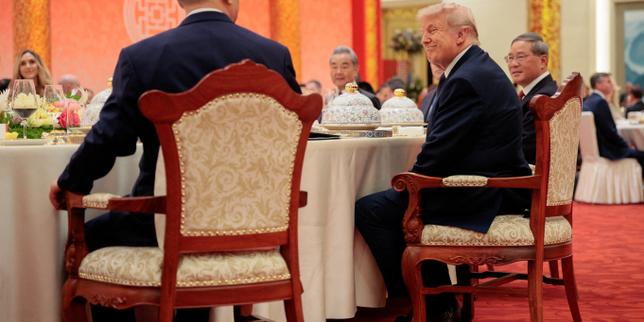
When they finally sat for the banquet in the Great Hall of the People, the room was a sea of red and gold. The menu was lavish, the toasts were soaring, and the optics were perfect. Yet, behind the smiles of the delegations, a frantic tallying was taking place.
The "gift" for the occasion was a staggering $250 billion in signed deals. Boeing planes. Soybeans. Tech components. It sounded like a victory. In the world of 24-hour news cycles, a quarter-trillion-dollar figure is a headline that wins.
But look closer at the ink. Many of these agreements were non-binding memorandums of understanding. They were promises to think about buying, rather than receipts for a sale. The Chinese are masters of the "theatrical purchase"—offering just enough economic oxygen to keep the relationship from suffocating, without changing the underlying structure of their state-run economy.
Consider the perspective of a Midwestern farmer or a Silicon Valley engineer. For them, this banquet wasn't about the shark fin soup or the vintage wine. It was about whether their livelihoods were being traded for a photo op. The invisible stakes were the rules of the road for the 21st century. Would the world follow the American model of open markets, or the Chinese model of controlled growth?
Two Suns in One Sky
The tension at the table wasn't just about money. It was about the fundamental friction of two superpowers trying to occupy the same space. Xi spoke of the "Chinese Dream," a vision of national rejuvenation that restores China to its rightful place as the dominant power in Asia. Trump spoke of "America First," a retrenchment from global police work in favor of bilateral wins.
They are two leaders who, in many ways, mirror each other. Both are nationalists. Both are skeptical of the old international order. Both view the world as a zero-sum game where for one to win, the other must lose.
During the banquet, the conversation moved to North Korea. This is the ultimate geopolitical chess match. To Trump, Kim Jong Un was a "Little Rocket Man" who needed to be contained by Chinese pressure. To Xi, the North Korean regime is a messy, dangerous, but necessary buffer that prevents US troops from sitting on the Chinese border.
As the courses were served, the gap between their worldviews remained as wide as the Pacific. No amount of Peking duck could bridge the distance between a leader who thinks in four-year election cycles and one who thinks in decades.
The Ghost at the Table
There was a third party at that dinner, though no chair was set for it: the ghost of the 19th century.
China remembers what it calls the "Century of Humiliation," when Western powers carved up its coastlines and dictated its laws. For Xi Jinping, hosting the American president in the heart of the Forbidden City was a symbolic closing of that chapter. It was a message to his own people and the world: We are no longer the students. We are the peers.
Trump, perhaps more than any previous president, sensed this shift. He didn't lecture Xi on human rights or democratic values with the same fervor as his predecessors. He treated Xi as a formidable rival, a "king" as he once called him. This was a departure from the traditional American stance of moral superiority. It was a recognition of raw power.
The Morning After
By the time the last toast was made and the motorcade sped away through the neon-lit streets of Beijing, the "plus" in the state visit began to fade. The headlines moved on. The $250 billion in deals slowly trickled down into a series of complicated disputes. The trade war didn't disappear; it intensified.
We often mistake the scenery for the substance. We see the gold leaf on the pillars and the choreographed handshakes and believe that history is being made by the sheer force of personality. But the tectonic plates of geography and economics don't care about banquets. They move according to their own internal heat.
What remained was the image of two men standing in the center of an ancient empire, each convinced he held the keys to the future. They looked at the same moon over Beijing, but they saw two different worlds.
The lights in the Forbidden City were turned off. The tourists returned the next day, snapping selfies where presidents had walked. The dragons carved into the stone steps remained silent, their eyes fixed on a horizon that has seen a thousand such dinners, and will see a thousand more, while the empires they represent rise and fall like the tide.
The true cost of the banquet wasn't the price of the food or the protocol. It was the realization that the era of easy cooperation was over. The feast was a farewell to the old world, a final, glittering mask worn by two giants before they stepped back into the ring.