Seven-thirty on a Tuesday morning in Admiralty Station feels less like a commute and more like a geological event.
Stand near the platform edge where the Island Line bleeds into the Tsuen Wan Line, and you can actually feel the floor vibrate before you hear the train. A low, sub-audible hum rises through the soles of your shoes, followed by the metallic hiss of braking bogies and the collective, rhythmic shuffle of four thousand leather soles moving in unison. Air conditioned to a crisp twenty-two degrees Celsius smells faintly of damp wool, iced lemon tea, and the ozone tang of overhead power lines. For forty-five years, this subterranean choreography has been the quiet miracle of Hong Kong—a transit network so absurdly punctual that a three-minute delay makes the evening news.
Yet behind the polished stainless-steel doors and the cheerful chime of Octopus card readers, the company that built this modern wonder is staring into a financial abyss.
MTR Corporation—the transit juggernaut that moves nearly five million passengers every weekday and exports its operational genius from London to Melbourne—recently sounded an alarm that rattled boardrooms across Asia. Even after the Hong Kong government handed the company a massive gift of prime real estate in the Northern Metropolis, MTR is warning of an impending cash crunch.
Wait. Stop and read that again.
How does a company that owns some of the most valuable air rights on Earth, runs a near-monopoly on urban rail in one of the world’s densest financial capitals, and just received a sprawling swath of government land suddenly run short of cash?
To understand this paradox, you have to forget everything you think you know about how a train company makes money. And you have to look closely at the invisible clock ticking beneath the red soil of the New Territories.
The Illusion of the Magic Money Machine
For decades, urban planners around the world studied Hong Kong’s "Rail plus Property" model with the kind of breathless envy usually reserved for Renaissance art. The formula looked like alchemy. Unlike New York’s MTA or London’s Transport for London—both perpetually begging taxpayers for bailouts—MTR turned a consistent profit without taking direct government subsidies to run its trains.
The secret was simple in theory. The government granted MTR exclusive development rights over the land above and around new railway stations at "greenfield" prices—meaning the value of the dirt before a train line existed. MTR would then partner with private property developers, build gleaming shopping malls and forty-story residential towers directly atop the tracks, and split the massive profits. Those real estate windfalls paid for the tunnels, the tracks, and the trains.
It was a self-funding perpetual motion machine. Until the physics of the city changed.
Consider a hypothetical commuter—let’s call her Mei-Ling—who boards the East Rail Line every morning from a high-rise apartment perched directly above a station in Sha Tin. Thirty years ago, when her parents bought that flat, the transaction helped fund the railway beneath her feet. Back then, property developers lined up around the block to bid on MTR sites, throwing billions of dollars in upfront cash onto the table before a single pile was driven into the ground.
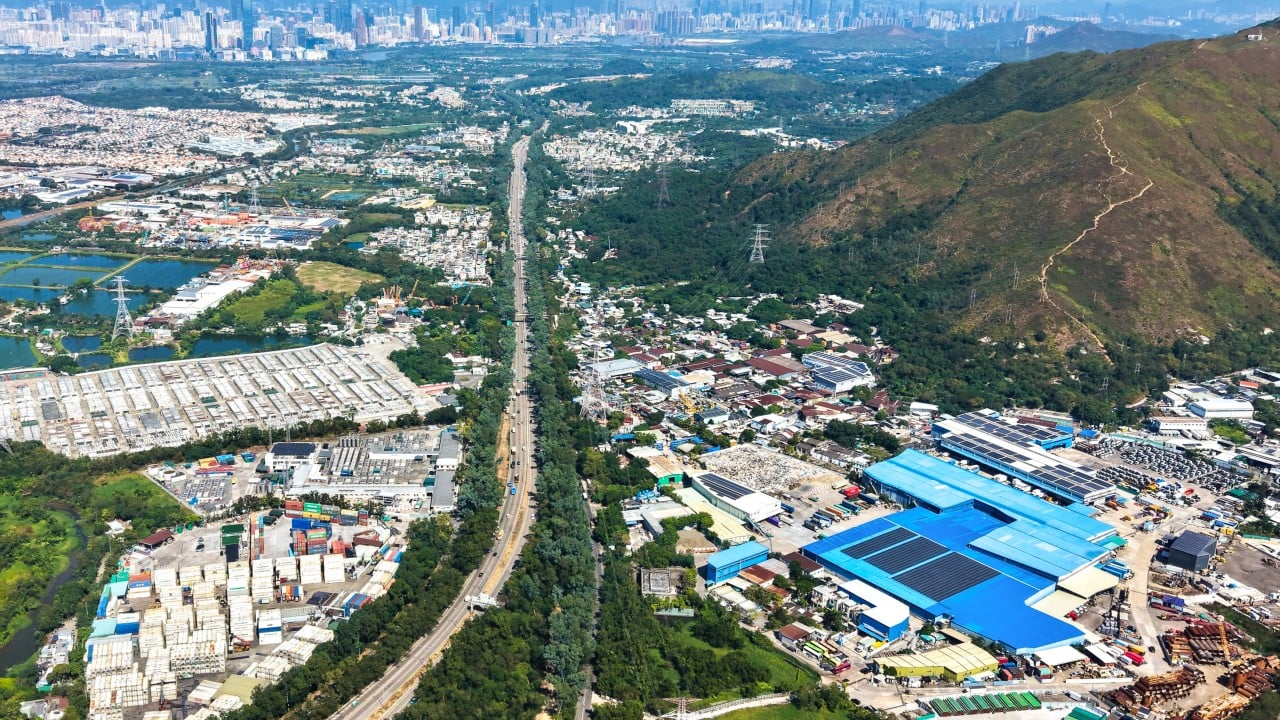
Today, if Mei-Ling looks out her train window as the carriages speed north toward the Shenzhen border, she sees the future of Hong Kong: the Northern Metropolis. Covering roughly three hundred square kilometers along the northern frontier, this megaproject is designed to house 2.5 million people and serve as an innovation hub linking Hong Kong with mainland China’s Greater Bay Area.
To connect this new city to the urban core, MTR has been tapped to build a staggering web of new infrastructure—the Northern Link, the Tung Chung Line Extension, the Tuen Mun South Extension, and the Hung Shui Kiu Station. The price tag? Over one hundred billion Hong Kong dollars—roughly thirteen billion US dollars—concentrated into a brutal, overlapping construction window over the next decade.
And to pay for it, the government handed MTR huge parcels of land in the Northern Metropolis.
On paper, it looks like the classic Hong Kong playbook. In reality, it is like handing a thirsty man a deed to a vineyard when what he desperately needs is a glass of water right now.
When Dirt Cannot Pay the Concrete Bill
Here is the brutal mechanics of the cash crunch that rarely makes it into the glossy brochures.
Building a railway requires massive, relentless upfront cash. Tunnel boring machines do not accept promissory notes. Structural steel suppliers, signaling engineers, and concrete contractors demand payment every thirty days, rain or shine, boom or bust. MTR’s capital expenditure is surging toward historic peaks, swallowing tens of billions of dollars every single year just to keep the digging on schedule.
Real estate, on the other hand, pays out in slow motion.
To turn a patch of marshland or brownfield scrub in the Northern Metropolis into cash, MTR must first clear the site, wait for government zoning approvals, conduct environmental assessments, tender the project to private developers, wait years for the towers to rise, and only then collect its share of the profits when apartments are finally sold to families.
That lag—the gaping chasm between spending cash today and harvesting property profits seven or ten years from now—is where companies bleed out.
Think of it as a household trying to renovate its entire house while simultaneously buying a farm that won't produce crops for eight summers. Even if the farm will eventually make the family rich, the contractor renovating the kitchen still wants his check on Friday. If your checking account is empty on Thursday night, the future harvest will not save you.
Worse still, the harvest itself is no longer guaranteed.
Anyone who has walked down Nathan Road or browsed property listings in Causeway Bay over the past few years knows that Hong Kong’s legendary real estate market has lost its invincibility. Higher interest rates, shifting demographics, and a sluggish economic recovery have left major property developers bruised and deeply cautious. Over the past two years, several high-profile MTR land tenders drew tepid interest—or failed to attract a single acceptable bid, forcing the rail operator to withdraw them entirely.
When developers refuse to bid, the upfront cash payments that MTR used to rely on simply evaporate. The magic money machine stalls.
The Weight of the Concrete Beneath Our Feet
I still remember standing at the edge of an active excavation pit in Kowloon a few years back, watching a crane lower a forty-ton steel reinforcement cage into a slurry wall trench sixty feet below street level. The noise was physical—a percussive roar of diesel generators, hydraulic hammers, and shouting foremen echoing off wet concrete walls. Down in the mud, workers in yellow hard hats moved like ants around machinery the size of small houses.
Seeing that scale up close changes how you view a subway map. Those neat colored lines printed above train doors are not ink; they are millions of tons of displaced granite, waterproof membranes, high-voltage substations, and ventilation shafts bored beneath skyscrapers that cannot afford to shift by a single millimeter.
And in Hong Kong, building underground has become eye-wateringly expensive.
Construction labor costs in the city rank among the highest in the world, driven by an aging workforce and strict safety protocols. Every station box must be engineered to withstand super typhoons and torrential monsoon rains that can dump half a meter of water in twenty-four hours. Even a minor geological surprise—an unmapped fault line or a pocket of decomposed granite—can add months of delay and hundreds of millions of dollars to the ledger.
Meanwhile, the trains themselves are getting older.
The core network that carries Mei-Ling to work every morning is approaching half a century of relentless daily service. Maintaining a system running at 99.9 percent reliability while upgrading signaling systems during a three-hour overnight maintenance window—between 1:30 AM and 4:30 AM, when the last drunks leave Lan Kwai Fong and the first market vendors wake up—requires billions in recurring capital just to keep the existing trains from breaking down.
MTR is effectively trying to run a marathon while carrying an anvil on each shoulder: one anvil is the aging legacy network demanding constant renewal, and the other is the thirteen-billion-dollar Northern Metropolis expansion demanding immediate cash.
Why Fare Hikes Cannot Rescue the Balance Sheet
Whenever a transit agency runs short of money, commuters brace for the inevitable: higher ticket prices.
In Hong Kong, fares are governed by a rigid, fiercely debated formula tied to inflation and wage growth, complete with an affordability cap that prevents MTR from raising prices faster than household incomes. Even when fares edge upward by a few percentage points, passenger revenues barely cover the day-to-day operational costs of running the trains—electricity, driver salaries, station cleaning, and routine maintenance.
Fares have never paid for new railways. They were never meant to.
If MTR tried to fund the Northern Metropolis through ticket prices, a single ride from Tsim Sha Tsui to Central would cost more than a sit-down lunch, emptying the carriages and strangling the very economic mobility that makes Hong Kong function.
Which leaves the company with a narrow, treacherous set of options—and every single one carries a hidden price tag for the public.
First, MTR can borrow heavily from global bond markets. The company still enjoys strong credit ratings, backed by the implicit support of the Hong Kong government, which owns roughly seventy-five percent of its shares. Yet borrowing tens of billions of dollars in an era of elevated interest rates means diverting hundreds of millions of dollars every year toward interest payments instead of public infrastructure. Debt buys time, not wealth.
Second, MTR can sell off pieces of its crown jewels—mortgaging or divesting stakes in its lucrative shopping malls, such as Elements in Kowloon or Telford Plaza, to raise immediate liquidity. It is the corporate equivalent of selling your silverware to pay the electricity bill: effective in an emergency, painful over the long haul, because those malls generate the steady, recession-resistant rental cash flow that cushions the company when housing sales slump.
Third—and most controversially—MTR may have to slow down the shovels, phasing construction over a longer horizon, or ask the government to fundamentally rewrite the financial bargain that has defined Hong Kong urbanism since 1979.
The Invisible Stakes of a Delayed Train
It is easy to read a headline about corporate balance sheets, debt-to-equity ratios, and land premium valuations and feel nothing at all. Financial jargon has a way of anaesthetizing us to human consequences.
So strip away the spreadsheets and look at what actually hangs in the balance.
If the Northern Metropolis rail links stall or stretch out across an extra decade, the housing crisis that forces young Hong Kong couples to live in 200-square-foot subdivided flats—or delay starting families altogether—remains locked in place. Without fast, reliable rail connections, the Northern Metropolis risks becoming a collection of isolated bedroom communities choked by highway traffic, rather than the vibrant economic engine the city desperately needs to reinvent itself.
At the same time, if MTR stretches its balance sheet too thin to force the projects through, the quiet reliability that four million commuters take for granted every morning begins to fray. Deferred maintenance rarely announces itself with a press release; it shows up five years later as a snapped overhead cable during rush hour, a stalled train in a humid tunnel, or a signal failure that strands half the city on platform stairs.
I admit, looking at the sheer scale of the numbers—billions upon billions of dollars colliding with a sluggish property market—it is hard not to feel a creeping sense of unease. For forty years, Hong Kong solved a puzzle that baffled almost every other major metropolis on Earth. It built a world-class transit system that paid for itself, turning urban density from a curse into a self-financing superpower.
Watching that model strain under its own weight feels like watching an acrobatic troupe perform without a net just as the wind picks up.
Rewriting the Deal Before the Cash Runs Dry
Can the model survive? Yes—but only if Hong Kong stops pretending that 1980s real estate math works in a 2026 economy.
The Northern Metropolis land grant was meant to be a lifeline, a massive transfer of future wealth to underwrite present-day concrete. Yet land is only as liquid as the market willing to buy it. Until private developers regain the appetite—and the balance-sheet confidence—to write multi-billion-dollar checks for suburban plots, MTR sits in the awkward position of being asset-rich and cash-poor.
Solving this will likely require creative financial engineering that breaks taboos Hong Kong has guarded for decades: direct government co-investment in tunnels and track beds, deferred land premium structures that match cash outflows with actual apartment sales, or dedicated infrastructure bonds backed directly by public revenue rather than property speculation.
None of those solutions are painless. Every dollar the government puts into railway concrete is a dollar pulled away from hospitals, schools, or social welfare. Yet the alternative—letting the city's circulatory system clog because the old funding formula no longer clears—is far costlier.
Tomorrow morning at seven-thirty, Mei-Ling will step onto the East Rail Line platform, tap her Octopus card against the yellow reader, and listen for the familiar chime. The doors will glide shut with pneumatic precision, and the train will accelerate smoothly into the dark tunnel toward the harbor. To the millions standing shoulder-to-shoulder inside those brightly lit carriages, the miracle will appear completely intact, humming along on schedule, powered by invisible currents—and running on borrowed time.