An old man sits on a collapsible plastic stool at the edge of the New Praya in Kennedy Town. His name is Ah-Keung. He has lived in this corner of Hong Kong Island for seventy-two years, long before the MTR tracks tunneled through the rock to open the neighborhood to the rest of the territory. Every evening, as the humidity thickens and the sky bleeds from an electric blue into a bruised plum, he watches the world gather at the water.
Lately, the world looks very different. A young woman from Shenzhen steps off the curb, her eyes locked onto her phone screen. She balances precariously on the narrow, cracked sidewalk as a double-decker bus roars past, inches from her shoulder. She is searching for the exact angle where the neon sign of a trendy coffee shop intersects with the shipping lanes of Victoria Harbour. It is the iconic Kennedy Town sunset shot, a digital trophy coveted by thousands on social media.
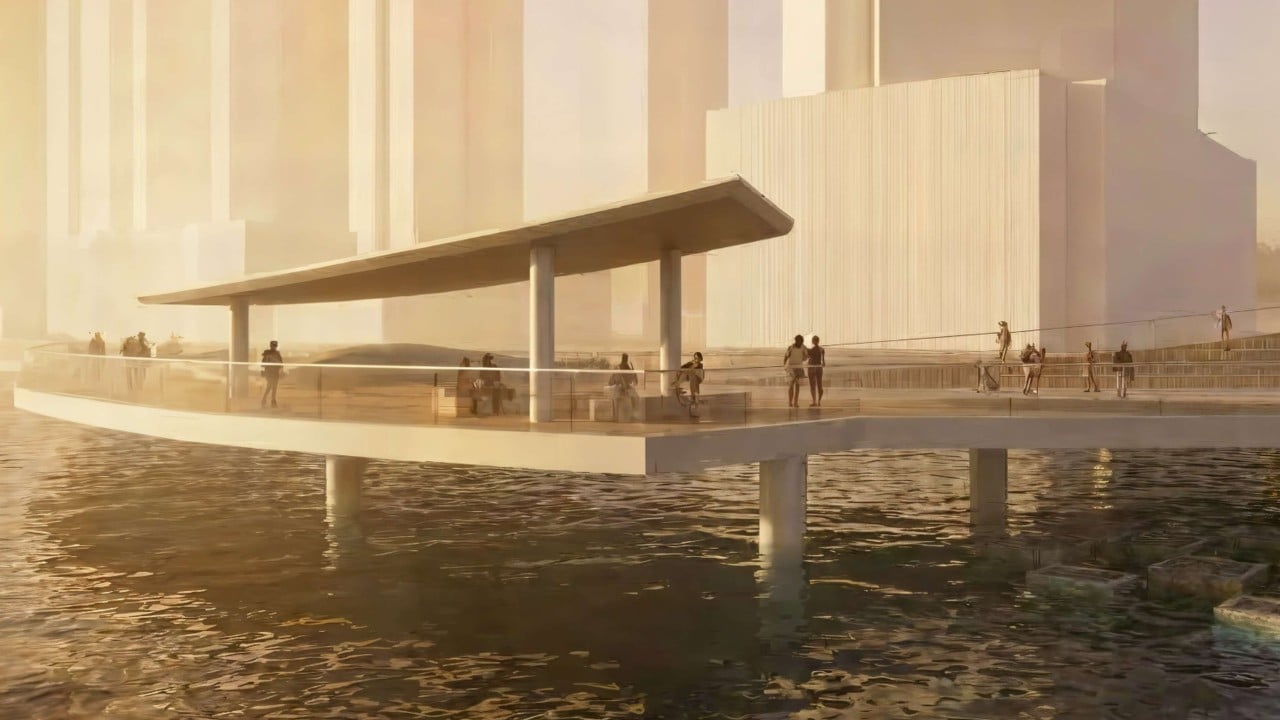
To the engineers sitting in government offices, this friction is a data point. The solution seems obvious on paper: build a walkway. Specifically, a HK$1.5 billion offshore pedestrian promenade, stretching 200 meters long and 10 meters wide, jutting out into the harbor to connect Belcher Bay to Cadogan Street. It requires reclaiming 0.25 hectares of sea. It promises tiered seating, ecological shorelines, and a safe place for tourists to take photos without dodging traffic.
But the real problem lies elsewhere. In the race to fix the plumbing of urban congestion, we are in danger of killing the very magic that drew people here in the first place.
The Ghosts in the Concrete
Urban planning often treats public spaces as geometry. If you have too many bodies on a two-meter sidewalk, you add ten meters of concrete over the water. Problem solved.
Consider what happens next when you apply corporate standardization to an ancient, organic ecosystem. Kennedy Town is not a blank canvas. It is a former dockside neighborhood built on maritime grit, storage warehouses, and wholesale fish markets. The salty air here does not smell like a pristine park; it smells like low tide, diesel fuel, and history.
The preliminary government design for the new walkway looks identical to the promenades you find in Tsim Sha Tsui, Central, or West Kowloon. It is clean. It is orderly. It features the same prefabricated gray tiling, the same manicured shrubbery, and the same municipal railings that scream state-sanctioned leisure.
Ivan Ho Man-yiu, the head of Hong Kong’s Harbourfront Commission, pointed out the flaw in this approach. He looked at the blueprints and realized they completely missed the "city mood" of the district. The current plan treats Kennedy Town as a transit bottleneck to be widened rather than a living cultural landscape to be protected.
There is an invisible stake hidden beneath the water. Right at the edge of the proposed reclamation area sits a century-old seawall, one of the oldest surviving structures of its kind on the island. It is made of massive, hand-cut granite blocks, pitted by a hundred years of saltwater and typhoons. To an engineer, it is an obstacle to cover with modern, prefabricated ecological panels designed to foster biodiversity. To the neighborhood, it is the anchor of their collective memory.
If we bury that granite under a generic concrete shelf, we lose the texture of the past. We swap authenticity for a sanitized imitation of it.
The Friction is the Vibe
We have come to believe that comfort is the ultimate goal of travel and urban life. We want wide paths, clear signposts, and smooth surfaces. Yet, the places we fall in love with are almost always born from friction.
People do not flock to the Kennedy Town waterfront because it is comfortable. They go because it feels alive. It is the thrill of a neighborhood caught between two eras. On one side of the street, old men roast goose in tiny, grease-stained kitchens that have stood for decades. On the other side, baristas pour oat milk lattes for digital nomads. The narrowness of the street forces people to look at each other, to squeeze past one another, to engage with the reality of a living, breathing city.
When you build a massive, ten-meter-wide platform out on the water, you create a buffer zone. You separate the sea from the streets. The tourists will move to the platform, capturing their perfect, uninterrupted sunsets on their pristine viewing decks. The coffee shops will stay on the other side of a newly quiet road. The connection breaks. The neighborhood becomes a theater backdrop, viewed from a distance rather than experienced from within.
It is a mistake we make globally. We tourist-proof our cities until they lose the very edge that made them magnetic.
Designing for the Living
This is not an argument for inaction. Anyone who has tried to walk down the New Praya during a weekend sunset knows the status quo is dangerous. The crowds spill into the paths of moving vehicles, and a major accident is a matter of when, not if.
But the solution must respect the local atmosphere. If the Harbourfront Commission can force a rethink of the design before construction begins in mid-2028, there is a chance to do something remarkable.
Instead of an aggressive concrete intrusion that mimics a highway for pedestrians, the walkway could embrace the ruggedness of Kennedy Town. It could use materials that age, timbers that weather, and layouts that mimic the irregular, winding nature of the old coastline. It should not be a highway; it should be an extension of the neighborhood's living room.
Ah-Keung does not care about the HK$1.5 billion budget or the streamlined procedures of the amended Protection of the Harbour Ordinance. He cares about whether he will still be able to sit by the water and feel the spray of the waves when a container ship passes by.
The waves along this stretch of the coast are notoriously strong, a physical reality that commission members have warned must be factored into the final architecture. The sea here resists being tamed. The design should do the same.
When the project is finally completed in 2031, success will not be measured by how many likes a sunset photo gets on a smartphone app. It will be measured by whether a local elder and a traveling stranger can still stand on the edge of the island, look out over the dark water toward Tsing Yi, and feel that they are standing somewhere that could only ever exist in Hong Kong.