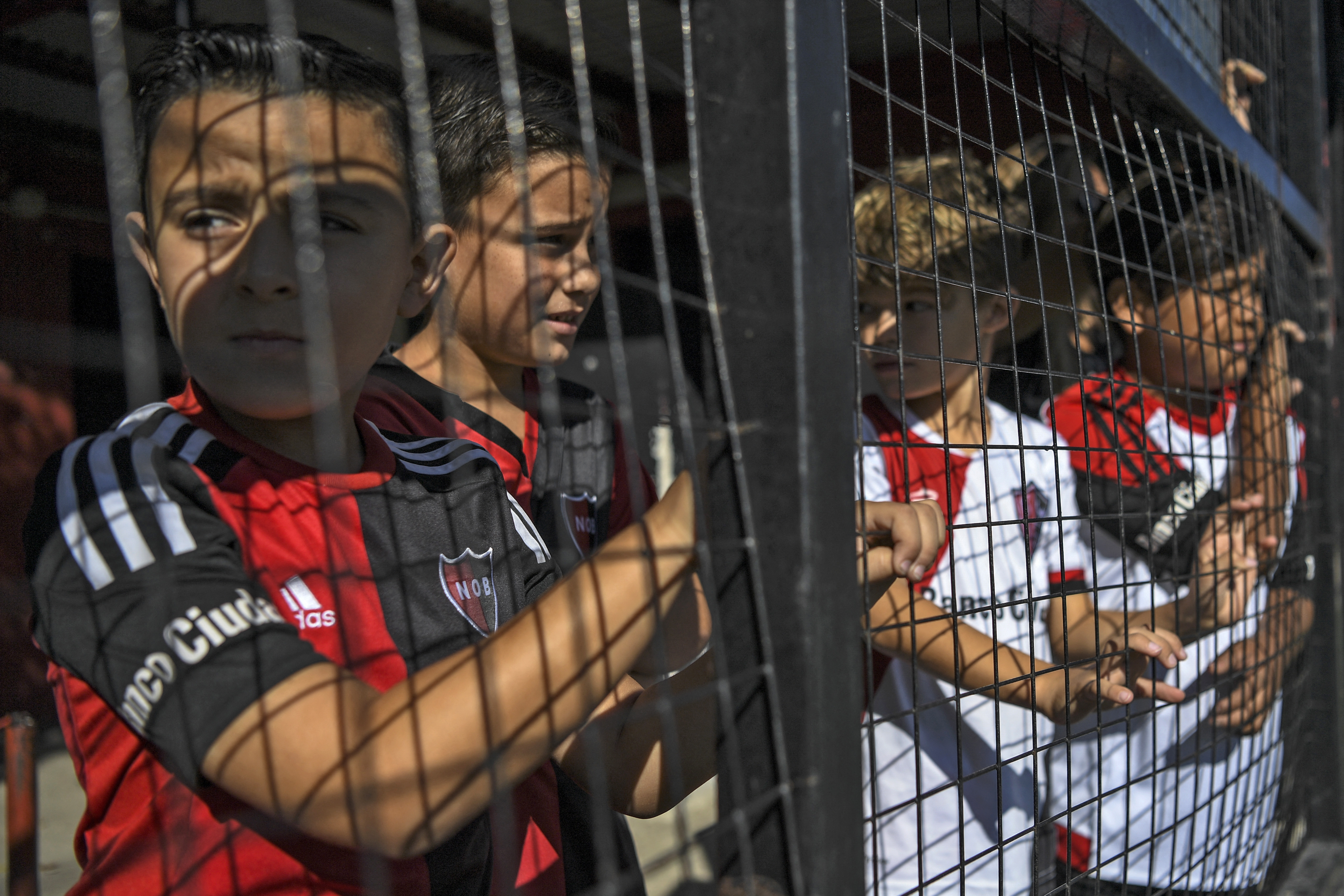
The air in Buenos Aires smells of woodsmoke, wet grass, and cheap coffee. It is five o’clock on a Tuesday evening, and the concrete utility lot behind a neighborhood parish is already vibrating.
There are no pristine turf fields here. No parents screaming tactical instructions from behind a forty-thousand-dollar chain-link fence. No color-coded roster sheets printed out on laminated cardstock. There is only a patchy square of hard-packed dirt, a pair of bent goalposts made from welded scaffolding pipes, and forty kids ranging from six to fourteen years old playing a game that looks less like an athletic competition and more like a controlled riot. Building on this theme, you can find more in: Why That Low Altitude Stadium Flyover Stunned Everyone Online.
At the edge of the pitch stands a man with silvering hair tucked under a faded Racing Club baseball cap. He is watching a ten-year-old boy try to navigate through a swarm of five defenders in a space the size of a telephone booth. The boy loses the ball, wins it back with a sharp toe-poke, nutmegs a defender twice his size, and drags a shot just wide of the post.
The man in the cap does not blow a whistle. He does not yell about positioning. He simply nods, spits out a sunflower seed shell, and watches the ball roll back into the frantic, unsupervised chaos. Observers at ESPN have also weighed in on this matter.
This is potrero culture. And it is the secret engine of Argentine soccer.
To understand why a country with a fraction of the economic power, a fraction of the sports science budgets, and a fraction of the climate-controlled indoor training domes of the United States consistently produces the most hypnotic, resilient, and transcendent soccer players on the planet, you have to look away from the balance sheets and look directly into the dirt.
We have built a youth sports machine in America that treats childhood like an administrative spreadsheet. We have sterilized the game. We have packaged it, priced it, branded it, and ultimately, broken it.
Consider the typical trajectory of a talented American kid who falls in love with soccer.
At age eight, they are identified by a local club. By age ten, they are playing on travel teams that require families to drive two hours each way every single weekend, spending thousands of dollars a year in club fees, uniform packages, tournament travel, and private training sessions. By age twelve, they are trapped in a calendar year dominated by the Elite Clubs National League or MLS NEXT, playing upwards of seventy matches a year on manicured, imported grass under the watchful gaze of licensed coaches who hold tactical clipboards and talk endlessly about zone transitions and progressive build-up play.
It looks professional. It feels elite. It costs a mortgage payment.
And it is quietly draining the life out of the sport.
When you remove improvisation from a game played primarily with the feet, you remove the soul. When every training session is scripted down to the final five-minute cooldown, you rob a child of the single most important evolutionary tool in athletic development: problem-solving under pressure.
In Argentina, nobody teaches a child how to dribble in tight spaces. They learn because they have to. On the potrero—the vacant lots, the streets, the club courtyards—space is scarce. Opponents are older, heavier, and less forgiving. If you hold onto the ball too long, you get your shins clipped. If you try a flashy move without a purpose, you lose possession and spend the next twenty minutes chasing shadows.
It is an environment governed by natural selection, not curriculum guidelines. It is chaotic, noisy, and deeply human.
Walk onto a youth soccer complex in suburban Ohio or Northern California on any given Saturday, and the dominant sound is not laughter or the sharp crack of a clean strike. It is the rhythmic, anxious drone of adult voices.
“Step to him!”
“Release early!”
“Width! Give me width!”
We have turned our children into remote-controlled cars, moving across a green grid in response to the frequency broadcasted by the adults standing on the sideline. The kids are not playing the game anymore; they are executing an adult's choreography.
When a ten-year-old American player makes a mistake—a misplaced pass, an ambitious dribble that fails, a failed attempt at a creative flick—their shoulders immediately drop. They glance nervously toward the sideline, scanning the technical area for the disapproving glare of the coach or the worried look of a parent who just paid four hundred dollars for weekend tournament entry fees.
Fear is a terrible teammate. Fear destroys instinct.
In a study of developmental psychology in sports, researchers often point to the concept of deliberate play versus deliberate practice. Deliberate practice is structured, repetitive, and goal-oriented. It is what American youth sports excel at building. Deliberate play, on the other hand, is intrinsically motivated, designed to maximize enjoyment, and entirely driven by the participants.
Argentina’s youth infrastructure is built almost entirely on the foundation of unyielding, unstructured play, with formal club structures acting merely as a late-stage filter rather than an early-stage factory.
Lionel Messi grew up kicking a taped-up bundle of rags against a concrete wall in Grand Bourg, playing hours of pickup games against teenagers who could have broken him in half. Diego Maradona learned his craft on the dusty fields of Fiorito, where the ball bounced unpredictably over rocks and ruts, forcing his feet to develop an intimate, almost telepathic relationship with the sphere.
They did not learn vision from a PowerPoint presentation. They learned it because survival in the game demanded that they see the invisible angles that everyone else missed.
The United States Soccer Federation spends millions of dollars trying to reverse-engineer this magic. They study the academies of Europe. They import tactical frameworks from Germany and Spain. They mandate coaching licenses that require hours of classroom instruction on periodization and macro-cycles.
Yet, for all our infrastructure, we consistently struggle to produce creators. We build magnificent athletes—fast, strong, disciplined, tactically obedient players who can run all day and execute a tactical press with military precision. But when the game slows down in the final third, when the structured plan falls apart and a match requires a moment of pure, unadulterated individual brilliance to unlock a stubborn defense, we freeze.
We look around for the playbook, only to realize the playbook doesn't have a chapter for improvisation.
To fix this, we do not need more expensive turf fields. We do not need higher club registration fees or more sophisticated scouting apps.
We need to step back.
We need to let children play the game the way it was meant to be played before adults hijacked it with spreadsheets and college scholarship dreams. We need to normalize street ball, pickup matches in local parks where no score is kept, and games where adults are banned from speaking entirely.
Imagine dropping twenty kids onto a field with four cones and a ball, locking the gate, and walking away for two hours.
That is where the magic happens. That is where the quiet resilience is forged.
Until we find the courage to dismantle our hyper-commodified, over-coached, anxiety-inducing youth sports complex and replace it with a culture that values joy, failure, and freedom just as much as tactical compliance, we will continue to wonder why the rest of the world plays the game like they are dancing, while we play it like we are filing taxes.
The sun dips below the corrugated tin roofs of Buenos Aires, painting the dust in the air a bruised shade of violet. The game on the potrero doesn't stop for darkness; someone has dragged a flickering halogen work light out from a garage, casting long, erratic shadows across the dirt.
A twelve-year-old boy receives a bouncing ball with his chest, spins away from two markers in one fluid motion, and slides a blind pass into an empty patch of gravel where his teammate is already sprinting.
Nobody claps. Nobody takes notes.
The ball just keeps rolling.