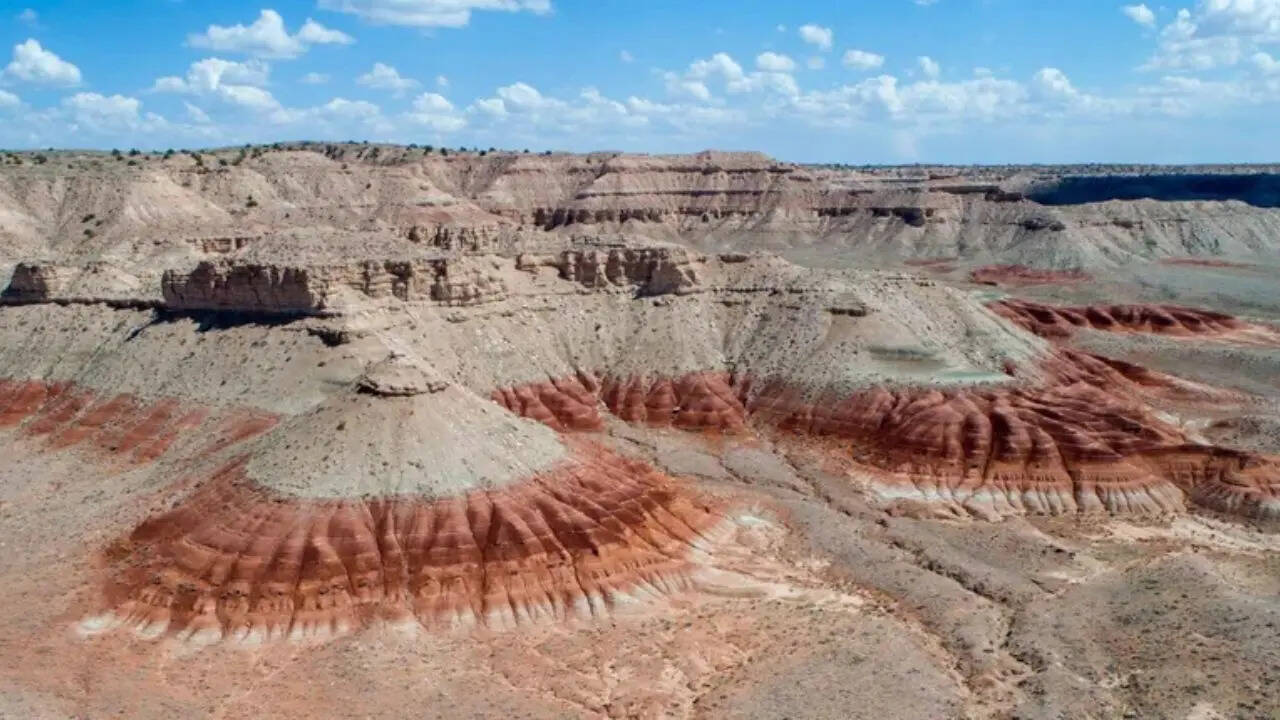
Geology is often less about rocks and more about the human obsession with a clean narrative. We want a "smoking gun." We want a single, catastrophic event—a "lost ancient lake" bursting its banks—to explain the 277 miles of jagged, multi-layered defiance known as the Grand Canyon.
The latest "shocking" study making the rounds is just the newest iteration of the Lake Spillover Hypothesis. It's sexy. It’s cinematic. It’s also a lazy oversimplification that ignores the brutal, grinding reality of deep time.
Stop looking for a bathtub that tipped over. The Grand Canyon isn't a single event. It’s a chaotic, multi-generational heist of the Earth’s crust that didn't start 6 million years ago, and it certainly didn't happen because of one "lost" lake.
The Lake Spillover Trap
The argument from the "consensus" crowd usually goes like this: Ancient Lake Bidahochi, located in what is now northeast Arizona, filled up until it breached its rim. This supposedly sent a wall of water downstream with enough force to carve the canyon in a geological heartbeat.
It’s a great story for a documentary. It’s terrible for a rigorous field report.
If you spend twenty years staring at the Vishnu Basement Rocks or the Tapeats Sandstone, you realize the "spillover" theory has a massive physics problem. To carve through two billion years of rock, you don't just need a "big splash." You need sustained, high-energy transport of abrasive sediment over millions of years. A single lake drainage event is a flash in the pan. It might scour a few miles of topsoil, but it isn't going to chew through two miles of vertical stratigraphy.
The Ancestral River Problem
The real scandal in geology isn't what we found; it's what we refuse to reconcile. We are currently looking at two different canyons masquerading as one.
The "Old Canyon" camp (think researchers like Rebecca Flowers) has used apatite thermochronometry to suggest parts of the canyon were carved as far back as 70 million years ago. Meanwhile, the "Young Canyon" crowd insists on the 5-6 million-year timeline.
Here is the counter-intuitive truth: They are both right, and that makes the "Lake Spillover" theory irrelevant.
The Grand Canyon is a Frankenstein’s Monster.
Imagine a scenario where separate, smaller drainage systems existed independently for tens of millions of years. One flowed north. One flowed west. They were disparate, lazy rivers doing incremental work. Then, through a process called stream capture (or "headward erosion"), the younger, more aggressive lower Colorado River literally ate its way backward through the plateau until it hijacked the older systems.
The "Lake" everyone is obsessing over was likely just a temporary puddle caught in the crossfire of this tectonic kidnapping.
Stop Asking "How Old Is It?"
People always ask the same flawed question: "When was the Grand Canyon formed?"
The question assumes a start and an end date. It treats the canyon like a finished building. This is the first mistake. The canyon is a process, not a product.
When you look at the Great Unconformity—that jarring line where 500-million-year-old rock sits directly on top of 1.7-billion-year-old rock—you are looking at a billion years of missing history. The canyon didn't just "form"; it revealed a gap.
The lake theory tries to fill that gap with a sudden flood because humans can’t wrap their heads around the "Great Denudation." We struggle to envision 800 million years of nothingness. We need a "shocking study" to bridge the psychological trauma of geological time.
The Physics of Erosion No One Mentions
Erosion isn't just water touching rock. Water by itself is relatively harmless to granite. To carve a canyon, you need tools.
- Abrasive Load: You need boulders, gravel, and sand.
- Gradient: You need a steep drop.
- Tectonic Uplift: This is the part the lake-believers ignore.
The Colorado Plateau has been rising for millions of years. As the land pushed up, the river stayed in place, acting like a giant band saw. If the plateau hadn't risen, the "Lost Lake" would have just created a swamp. The canyon exists because the Earth pushed the rock into the river.
The river didn't go down; the land went up.
By focusing on a "lost lake," we ignore the massive, slow-motion tectonic engine of the American West. It’s like blaming a car crash on a raindrop while ignoring the fact that the road was moving at 100 miles per hour.
Why the "Shocking Study" Sells
The media loves the Lake Spillover Hypothesis because it’s easy to visualize. It fits the "Disaster Movie" archetype. It’s much harder to sell a headline that says: "Boring, Incremental Tectonic Uplift and Complex Stream Capture Over 70 Million Years Continues to Be the Likely Explanation."
I’ve seen academic careers built on these "discovery" cycles. You find a localized sediment deposit that looks like lake-bed silt, you write a press release about a "lost world," and you get a grant. But look closer at the data. These "lakes" were often ephemeral. They were shallow. They lacked the volume to provide the hydrostatic head necessary to jumpstart a 277-mile excavation project.
The Actionable Reality for the Traveler
If you’re standing at Mather Point, stop looking for the "rim" of an ancient bathtub.
Look at the Inner Gorge. Look at the dark, jagged schist at the bottom. That rock was formed six miles underground. The fact that you are standing on a rim looking down at it means six miles of Earth’s crust vanished. A lake didn't do that. A "spillover" didn't do that.
You are witnessing the result of a planet-scale grinding machine that has been running since the dinosaurs were walking around.
The Logistics of Deep Time
Let’s talk about the math. If you want to erode the canyon in the "Young" timeline of 6 million years, you need an erosion rate that is consistently aggressive across every layer. But the layers aren't consistent.
The Redwall Limestone behaves differently than the Bright Angel Shale.
A massive flood would have left a very different signature—it would have smoothed out the profile. Instead, we see "stair-step" topography. That is the signature of a river that took its time, pausing to struggle with the hard layers and sprinting through the soft ones. It’s the signature of a persistent, annoying river that refused to change its course while the continent tried to shove it aside.
The Truth Nobody Admits
The "mystery" of the Grand Canyon isn't that we don't know how it formed. The mystery is why we keep trying to find a simpler answer than the one staring us in the face.
We are addicted to the idea of "catastrophism" because it makes the world feel smaller and more manageable. If a lake carved the canyon, then the world is a place where things happen for clear, singular reasons.
If the "Integrated Drainage" theory is true—if the canyon is a messy, accidental patchwork of ancient valleys and modern river-theft—then the world is chaotic, unpredictable, and vastly older than our brains can comfortably process.
The "lost lake" is a fairy tale for people who are afraid of deep time.
The Grand Canyon wasn't a "discovery" or a "miracle" or a "disaster." It was a slow-motion collision between a persistent river and a rising continent, a five-million-year car wreck that is still happening today.
Get over the lake. Start looking at the uplift.