The air in Butler, Pennsylvania, on that Saturday in July was thick with the kind of heat that sticks to the back of your neck. It was a carnival atmosphere, a sea of red hats and sweat-soaked shirts, the kind of gathering where political fervor usually blends with a sense of community. Then the pops started. Not the festive crackle of fireworks, but a sharp, mechanical rhythm that sliced through the humidity.
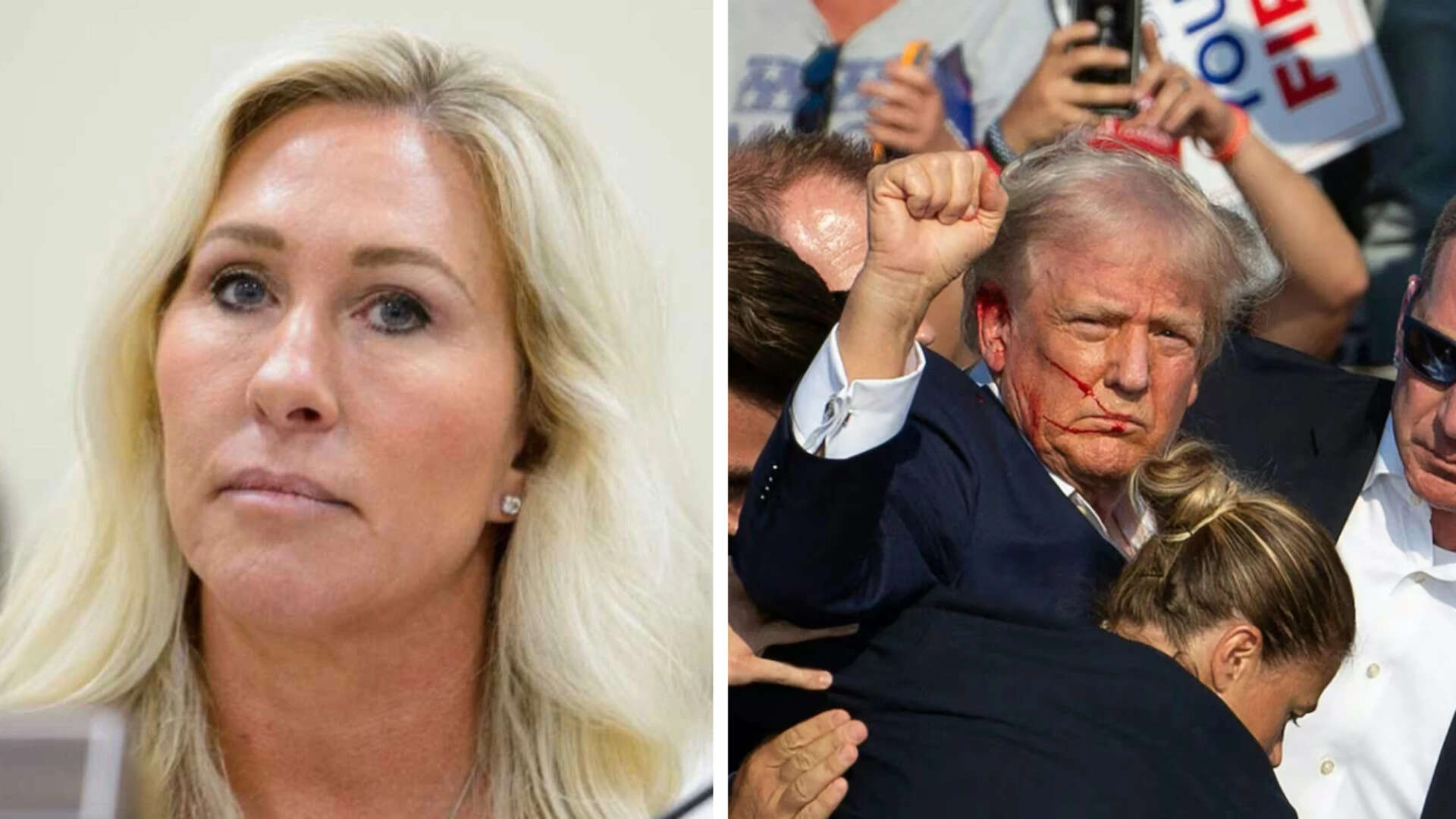
We all saw the video. We saw the former president’s hand fly to his ear. We saw the grimace, the crouch, and the frantic huddle of suits and sunglasses. We saw the streak of blood across a cheek. But for some, the evidence of their eyes wasn’t enough. Before the dust had even settled on the fairgrounds, a different kind of noise began to rise, louder and more chaotic than the gunfire itself.
The Architecture of Disbelief
In the digital age, a tragedy is never just a tragedy. It is a prompt. Within hours, the narrative didn't just report the event; it began to deconstruct it into a series of stage directions. Marjorie Taylor Greene, a woman whose political career is built on the bedrock of provocation, leaned into the digital void. She didn't just question the security failures—she brushed against the idea that the entire spectacle was a choreographed performance.
The claim that "what happened in Butler" was staged isn't just a political talking point. It’s a symptom of a deeper, more corrosive rot in how we process reality. When a congresswoman floats the idea that a bullet grazing a human being was part of a script, she isn't just attacking a political opponent or a government agency. She is attacking the very concept of a shared experience.
Imagine a man sitting in his living room in Ohio, watching the news. He sees the same footage you do. But he has been told, repeatedly, that everything he sees is a lie. The news is a lie. The government is a lie. The physics of ballistics are a lie. For him, the blood on Trump's face isn't a sign of a near-death experience; it's a special effect.
This isn't just skepticism. It's a total retreat from the tangible world.
The Invisible Stakes of "Staged"
Why does it matter if a politician suggests an assassination attempt was fake?
The stakes are invisible until they aren't. When we stop believing in the physical reality of violence, we lose the ability to have a conversation about how to stop it. If the bullets weren't real, then the fear isn't real. If the fear isn't real, the consequences don't exist.
Greene’s rhetoric acts as a wedge. It forces her audience to choose between the evidence of their senses and their loyalty to a tribe. If you admit that a real person tried to kill a real candidate, you have to grapple with the terrifying instability of our current political climate. It’s much easier, much cleaner, to believe it was all a play. A "psyop." A trick of the light and some clever makeup.
But consider the collateral damage. Corey Comperatore wasn't a character in a script. He was a father and a fire chief. He died in that bleacher, shielding his family. When the narrative shifts to "staged," his death becomes a loose end in a conspiracy theory rather than a human tragedy. The grief of his family is reduced to a prop. This is the human cost of the "staged" claim: it strips the victims of their humanity to serve a digital algorithm.
The Mechanics of the Echo
The way these claims travel is a feat of modern engineering. It starts with a "just asking questions" post. A grainy screenshot. A zoomed-in video of a Secret Service agent that looks "suspicious" to someone who has never seen a tactical extraction in their life.
The claim doesn't need to be true. It only needs to be persistent.
By the time Marjorie Taylor Greene amplifies these whispers, they have already gained a life of their own. She provides the institutional weight that turns a fringe theory into a headline. The "staged" narrative serves a specific purpose: it keeps the base in a state of perpetual high-alert. It suggests that the "Deep State" is so powerful, so theatrical, that they can conjure a sniper out of thin air to manipulate the public heart.
It is a masterful way to avoid talking about the actual failures of the day. If it was staged, we don't have to talk about how a twenty-year-old with a rifle got onto a roof with a clear line of sight. We don't have to talk about the breakdown in communication between local and federal law enforcement. We don't have to talk about the ease of access to high-capacity firearms.
The conspiracy is a shortcut. It’s an exit ramp from the difficult, messy work of fixing a broken system.
The Physics of a Miracle
Let’s look at the math for a second. To "stage" a graze to the ear from 150 yards away would require a level of precision that defies the laws of physics and human error. A movement of a quarter-inch by the target—a simple turn of the head to look at a chart—is the difference between a graze and a funeral.
No one, no matter how dedicated to a "role," bets their life on a quarter-inch.
When we step away from the keyboard and look at the logistics, the "staged" argument falls apart. But conspiracy theories don't care about ballistics. They care about feelings. They provide a sense of order in a world that feels increasingly chaotic. If the world is a stage, then there is a director. If there is a director, there is a plan. And a plan, even a sinister one, is less frightening than the reality: that we live in a world where a lone, disturbed individual can change the course of history in a heartbeat.
The truth is much more terrifying than the conspiracy. The truth is that we are vulnerable.
The Erosion of the Public Square
Every time a claim like Greene’s is validated by a "like" or a "share," the floor of our public square drops a little lower. We are building a society where there is no longer a baseline of fact. We are living in a choose-your-own-adventure reality.
I remember talking to a veteran who had seen combat in three different decades. He watched the Butler footage with a clinical eye. He saw the way the crowd reacted—the delayed realization, the primal scream of a woman in the front row, the smell of cordite. To him, there was no doubt. "You can't fake the way the air changes when a bullet passes through it," he told me.
Yet, his expertise is silenced by the roar of the internet. We have traded the testimony of witnesses for the opinions of influencers. We have traded the weight of history for the speed of a tweet.
The danger of Marjorie Taylor Greene's rhetoric isn't just that it's wrong. It’s that it's effective. It creates a fog that never quite lifts. Long after the investigations are over and the reports are filed, a significant portion of the population will still believe that "something wasn't right" in Butler. They will carry that doubt into the voting booth. They will carry it into their conversations with their neighbors.
This is how a democracy dies. Not with a bang, but with a series of questions designed to make sure we never hear the bang in the first place.
The Reflection in the Screen
We have to ask ourselves why we are so quick to buy into the theater of the absurd. Is it because we’ve been fed a diet of reality TV and cinematic universes for so long that we can no longer tell where the screen ends and the world begins?
The "staged" claim is the ultimate comfort food for the cynical. It allows us to opt out of the empathy required to process a near-assassination. If it’s fake, we don't have to feel bad for the man on stage. We don't have to feel bad for the people in the crowd. We can just sit back and critique the performance.
But the blood was real. The bullets were real. The fear in that field was as real as the heat of the Pennsylvania sun.
When we allow the narrative of the "staged" event to take root, we aren't being "critical thinkers." We are being cowards. we are refusing to look at the jagged, ugly reality of our political moment. We are choosing a comfortable lie over a devastating truth.
The image that sticks with me isn't the fist in the air or the Secret Service huddle. It’s the empty shoes left behind in the grass after the crowd fled. Those shoes belonged to real people who ran for their lives. No one leaves their shoes behind for a staged performance. They leave them behind because they are terrified.
And that terror is the only thing in this story that doesn't need a script.