The mud of Aintree has a specific scent. It is a thick, metallic soup of peat, crushed grass, and the sweat of four dozen horses who are currently wondering if they are about to become legends or statistics. If you stand near the Elbow—that cruel, final kink in the home straight where the lungs scream and the soul starts to fray—you don't just hear the thunder of the Grand National. You feel it in the soles of your boots. It’s a rhythmic, bone-shaking vibration that tells you exactly how much weight is being thrown against the earth.
To win this race once is a fluke of physics and fate. To win it twice is an act of defiance.
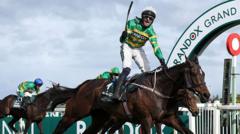
In April 2026, I Am Maximus didn't just run a race. He carried the expectations of a betting nation, the weight of a top-heavy handicap, and the ghost of his own 2024 victory across four miles and two furlongs of the most treacherous terrain in the sporting world. He became the first horse since the immortal Red Rum and the tenacious Tiger Roll to look at the Aintree history books and demand a second entry.
The Weight of the World
Handicapping is a polite word for a mathematical assassination attempt. When a horse wins the Grand National, the racing authorities respond by piling lead into its saddle for the next time. They want to level the playing field. They want to ensure that no one is too good, that the drama remains high, and that the underdog always has a fighting chance.
I Am Maximus arrived at the starting line carrying 11st 10lb. To the casual observer, that’s just a number on a program. To a horse, it is a physical anchor. Every time he launched his half-ton frame over a fence like Becher’s Brook—where the ground on the landing side drops away as if the world has ended—that extra lead pulled at his tendons. Every stride through the rain-softened turf required a fraction more wattage from his hindquarters.
Paul Townend, sitting high in the stirrups, wasn't just steering. He was managing a dwindling battery. In a race with thirty-four obstacles and thirty-three other frantic competitors, the margin for error is narrower than a blade of grass. You aren't just racing the other horses; you are racing the probability of disaster.
The Invisible Stakes of the Canal Turn
Think about a moment of pure chaos. Now, add thirty horses to it, all traveling at thirty miles per hour toward a ninety-degree turn immediately after a leap over five feet of spruce.
This is the Canal Turn. It is where the Grand National often decides who lives to fight the second circuit and who ends up in the dirt. On this Saturday in 2026, the field was a churning sea of silks—emerald, scarlet, and royal blue—colliding in a desperate bid for the inside rail.
I Am Maximus was tucked away. He isn't a flashy traveler. He doesn't pull his rider's arms out with eagerness. Instead, he has the brooding, workmanlike quality of a stone mason. He chips away. He finds a rhythm that looks almost lazy until you realize he is gaining six inches on the field with every jump.
There is a myth that these horses are mindless machines driven by the whip. If you’ve ever stood in the stables at dawn, you know better. A horse like this knows where the finish line is. He knows the sound of the crowd at the Melling Road. He knows when the horse next to him begins to falter, the tell-tale rattle of a tired breath, and he chooses—personally, internally—to push harder.
A Duel in the Rain
As the field swung toward the final two fences, the "standard" narrative of the race began to dissolve. The long shots who had led for three miles were hitting the wall. Their legs were turning to jelly. Their jockeys were "scrubbing," a desperate rowing motion with the reins that signals the engine is empty.
Minella Indo, a veteran with the heart of a lion, was there. Several surging youngsters with half the weight on their backs were there, looking fresh and dangerous. The commentators were shouting about the "changing of the guard."
Then, Townend moved his hands.
It wasn't a violent gesture. It was a communication. A subtle shift in balance that told I Am Maximus the time for patience had ended. The response was immediate. The horse didn't just speed up; he lowered his head and began to devour the ground.
Watching a repeat winner find their second wind is like watching a master craftsman return to a familiar workbench. There was no panic. While others were frantic, jumping "big" out of fear or "short" out of fatigue, I Am Maximus remained clinical. He cleared the last fence with the precision of a ghost passing through a wall.
The Long Loneliness of the Run-In
The run-in at Aintree is 494 yards long. It is the longest, loneliest stretch of grass in the world.
The stands are a wall of noise, a cacophony of forty thousand people screaming for their money or their heroes. But for the jockey and the horse, it is strangely silent. All they have is the rhythm of the gallop and the terrifying knowledge that someone might be coming up behind them.
In 2024, I Am Maximus had won by ten lengths, a dominant display that left the field in tatters. This time, in 2026, it was different. It was a grind. The weight was telling. Every yard was a negotiation between the horse’s muscles and his mind.
He didn't win by a mile this time. He won by grit.
He crossed the line and the transition was instant. From a weapon of pure kinetic energy, he returned to being a horse—nostrils flared, steam rising from his coat in the cool Liverpool air, his ears flickering toward the sound of the cheering.
Beyond the Betting Slip
We talk about the Grand National in terms of "The Result." We discuss the starting price (he went off as the favorite, a rare occurrence for a repeat winner) and the payouts. But that isn't why the race persists in a world that is increasingly allergic to risk.
We watch it because it represents the only honest thing left. You cannot bribe a four-mile gallop. You cannot "brand-manage" a jump over the Chair.
I Am Maximus joined the immortals because he accepted the burden of being the best and carried it through the mud. Most of us spend our lives trying to shed our burdens. We want things to be easier, faster, lighter. We want the lead taken out of our saddles.
There is a profound, quiet beauty in a creature that accepts the extra weight and runs anyway.
As the horse walked back into the winner’s enclosure, his chest heaving, his coat caked in the gray-brown grime of the North, he looked less like a pampered athlete and more like a soldier returning from a long campaign. He had nothing left to prove, yet he had given everything anyway.
The record books will show the date, the jockey, and the distance. They will note the "two-time winner" status with a sterile footnote. But the people who were there, leaning over the rails as the ground shook, will remember something else. They will remember the way he looked at the Elbow—head down, ears pinned, refusing to let the heavy earth hold him back for even a second longer.