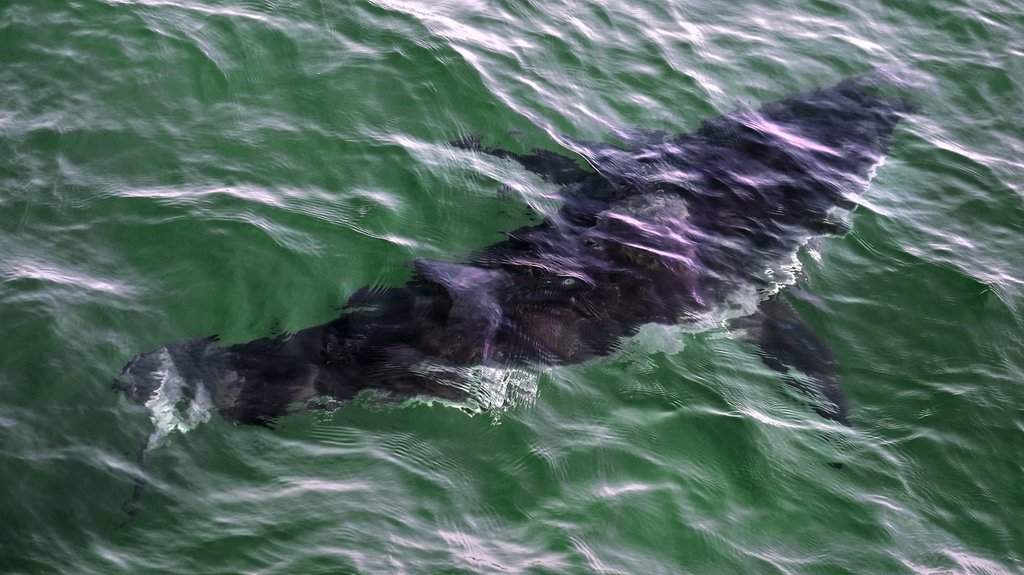
Summer along the Atlantic coast used to be an exercise in simple geometry: stretch a towel across the sand, calculate the distance to the cooler, and ignore the cold Atlantic chill. That math is broken. A steady accumulation of great white shark sightings from Cape Breton to the South Shore has transformed public perception, turning routine beach days into high-stress events. Local authorities find themselves cornered between public panic and institutional inertia, fielding loud demands for high-tech beach monitoring systems that resemble the coastlines of Australia or California.
The core driver of this tension is not a sudden migration anomaly, but a biological success story decades in the making. Populations of great white sharks plummeted by as much as eighty percent across North America through the 1970s and 1980s due to overfishing. Strict conservation laws coupled with a booming grey seal population—their primary caloric fuel—have allowed apex predators to reoccupy their historical territory off the Canadian east coast. They never truly left; they were simply hunted out of visibility. Now they are back, and beachgoers are running smack into the reality of sharing an ecosystem.
Yet the conversation surrounding beach monitoring reveals a profound disconnect between public expectation and environmental physics.
The Technological Mirage
When a sighting closes a stretch of sand like Martinique Beach or Queensland Beach, the public cry for surveillance hardware is immediate. Drones, acoustic telemetry receivers, and satellite tags dominate the discourse. People look at sun-drenched Australian shores featuring real-time helicopter patrols and automated sonar nets, then ask why Nova Scotia cannot do the same.
The comparison crumbles under closer inspection.
Canadian waters present a hostile environment for optical technology. Cold, nutrient-rich seas churn up plankton blooms, high turbidity, and fierce tidal swings that reduce underwater visibility to mere inches for large parts of the swimming season. A drone hovering fifty feet above the surf will spot a shadow only under pristine atmospheric conditions. Most of the time, it will stare at grey water, blind to anything swimming beneath the surface layer.
Provincial officials, including representatives from the Nova Scotia Lifesaving Society, are right to urge caution before importing foreign solutions. Implementing aerial drone surveillance along hundreds of kilometers of rugged, unmonitored coastline requires capital investment that dwarfs current municipal budgets. More importantly, it creates a dangerous psychological feedback loop. When a jurisdiction deploys high-tech monitoring gear, it implicitly promises zero risk. The ocean cannot deliver on that promise.
The Anatomy of a Non-Intervention Strategy
Instead of building an expensive digital wall that fails to protect anyone, authorities have relied on low-tech advisory measures. QR codes linked to safety guides, educational signage warning against swimming near seal colonies, and restrictions during prime feeding hours at dawn and dusk form the backbone of the province's defense.
Critics call these measures passive. They argue that handing a frightened tourist a pamphlet amounts to an abdication of duty.
This argument misunderstands the nature of marine wildlife management. Sharks do not patrol designated swim lanes. A great white tagged off Scatarie Island can travel hundreds of miles in weeks. A drone that clears a beach at noon offers zero guarantee that an animal will not cruise through the exact same spot ten minutes after the battery dies and the crew packs up. False security is worse than no security because it alters human behavior in ways that invite complacency.
Lifeguarded beaches remain the only functional line of defense, not because lifeguards can spot a ten-foot apex predator from a wooden chair, but because they enforce behavioral boundaries. They keep swimmers in shallow, sheltered areas where chaotic surf and murky depths make successful ambushes unlikely.
Living with the Apex
The debate over beach monitoring ultimately exposes human discomfort with wild spaces. For generations, Canadians treated the ocean as an aquapark with cold water. The return of the great white forces an uncomfortable reckoning.
If you step into the Atlantic, you enter a food web. No amount of drone funding or municipal signage will alter that biological fact. The institutions managing our coastlines must resist the temptation to spend millions on theater that pacifies headlines while doing nothing to change survival rates in the water.
Education remains the only tool with a proven track record. Swimmers must learn to read the water, recognize seal activity, and accept that absolute safety in a natural marine habitat is a modern myth. The sharks are doing what they evolved to do. The burden rests entirely on us to adjust our habits to match the reality of a restored ocean.