Everyone loves a tree. Humanity possesses an embarrassing, biological weakness for green things. Show the public a dusty stretch of sand, drop a few million saplings from a quadcopter, slap a cheerful headline on the broadcast about turning the 'Sea of Death' into an orchard, and watch the applause roll in. It feels good. It feels righteous.
It is also an ecological catastrophe in slow motion.
The mainstream narrative surrounding the Taklamakan Desert in China's Xinjiang region is built on a comforting lie. The lazy consensus goes like this: deserts are scars on the face of the earth, dead zones crying out for salvation, and technology has finally given us the power to fix them by dumping water and vegetation onto shifting dunes. I have watched billions of dollars thrown at arid engineering projects across the globe, and every single time, the story ends the same way. We fight geography, and geography wins, leaving a trail of bankrupt municipalities and ruined aquifers behind.
Let us dismantle the romanticism right now.
The Arid Myth of the Dead Zone
The Taklamakan is not a failure of nature. It is a fully functioning, highly stable geological system. For millions of years, this basin has operated as a hyper-arid sink, trapping sediment and driving global climate patterns by generating massive dust plumes that fertilize Pacific fisheries and regulate atmospheric heat absorption.
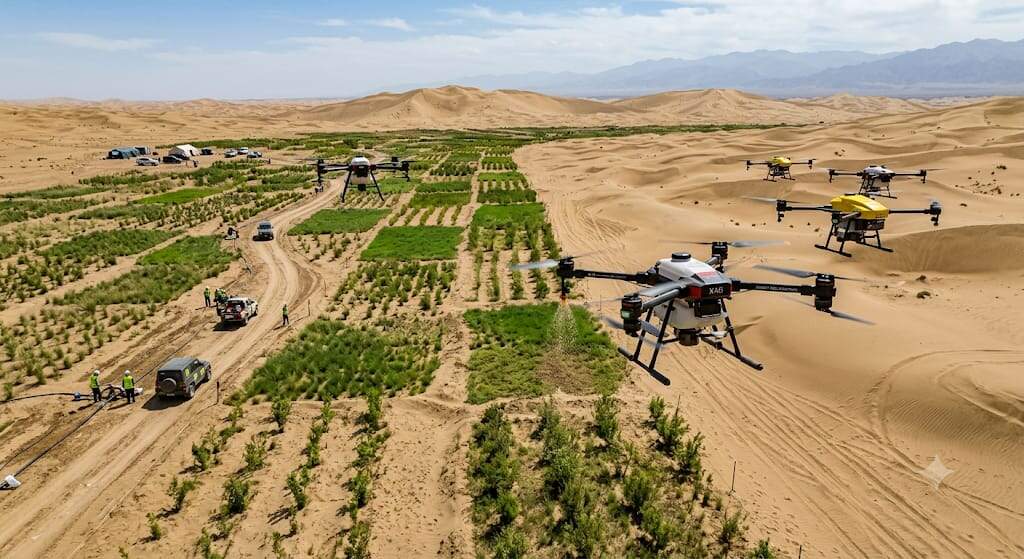
When mainstream outlets trumpet the use of drone technology to scatter seeds, plant drought-resistant shrubs, and lay down straw checkerboards across the sand, they ignore the hydrological reality. Water does not magically appear because a drone dropped a seed pod. To keep non-native or artificially introduced vegetation alive in a region receiving less than fifty millimeters of annual rainfall, you must pump deep fossil groundwater or divert distant river systems.
I have spoken with hydrologists who have spent decades tracking water tables in Central Asia. The math is brutal. Pumping ancient aquifers to sustain surface vegetation in a desert is the ecological equivalent of burning your furniture to heat the house during a mild winter. You get a quick burst of warmth—or in this case, a nice photo-op of green shoots piercing the sand—followed by total, irreversible exhaustion of the resource. Once that fossil water is gone, the plants die, the soil destabilizes worse than before, and you are left with a man-made dust bowl far more volatile than the natural desert you started with.
The Drone Illusion
Let us talk about the hardware, because the tech-media complex loves a gadget story. Drones are efficient. They cover vast hectares quickly. They make great B-roll for evening news segments.
However, dropping a seed from a hexacopter does not rewrite evolutionary biology. Desert plants do not struggle to survive because they lack delivery mechanisms; they struggle because the environment lacks the sustained moisture required to transition from germination to a self-sustaining root system.
[Traditional Forestry] -> High Initial Cost -> Manual Labor -> Low Survival Rate
[Drone Seeding Hype]  -> Low Initial Cost  -> Zero Labor   -> Near-Zero Survival Rate + Aquifer Depletion
Without persistent human intervention—irrigation lines, chemical soil binders, continuous replanting—drone-seeded vegetation in an extreme hyper-arid zone has a natural survival rate close to zero. The corporate PR machines prefer to highlight the first three weeks after a spring rain when the seedlings pop up. They conveniently vanish by month six when the summer heat scorches the root crowns and the wind strips the dry stalks away.
We are not engineering a green revolution. We are running an expensive PR campaign that disguises water theft as conservation.
What the Data Actually Says
Look past the press releases coming out of regional agricultural bureaus. The expansion of green belts along the perimeter highways of the Taklamakan—such as the famous Tarim Desert Highway shelterbelt—did not happen because of magic drone drops. It happened through decades of intensive, back-breaking human labor, laying thousands of kilometers of drip-irrigation pipes powered by deep-well pumping.
And what was the cost? Lower water tables across the surrounding basin. Pistachio and jujube orchards planted in reclaimed desert zones require massive amounts of irrigation. As those trees mature, their water demand scales exponentially. When drought years hit—and in a desert, drought is the baseline, not the exception—farmers are forced to drill deeper, competing directly with local ecosystems and traditional pastoralists for the last drops of sub-surface moisture.
You cannot out-engineer a hydrological deficit with a fleet of commercial quadcopters. Every liter of water pulled from a non-recharging aquifer to keep a desert shrub alive is a liter stolen from the future stability of the entire region.
The Uncomfortable Truth About Sandstorms
Another persistent myth is that planting trees stops dust storms. The logic sounds intuitive: trees act as a windbreak, holding the soil in place.
On a micro-scale, immediately adjacent to a heavily irrigated shelterbelt, that is true. But the Taklamakan does not generate its dust from localized backyard drift; it is whipped by massive cold fronts and high-altitude jet streams sweeping down from Siberia and the Tibetan Plateau, moving millions of tons of fine particulate matter across entire continents.
Artificially greening a few thousand hectares of perimeter dunes is like trying to stop a hurricane by holding up an umbrella. The scale of natural atmospheric dynamics completely dwarfs human intervention zones. Worse, when artificial vegetation fails—and it does, the moment funding dips or water supplies run dry—it leaves behind pulverized, disturbed topsoil that actually erodes faster and generates finer, more dangerous dust than undisturbed, natural crust formations.
Nature builds biological crusts in deserts—complex matrices of cyanobacteria, lichens, and mosses—that lock sand down far more effectively than thirsty imported bushes. When we bulldoze or disrupt these native micro-ecosystems to plant commercial greenery, we destroy the very armor the desert uses to keep its sand in place.
Stop Trying to Cure a Healthy Patient
The underlying pathology here is our cultural inability to leave untouched wilderness alone. We see emptiness and our immediate instinct is to conquer it, paint it green, and make it productive by our narrow, short-sighted metrics.
The Taklamakan does not need saving. It needs to be understood.
If we want to address environmental degradation in drylands, we must stop wasting capital on vanity projects that look good on Instagram and start focusing on realistic rangeland management, protecting existing native water sources, and accepting that some landscapes are meant to remain wild, dry, and free of our interference.
Put the drones away. Stop pumping the aquifers. Let the sand blow.