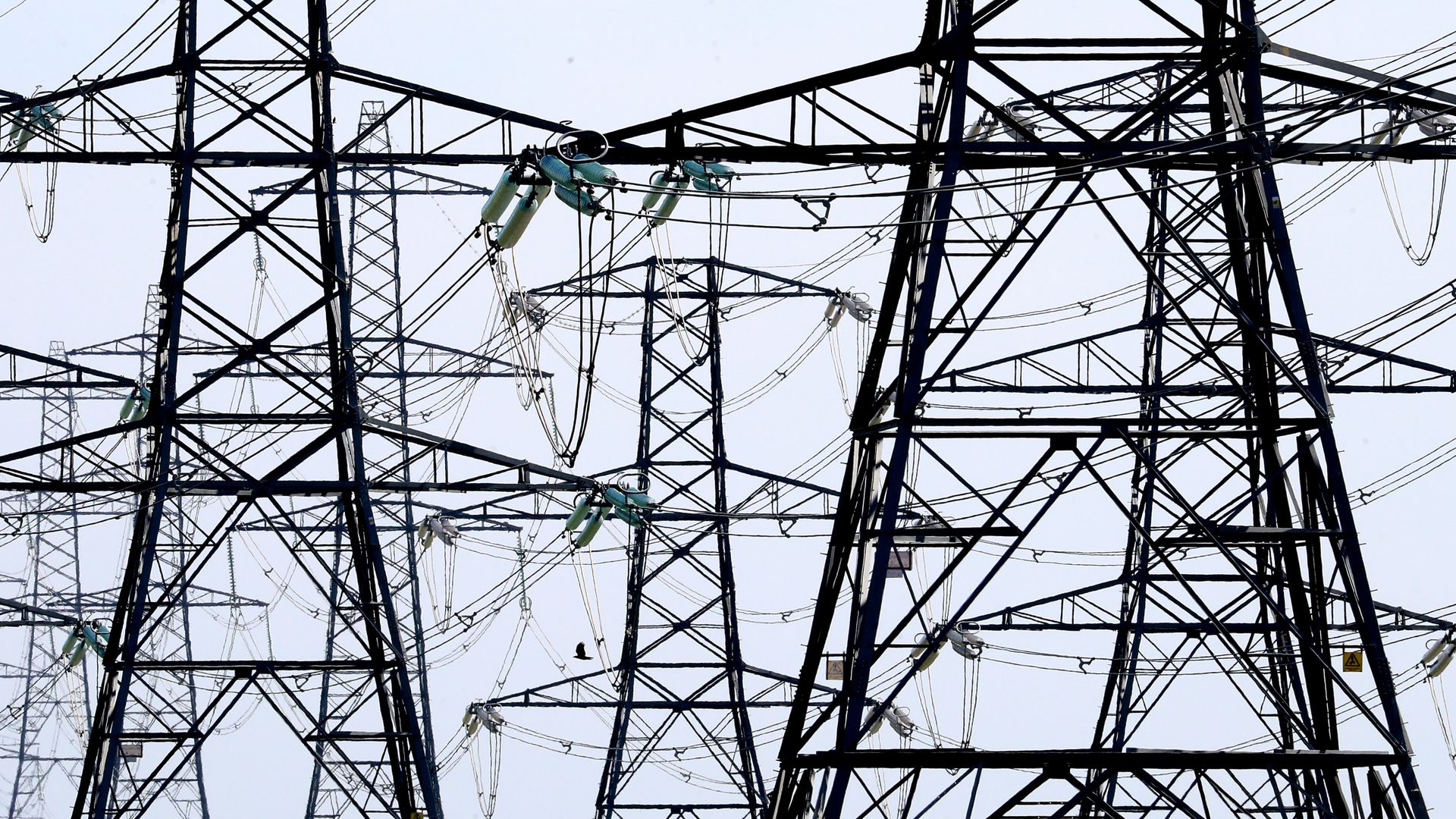
Hyperscale data centre expansion in the United Kingdom is no longer constrained by capital availability or real estate acquisition; it is governed entirely by transmission grid queue management and high-voltage substation capacity. A commercial agreement between National Grid and a major data centre developer represents more than a localized infrastructure milestone—it signals a structural shift in how electrical transmission operators allocate scarce baseload capacity to high-density compute facilities. To evaluate the viability of large-scale UK compute infrastructure, analysts must examine the mechanics of transmission connection queues, the thermodynamic realities of power density, and the regulatory restructuring of grid access.
The Structural Bottleneck of UK Transmission Infrastructure
For the past decade, data centre site selection in the UK followed a predictable geographic pattern centered on the M4 corridor and Slough, driven by proximity to transatlantic fiber landings and low-latency financial networks in London. That model has hit a physical ceiling. The local distribution networks and high-voltage transmission substations serving Greater London lack the spare thermal capacity to absorb single-site loads exceeding 100 megawatts (MW).
National Grid operates the high-voltage electricity transmission network in England and Wales, managing voltages of 275 kilovolts (kV) and 400 kV. Connecting a gigawatt-scale or multi-hundred-megawatt data centre directly to this transmission backbone requires bypassing regional Distribution Network Operators (DNOs) and securing a direct Transmission Entry Capacity (TEC) or demand connection agreement.
The core friction lies in the historic design of the UK grid. Built around centralized fossil-fuel generation flowing outward to distributed industrial and residential loads, the network is undergoing a simultaneous bidirectional transformation. Offshore wind generation in the North Sea is injecting massive, intermittent supply into coastal landing points, while hyperscale data centres are creating unprecedented, continuous point-loads inland. When National Grid strikes a bespoke connection deal to enable a giant UK data centre, it is essentially solving a spatial optimization problem: matching high-capacity transmission corridors with land parcels capable of hosting industrial-scale cooling and backup generation.
The Mechanics of the Connection Queue
Historically, National Grid Electricity System Operator (NESO) managed connection applications on a first-come, first-served basis. This administrative rule created a speculative backlog exceeding 700 gigawatts of generation and demand projects—several times the peak electrical demand of the entire United Kingdom. Zombie projects with minimal capital backing held grid capacity hostage, delaying viable infrastructure builds by up to a decade.
A breakthrough deal between National Grid and a hyperscale developer relies on specific commercial and regulatory mechanisms to clear this logjam:
- Queue Management Reforms (TMO4+): Under updated regulatory frameworks approved by Ofgem, developers must meet strict financial and planning milestones—such as securing land rights and submitting formal planning applications—to retain their queue position. Speculative applicants are stripped of capacity, freeing up substation bays for capitalized data centre operators.
- Curtailment and Flexible Connections: Rather than waiting years for deep network reinforcement (such as building new overhead 400 kV pylon routes, which face severe local planning opposition), large demand users increasingly accept non-firm or profiled connection agreements. Under these terms, the data centre agrees to reduce its grid draw during peak system stress events, shifting temporarily to on-site battery energy storage systems (BESS) or low-emission backup generators.
- Co-Location with Generation: Siting data centres adjacent to existing or planned renewable generation or decommissioned coal and gas power stations allows developers to utilize existing high-voltage grid interconnects, drastically compressing the timeline for transformer installation and switchgear commissioning.
Deconstructing the Cost Function of Hyperscale Compute
When evaluating a major UK data centre commitment, surface-level headlines focus on total capital expenditure (CapEx) figures, often citing multi-billion-pound investments. From an operational perspective, CapEx is secondary to the long-term unit economics of power delivery and thermal dissipation.
The total cost of ownership (TCO) for a hyperscale facility is governed by four interacting variables:
- Grid Connection and Reinforcement Charges: Under the Connection and Use of System Code (CUSC), a developer pays for sole-use assets (the dedicated substation and cabling connecting the site to the grid) and provides financial security against wider network reinforcement costs. If a facility triggers the need to upgrade an upstream 400 kV transformer, those liabilities can add tens of millions of pounds to upfront project costs.
- Wholesale Power and Transmission Network Use of System (TNUoS) Tariffs: The UK enforces locational pricing for transmission charges. Demand users in southern England face substantially higher TNUoS tariffs than those in northern England or Scotland, reflecting the cost of transporting electricity southward from northern wind farms. A multi-hundred-megawatt facility operating at a 90% load factor incurs massive ongoing operational expenditure (OpEx) penalties if sited in a demand-heavy zone.
- Power Usage Effectiveness (PUE) and Cooling Architecture: Traditional enterprise data centres operate at a PUE of 1.5 or higher, meaning 50% more energy is consumed by cooling and power distribution than by the servers themselves. Modern AI-training clusters require rack densities exceeding 50 kW to 100 kW, rendering traditional air cooling thermodynamically obsolete. Developers must deploy direct-to-chip liquid cooling or immersion cooling, pushing target PUEs down toward 1.15. The UK's temperate maritime climate provides a structural advantage here, enabling free-air or adiabatic cooling for roughly 85% to 90% of the year, significantly reducing compressor energy draw compared to continental Europe or North America.
- Carbon Compliance and Additionality: Hyperscale tenants enforce strict corporate sustainability mandates. Securing grid power is insufficient if the underlying generation mix relies on unabated natural gas during wind droughts. Consequently, developers must pair grid connection deals with long-term Power Purchase Agreements (PPAs) tied to new-build UK renewable assets, adding complexity to the financial structuring.
The Shift from Cloud Latency to AI Training Throughput
Understanding why National Grid and developers are accelerating massive, single-site deals requires distinguishing between two fundamentally different compute workloads: cloud inference and foundation model training.
Traditional cloud computing—hosting enterprise databases, streaming video, and serving web applications—is latency-sensitive. Data packets must travel between the end-user and the server in milliseconds. This physics constraint forced data centres into dense metropolitan areas like West London, where grid capacity is most scarce.
Artificial intelligence training clusters operate under entirely different physical laws. Training a large language model or running massive batch-processing workloads is throughput-sensitive, not latency-sensitive. A delay of 10 milliseconds in fiber transit between London and northern England is irrelevant when a training run takes three months to complete. What matters is the ability to interconnect tens of thousands of Graphics Processing Units (GPUs) within a single physical campus using ultra-high-bandwidth, short-reach optical interconnects.
This architectural divergence decouples hyperscale site selection from the M4 corridor. It allows developers to target former industrial zones—such as Teesside, the Humber, or former coal power station sites in the Midlands—where National Grid already possesses high-capacity 400 kV substations, abundant industrial water supplies for closed-loop cooling, and proximity to offshore wind landing points.
Systemic Risks and Infrastructure Limitations
While a landmark grid connection agreement removes the primary barrier to site development, executing a mega-scale data centre project in the UK carries severe operational and regulatory risks that can erode projected returns.
Transformer Supply Chain Bottlenecks
Securing a contractual connection date from National Grid does not guarantee physical energization. The global supply chain for high-voltage power transformers (275 kV to 400 kV) and gas-insulated switchgear (GIS) is severely constrained. Lead times for custom-wound autotransformers routinely stretch between 24 and 48 months, driven by a shortage of grain-oriented electrical steel and specialized manufacturing capacity. If a developer fails to lock in tier-one OEM manufacturing slots simultaneously with signing the grid agreement, the substation bay will sit empty long after the contractual connection date passes.
Local Planning and Water Stress Friction
Even when national policymakers designate data centres as Critical National Infrastructure (CNI)—a policy lever designed to prevent local councils from blocking strategic projects—localized opposition remains a potent threat. Large campuses face intense scrutiny over two issues: acoustic noise from backup diesel generators and cooling fans, and water consumption. In regions of eastern and southern England classified by the Environment Agency as experiencing serious water stress, evaporative cooling designs face immediate regulatory rejection. Developers are forced to adopt closed-loop water systems or dry coolers, which carry a higher capital cost and slightly degrade PUE during summer heatwaves.
Grid Stability and Harmonic Distortion
Integrating a 300 MW to 500 MW non-linear electronic load onto a single point of the transmission network introduces complex power quality challenges. Switch-mode power supplies within server racks and uninterruptible power supplies (UPS) inject harmonic currents back into the grid, which can overheat transmission transformers and disrupt neighboring industrial users. National Grid enforces strict compliance with Engineering Recommendation G5/5 regarding harmonic voltage distortion. Developers must install extensive active harmonic filtering and synchronous condensers, adding engineering complexity and footprint to the facility's electrical yard.
Strategic Execution for Infrastructure Investors and Developers
The era of speculative land banking without secured power is over. For infrastructure funds, hyperscale operators, and energy developers navigating the UK market, capital allocation must follow a strict operational sequence:
- Prioritize Energization Certainty Over Real Estate Cost: Land accounts for less than 5% of a hyperscale data centre's total lifecycle cost, whereas a two-year delay in energization destroys internal rates of return (IRR) through lost leasing revenue and stranded capital. Investors must acquire sites exclusively where a firm or profiled TEC agreement is already executed, or where private-wire co-location with an existing power generator bypasses the public transmission queue entirely.
- Adopt Hybrid Power Architectures: Relying solely on a standard grid connection exposes the facility to multi-year reinforcement delays. Developers should design campuses as microgrids from inception, integrating utility-scale BESS and hydrogen-ready gas engines. This enables the facility to accept flexible, curtailable grid connections today while monetizing grid-balancing services (such as Dynamic Containment) through NESO during periods of low compute utilization.
- Shift Capital Toward Northern Transmission Corridors: Continuing to compete for scarce megawatts in Greater London yields diminishing returns due to punitive TNUoS tariffs and distribution bottlenecks. Capital should be deployed along the east coast transmission spine—specifically targeting locations adjacent to North Sea wind interconnects—where transmission congestion is lower, ambient temperatures favor low-PUE cooling, and industrial zoning accelerates planning approvals.