The Second Before the Silence
There is a specific frequency to terror. It does not begin with sound. It begins in the soles of your feet—a violent, subterranean heave that travels up through the floorboards, through the marrow of your shins, and straight into your throat.
In Jakarta, hundreds of miles away from the epicenter, glass towers sway like drunken reeds. Coffee cups slide off marble counters. Fluorescent lights flicker and die. But out there, closer to the cradle of the fracture, the world does not sway. It shatters.
A magnitude 7.7 earthquake is not merely a statistic. It is not an entry in a seismological ledger. It is the sudden, catastrophic release of centuries of pent-up geological friction. When the Indo-Australian plate grinds inexorably beneath the Eurasian plate, the earth does not yield quietly. It screams.
Consider a hypothetical morning in a coastal village perched on the ragged edges of the Indonesian archipelago. Let us call him Made. At 6:00 AM, Made is mending a fishing net outside his wooden stilt house. The air smells of salt, wet sand, and woodsmoke from his neighbor’s stove. His youngest daughter, six-year-old Sari, chases a stray dog across the courtyard, her laughter competing with the rhythmic crashing of the waves against the coral reef.
Then, the ocean goes still.
Not calm—unnaturally, terrifyingly still. The water pulls back from the shore with a greedy, sucking sound, exposing ribbed sandbars and flapping fish that have no business being out of the water.
Made drops his net. He knows this silence. Everyone in these islands knows this silence. It is the collective intake of breath before the mountain comes down.
The Anatomy of a Fracture
To understand what happened during that 7.7-magnitude tremor, we must look past the shaking buildings and into the invisible architecture of the planet. Indonesia straddles the Pacific Ring of Fire, an horseshoe-shaped basin of intense seismic and volcanic activity. Here, the crust of the Earth is broken into a mosaic of shifting tectonic plates, constantly colliding, sliding, and fracturing.
When a rupture occurs at a magnitude of 7.7, the amount of energy released is staggering. It is equivalent to thousands of tons of high explosives detonating simultaneously deep within the Earth's crust. The fault line tears open over dozens of kilometers, sending shockwaves radiating outward at supersonic speeds.
For the people living above these collision zones, infrastructure is a matter of life and death. Modern concrete structures, built without strict adherence to seismic codes, crumble like dry biscuits. Traditional wooden and bamboo homes, paradoxically, often fare better because of their inherent flexibility—swaying with the blow rather than fighting it—yet they offer little protection against the ensuing landslides or the crushing wall of water that follows a subsea rupture.
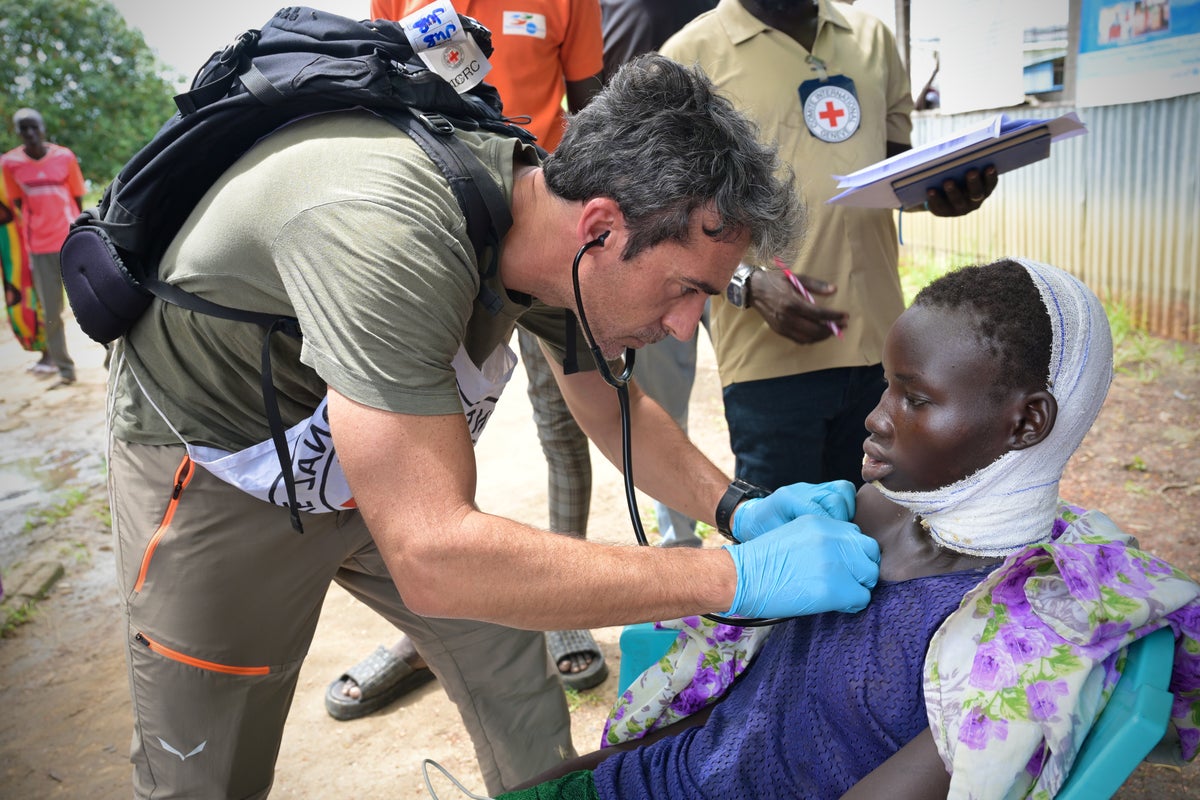
When the shaking finally stops, the true nightmare begins. The air fills with a thick, choking fog of pulverized concrete and red dust. Communication lines snap. Power grids collapse into dark tangles of wire. In the immediate aftermath, time fractures. Minutes stretch into hours as survivors dig through the rubble with their bare hands, their fingernails torn and bleeding, listening for the muffled cry of a trapped child beneath slabs of concrete.
The Anatomy of Survival
Fear is a universal language, but survival is localized. In the hours following the 7.7 quake, emergency responders, local volunteers, and families separated by chaos begin the grim, heroic work of search and recovery.
(Note: In discussing the immediate aftermath, I draw from historical patterns of disaster response in the region—where community resilience consistently bridges the gap before institutional aid can arrive.)
Back in the village, Made and Sari are alive, but their world has transformed into an alien landscape of jagged debris. Their home is a pile of splintered timber. Yet, as the dust settles, a neighbor appears from the haze, carrying an injured elder on his back. Another arrives with a jerrycan of fresh water.
This is the hidden reality of catastrophes of this scale. While the news cycles focus on the macro-level devastation—the total casualties, the economic cost, the satellite maps of destruction—the human story is written in micro-interactions. It is shared trauma. It is the old woman who refuses to leave her flattened storefront because it holds the memory of her late husband. It is the young medic who has not slept in thirty-six hours, bandaging wounds by the light of a smartphone screen that is slowly dying.
We are drawn to stories of natural disasters because they strip away the polite illusions of modern life. We spend our days worrying about quarterly reports, broken Wi-Fi, and social media metrics. We build our cities out of steel and glass and convince ourselves that we have conquered the earth.
Then the ground moves. And in ten seconds, we are reminded of our absolute fragility.
The Echoes That Remain
The shaking stops, but the psychological tremors continue for months. For Made and Sari, every creak of the rebuilding house sounds like a fault line giving way. Every distant rumble of thunder triggers a phantom panic, a tightening in the chest, an instinctive grab for a hand in the dark.
This is the burden of living in paradise. Indonesia's breathtaking beauty—its lush green volcanic peaks, its crystal-clear waters, its rich, fertile soil—is born from the very geological violence that threatens to tear it apart. The earth gives life, and the earth takes it back.
As the sun sets over the shattered coastline, casting a bruised purple and orange glow across the horizon, rescue helicopters thump distantly through the humid air. Tents are pitched on higher ground, a canvas city of refuge under an indifferent sky.
The numbers will eventually be tallied. The reports will be filed in government archives. The headlines will shift to the next global crisis. But for those who stood on the earth when it forgot how to hold them, the world has changed forever. They look at the horizon not with casual appreciation, but with a wary, abiding respect—knowing that beneath their feet, the slow, relentless grinding of the world never truly stops.