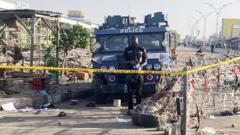
The coordinated suicide bombings in Gwoza, Borno State, which claimed at least 23 lives and left dozens more maimed, represent more than a localized tragedy. They signal a catastrophic breakdown in the "intelligence-led" security strategy that the Nigerian government has touted as the final nail in the coffin for regional insurgency. On June 29, 2024, a series of blasts—triggered by female attackers at a wedding, a funeral, and a hospital—shattered the fragile illusion of a defeated enemy. This was not a random act of desperation. It was a calculated, synchronized operation designed to exploit the specific social vulnerabilities of a community attempting to reclaim a sense of normalcy.
The attackers hit targets where crowds were guaranteed. This methodology reveals a sophisticated understanding of local surveillance gaps. By utilizing women as the primary delivery systems for these improvised explosive devices (IEDs), the perpetrators bypassed traditional security checkpoints that are often culturally hesitant to conduct intrusive searches on females. The result was a bloodbath that serves as a grim reminder that the tactical evolution of insurgent groups in the North-East is outpacing the state's defensive measures.
The Myth of the Decimated Insurgency
For the past two years, official communiqués from Abuja and the military high command in Maiduguri have leaned heavily on the narrative of mass surrenders. While it is true that thousands of fighters and their families have emerged from the Sambisa Forest to enter government rehabilitation programs, this exodus has created a dangerous survivorship bias in security assessments. The focus shifted toward the logistics of "de-radicalization" while the core cells of the Islamic State West Africa Province (ISWAP) and the remnants of Boko Haram shifted their operational base deeper into the ungoverned spaces of the Mandara Mountains.
Gwoza sits in the shadow of these mountains. The geography is a nightmare for conventional infantry but a sanctuary for guerrilla units. The militants have transitioned from holding territory—which made them easy targets for airstrikes—to a mobile, asymmetric model that relies on "sleeper" cells embedded within the very populations the military is supposed to protect.
The "why" behind the Gwoza attack is rooted in psychological warfare. When an insurgent group loses the ability to fight a pitched battle, it resorts to spectacular violence to prove its relevance. By hitting a wedding and then a funeral for the victims of that same wedding, the attackers created a cycle of terror that paralyzes social life. It tells the survivors that nowhere is safe—not even their moments of grief or celebration. This is how you break a population that has already begun to trust the state again.
The Intelligence Vacuum in the North-East
The failure to intercept the Gwoza bombers highlights a systemic issue in how intelligence is gathered and utilized in Nigeria’s security architecture. There is a profound disconnect between technical intelligence—intercepted signals and drone surveillance—and human intelligence (HUMINT) on the ground.
In many parts of Borno State, the relationship between the civilian population and the security forces remains strained by years of heavy-handed tactics and a perceived lack of protection. When the local populace does not feel safe sharing information about suspicious newcomers or unusual movements, the military is effectively blind. The attackers in Gwoza did not materialize out of thin air. They needed logistics, transportation, and a safe house to prime their vests. Someone saw them. The fact that no one reported them, or that those reports were not acted upon, is the real crisis.
Furthermore, the proliferation of IED components across the Sahel has made the manufacture of these weapons nearly impossible to track. Fertilizers, chemicals, and electronic triggers are smuggled through porous borders that remain largely unmonitored. Despite billions of naira spent on border security, the reality on the ground is a sieve. Corruption at border outposts remains a significant factor; a few thousand naira can often buy passage for a vehicle that has never been searched.
The Gendered Weaponization of Terror
The use of female suicide bombers is a recurring nightmare in the Lake Chad Basin, yet the security response remains remarkably static. This tactic is chosen for its efficiency in penetration. In many conservative communities, male security personnel are discouraged from patting down women, and there is a chronic shortage of female officers at checkpoints.
The insurgents exploit this cultural norm with ruthless precision. They often use coerced women or girls, some of whom may not even be aware of the nature of the "packages" they are carrying until they are remotely detonated. This creates a secondary layer of trauma for the community, as the very people they are conditioned to protect become the instruments of their destruction.
To address this, the Nigerian security apparatus needs more than just "more boots on the ground." It requires a radical shift in how it engages with the female population. This includes the recruitment and deployment of thousands of female intelligence officers and community liaisons who can operate in spaces that are currently off-limits to the male-dominated military structure.
Economic Desperation as a Recruitment Tool
While ideology plays a role, the persistent "how" of these attacks is fueled by the biting economic reality in the North-East. The destruction of local markets and the displacement of farmers have created a vacuum of opportunity. When the state fails to provide a viable economic future, insurgent groups find it easier to recruit—or "rent"—individuals for logistical support.
A young man who cannot afford to feed his family is much more likely to look the other way when a suspicious group moves into a neighboring compound if he is paid in cash. This is the "shadow economy" of the insurgency. Until the Nigerian government addresses the fundamental issues of food security and land access in Borno State, the military will continue to fight a hydra. Every time a head is cut off, two more grow back, nourished by poverty and resentment.
The Gwoza attacks should serve as a cold shower for those who believe the conflict in the North-East is in its "final stages." It is not. It is simply changing shape. The shift from holding territory to urban IED attacks requires a different kind of warfare—one fought with better intelligence, deeper community trust, and a relentless focus on the logistics of terror.
The Regional Implications of the Gwoza Breach
The insecurity in Nigeria’s North-East does not stay in Nigeria. The proximity of Gwoza to the Cameroonian border means that these cells are likely utilizing cross-border trails that the Multinational Joint Task Force (MNJTF) has failed to secure effectively. The lack of synchronized patrolling between Nigeria and its neighbors allows militants to play a deadly game of hide-and-seek, retreating across the border whenever the heat becomes too intense.
The "definitive" nature of this crisis is that it is a regional contagion. If Abuja cannot secure a strategic town like Gwoza, which has a significant military presence, then smaller villages have no hope. The international community often looks at these events as isolated "terrorist incidents," but they are actually symptoms of a failing regional security pact that prioritizes national sovereignty over collective safety.
The Nigerian government must stop measuring success by the number of bodies counted in the forest and start measuring it by the safety of the civilian population in the towns. The Gwoza massacre is a stark admission that, despite the rhetoric of victory, the state has lost its grip on the most fundamental duty of any government: the protection of its citizens' lives during their most vulnerable moments.
The immediate priority must be a complete overhaul of the HUMINT network in Borno State. This means incentivizing local cooperation through genuine protection and economic reintegration, rather than just the threat of force. It means acknowledging that the war has moved from the bush to the wedding hall, and the security strategy must follow it there with specialized urban counter-terrorism units that are integrated into the community, not barricaded away from it.
Nigeria’s security leaders need to face the brutal truth that their current "containment" strategy is merely managing a slow-motion disaster. Each bombing in a "liberated" area resets the clock on recovery and deepens the scars of a generation. The time for congratulatory press releases about "degraded" capabilities is over; the charred remains in Gwoza tell a different story.
Demand a public audit of the billions allocated to the "North-East Development Commission" and the specific outcomes of the border surveillance initiatives. If the money isn't stopping IED components from reaching the Mandara Mountains, then the money is being wasted or stolen.