The sun over the Farrer electorate doesn't care about backroom deals. It beats down on the Riverina and the Sunraysia with a relentless, impartial heat, baking the red earth and shimmering off the irrigation channels that keep the vineyards and orchards alive. In the towns like Albury, Deniliquin, and Griffith, people measure their lives by the price of water, the health of their topsoil, and the reliability of the person standing next to them. But in the air-conditioned offices of Sydney and Canberra, the measurement is different. There, life is measured in preferences.
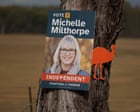
Michelle Milthorpe knows the weight of that red dust. As an independent candidate for the Farrer by-election, she has spent her weeks walking the main streets, listening to the echoes of concerns that haven't changed in a generation. She represents a specific kind of threat to the established order: the local who decided that "enough" was a destination they had finally reached.
Then came the decision that changed the math of the outback.
The Liberal and National parties, the traditional titans of the bush, looked at the chessboard and made a move that felt, to many on the ground, like a cold splash of water in a drought. They decided to direct their preferences to Pauline Hanson’s One Nation. It wasn't a move born of shared ideology or a sudden passion for One Nation's platform. It was a mathematical survival tactic. A tactical squeeze designed to ensure that the independent threat—the Milthorpe threat—was neutralized before the first ballot box was even sealed.
The Mathematics of Survival
To understand why this matters, you have to look past the slogans. Australian elections are won on the margins, and in a by-election, those margins become razor-sharp. When the Coalition parties—the Liberals and the Nationals—decide to funnel their "second choice" votes toward One Nation, they are building a wall.
Consider a hypothetical voter named Elias. Elias has farmed near Wentworth for forty years. He’s a traditionalist. He usually votes National because his father did, and his grandfather before him. But lately, he feels the major parties have drifted. He likes what he hears from Milthorpe—someone who speaks about local water rights without checking a party handbook first.
Under this new preference deal, if Elias stays loyal to his party but Milthorpe gains momentum, the "safety net" of his vote doesn't slide toward the independent. It slides toward One Nation. The major parties are betting that their base would rather see a populist firebrand in the seat than a local independent who might actually hold the balance of power.
It is a high-stakes gamble with the trust of the electorate. By positioning One Nation above Milthorpe on their recommended "How-to-Vote" cards, the Coalition is sending a clear signal: an independent voice is more dangerous to the system than a radical one.
The Invisible Stakes
Why is an independent so terrifying to the machine?
The answer lies in the loss of control. In the standard two-party system, the whips tell the members how to vote. The policy is decided in a room hundreds of kilometers away from the dust of Farrer. An independent breaks that circuit. They are a wild card in the deck, someone who can’t be threatened with a loss of party pre-selection or a demotion from the front bench.
Milthorpe’s campaign was built on the idea that Farrer has been "safe" for too long. In political terms, "safe" is a polite word for ignored. When a seat is guaranteed to go to one side, the investment dries up. The promises become thinner. The attention shifts to the "swing" seats in the suburbs of Melbourne or Sydney.
The preference deal is an attempt to keep Farrer safe. But safe for whom?
The Nationals have long claimed to be the only true voice for the bush. Yet, by aligning their preferences with One Nation—a party that often clashes with the more moderate wings of the Liberal party—they risk alienating the very people they claim to protect. They are inviting a different kind of energy into the room, all to keep the door shut on a local challenger.
The Human Cost of Tactical Voting
Walk into any bakery in Albury and you’ll hear the same thing: people are tired of the games. There is a profound exhaustion that comes from realizing your vote is being traded like a commodity before you’ve even cast it.
When the news of the preference deal broke, the reaction wasn't just political; it was visceral. It felt like a betrayal of the "local first" ethos that rural Australia prides itself on. To the voters, Milthorpe wasn't just a name on a ballot; she was a symptom of a desire for a different conversation. By trying to bury her candidacy under a mountain of preferences, the Coalition inadvertently highlighted exactly why she was running in the first place.
Imagine the tension in a small-town community center. On one side, you have the party faithful, grimly defending the strategy as a necessary evil to keep Labor or a "disruptive" independent out. On the other, you have the disillusioned, who see the move as proof that the parties care more about their own grip on power than the quality of representation the region receives.
The deal creates a strange friction. The Liberals, often seen as the party of urban professionals and economic stability, find themselves shaking hands with a movement defined by grievance and populism. The Nationals, the self-proclaimed stewards of the land, find themselves preferring a party that often lacks a detailed agricultural policy over a candidate who lives and breathes it.
The Preference Trap
Preferences are the "invisible ink" of Australian democracy. Most voters follow the card handed to them at the gate of the polling booth without a second thought. They trust the party they support to lead them to the next best option.
But this deal is a test of that trust.
If the voters of Farrer decide to ignore the "How-to-Vote" cards, the strategy could backfire spectacularly. There is a growing movement of "below the line" voters—people who take the time to number every box according to their own conscience, not a party’s orders. If Milthorpe can tap into the resentment caused by this deal, the very tactic meant to sideline her could become her greatest asset.
She isn't just fighting an opponent anymore; she is fighting a coordination.
The stakes are higher than a single seat in Parliament. This by-election has become a litmus test for the future of rural politics in Australia. Can the major parties continue to manage their heartlands through tactical voting and preference swaps? Or has the "human element"—the genuine, unscripted desire for local representation—finally reached a boiling point?
A Long Shadow in the Basin
The Murray-Darling Basin is a place of long memories. People remember who stood by them during the millennium drought. They remember which politicians showed up for the photo op and who stayed for the town hall meeting when the cameras were gone.
The decision to preference One Nation over Milthorpe will be remembered long after the posters are taken down. It will be cited in pubs and on headers during harvest as the moment the machine showed its gears.
Politics is often described as the art of the possible. But in Farrer, it has started to look more like the art of the cynical. The Coalition is betting that the fear of the "other"—whether that’s a Labor government or an unpredictable independent—is stronger than the desire for change. They are betting that the voters will follow the numbers, not their gut.
But the gut is a powerful thing in the country. It’s what tells a farmer when the rain is coming or when a sheep is sick. And right now, the gut of the Farrer electorate is telling them that something in the system is broken.
The preference deal isn't just a blow to Michelle Milthorpe. It is a challenge issued to every voter in the district. It asks them a simple, uncomfortable question: Who owns your vote? Is it yours to give, or is it a chip in a game being played by people who don't have to live with the consequences of the outcome?
As the sun sets over the silos, the shadows grow long. The red dust settles on the windshields of utes and the porches of farmhouses. The deal is done, the cards are printed, and the machinery of the major parties is humming. But the final word doesn't belong to the strategists in the city. It belongs to the people who will wake up tomorrow, look at the dry earth, and decide for themselves who truly speaks for the land.
The tally room will eventually provide the numbers, but it won't capture the feeling of a voter standing in a corrugated iron shed, pen in hand, looking at a list of names and realizing that for the first time in their life, the party they trusted is asking them to look away from their neighbor and toward a ghost.