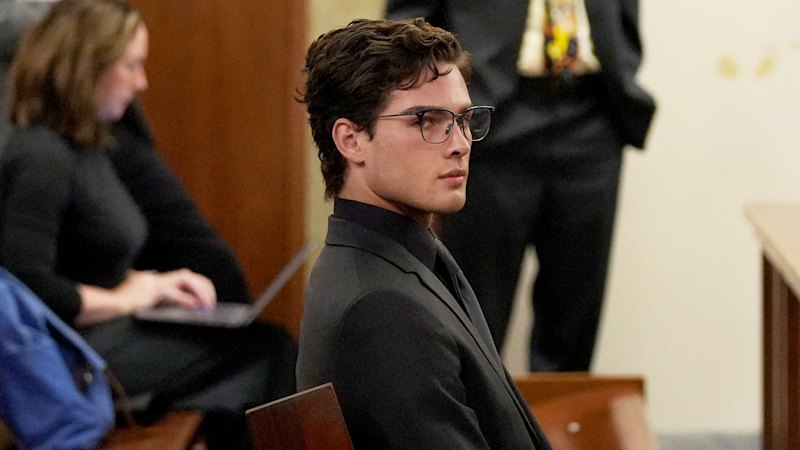
Fluorescent lights hum over scuffed linoleum. A clerk shuffles paper with dry, rhythmic snaps. Somewhere behind a heavy oak door, a buzzer clicks twice, and a young man who has spent years perfecting his angles in glass mirrors steps up to a microphone that does not care about his jawline.
Not guilty.
Two words. Flat. Ordinary. Utterly stripped of ring lights, color grading, and algorithm-friendly pacing.
When a social media influencer known online as Clavicular—a creator who built a following around the hyper-curated subculture of "looksmaxxing"—enters a not guilty plea to a charge of rape, the internet reacts the way it always does when digital fame collides with criminal law. Split screens. Comment wars. Instant verdicts delivered by strangers who have never seen a police report or sat through a cross-examination.
I have spent years covering rooms where real lives get weighed against tiny, unforgiving details—rooms that smell like stale coffee and wool coats, where nobody gets a second take or a flattering preset. The contrast between a creator's polished feed and the quiet heaviness of a courtroom is jarring every single time. Even when you know how the system works, watching a digital persona hit a brick wall of legal procedure still feels strange, unsettling, and heavy with things left unsaid.
The Architecture of a Digital Mask
To understand why a headline about a looksmaxxing influencer feels so disorienting, you first have to look at the culture that made him visible.
Looksmaxxing began in corners of online forums before spilling into mainstream short-form video feeds. At its core, it treats human appearance as an engineering problem—something to be optimized through grooming, posture, skincare, fitness, extreme routines, or cosmetic procedures. Some creators keep it light and practical, offering basic advice on haircuts or lifting weights. Others push further into rigid hierarchies that rank faces like stock tickers and turn insecurity into content.
Views reward certainty. Algorithms rarely pay out for nuance, hesitation, or quiet self-doubt.
When a creator posts dozens of clips showing sharp lighting, measured pauses, and confident posture, viewers start confusing performance with character. That is a natural human shortcut, though a risky one. We are wired to read faces and voices for cues about who someone is. Short-form video hijacks that instinct while editing out the messiness of real life.
Consider what happens next: a person becomes famous for control—control over lighting, diet, angles, and public image—and suddenly faces an accusation that strips away control entirely. A criminal charge is not a comment section you can mute or a bad clip you can archive. It is slow, procedural, and bound by rules of evidence that move at a glacial crawl compared to a fifteen-second reel.
A Hypothetical Evening Outside the Feed
Let me step back from the headline for a moment and offer a hypothetical scenario to show how easily public stories get flattened before facts are tested. Imagine a fictional creator named "Devon" who posts daily videos breaking down facial symmetry and discipline. One night after an event, an allegation surfaces involving someone he met off-camera. Within hours, clips from Devon's old streams are stitched together by strangers. One group insists his polished confidence proves arrogance and guilt; another insists the accusation is a coordinated smear meant to tear down a rising creator. Neither group was in the room. Both groups act as though watching a highlight reel makes them eyewitnesses.
That hypothetical mirrors the trap every high-profile criminal case triggers online. People treat a not guilty plea like a confession of defiance or a declaration of innocence, when legally it does something much narrower.
A plea of not guilty is a procedural starting line. It requires the prosecution to prove every element of the alleged offense beyond a reasonable doubt. It preserves the defendant's constitutional rights while the case moves through discovery, motions, hearings, and potentially a trial. In a legal system built on burden of proof, pleading not guilty does not mean the event did not happen in every sense, nor does it mean guilt has been settled. It means the state must make its case in court, under oath, before a judge or jury.
I have watched spectators walk out of courthouses angry because the law felt too slow or too technical for the outrage burning in their chests. That frustration is understandable. When sexual assault or rape is alleged, the stakes are deeply personal and painful. Yet courts are designed to test evidence rather than match the speed of a trending topic.
Why Certainty Travels Faster Than Proof
Why do online audiences rush to judgment so quickly whenever an influencer is accused of a serious crime?
Part of the answer is historical. Long before smartphones existed, public spectacles—from town squares to tabloid headlines—turned private tragedies and legal battles into entertainment. Technology did not invent voyeurism; it just removed the commute.
Another part is psychological. Uncertainty makes people uneasy. Saying I don't know yet, and the court process hasn't played out feels unsatisfying in a culture trained to tap, scroll, and decide in two seconds. Taking a hard stance gives people a sense of moral clarity, even when they have only read a single sentence or watched a ten-second clip.
There is also a distinct tension around internet subcultures focused on physical appearance. Critics often view looksmaxxing through a lens of vanity and superficiality, which can make people quick to assume the worst when a creator faces an allegation. Supporters, on the other hand, sometimes rally blindly around a familiar online figure out of loyalty or resentment toward critics. Both reactions replace careful attention with tribal reflex.
Real accountability requires patience that feeds are built to destroy.
And let's be honest: the legal process itself can feel opaque and intimidating to ordinary people. Terms like arraignment, probable cause, bond conditions, and continuances sound distant until you see how they shape someone's day-to-day reality. Even seasoned observers sometimes pause to double-check local rules or timeline details because criminal procedure varies by jurisdiction and moves in stages that rarely match how news is packaged.
Two Lives Caught in the Aftermath
Behind every sensational headline involving a rape allegation stand real human beings whose lives are suddenly defined by a single, terrible word.
On one side is the person who made the accusation. Bringing a sexual assault allegation forward—especially when the accused has an online audience that may mobilize in defense or attack—can expose an accuser to scrutiny, disbelief, and online harassment. Even when cases proceed quietly through official channels, the emotional toll of reliving events, answering questions, and waiting on institutions is immense.
On the other side is the accused individual—in this case, Clavicular—who has pleaded not guilty and is entitled to the presumption of innocence under the law unless and until guilt is proven in court. A felony accusation alters reputation, livelihood, relationships, and freedom long before any verdict is reached.
Neither side lives inside a neat narrative arc. Real life rarely offers tidy villains or effortless heroes. Sometimes evidence is straightforward; sometimes memories clash; sometimes witnesses disagree; sometimes timelines are disputed. That messiness is precisely why trials exist—and why outsiders scrolling on a phone rarely hold the full picture.
Looking Closely When Noise Peaks
When a story like Clavicular's not guilty plea circulates, how should a thoughtful reader approach it without getting pulled under by the noise?
First, separate the legal posture from the underlying facts. A plea is an entry into the legal process, not the final chapter. Watch for verified court filings, official statements from prosecutors or defense counsel, and credible reporting rather than rumor threads amplified for engagement.
Second, pay attention to what is missing. Social media thrives on fragments—a cropped video, an unverified screenshot, a dramatic caption. Missing context is usually the loudest thing in the room.
Third, hold space for gravity. Rape is a severe crime, and false or misleading claims in any public dispute also carry real harm. Treating the subject with seriousness means refusing to turn human trauma or legal jeopardy into cheap sport.
A courtroom does not care about follower counts.
When the heavy door swings shut and the crowd outside goes back to staring at glowing screens, the quiet work of law and memory begins—slow, unglamorous, and unforgiving.