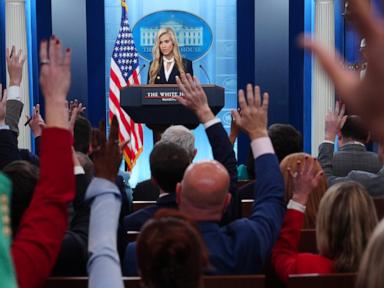
Silence.
In a room built for noise—for clattering keyboards, raised voices, camera shutters clicking in rapid bursts, and the low hum of television trucks parked outside on the driveway—a deliberate quiet carries more weight than a shout. You can feel it in your chest before you even hear it on the broadcast feed. The blue curtain hangs flat behind the mahogany lectern. The presidential seal glows softly. And for a few minutes, or a few dozen minutes, the exchange that millions of citizens treat as a daily mirror of power shrinks into something tight, clipped, and guarded. Don't forget to check out our previous coverage on this related article.
I have sat in rooms like that—not always the James S. Brady Press Briefing Room in Washington, yet rooms governed by the same unspoken choreography of power and scrutiny. You learn early that a press debut is never just about the person standing behind the microphone. It is about the collision between two worlds that rarely share the same definition of honesty. One world prizes message discipline, timing, and risk control. The other prizes friction, follow-ups, and the unscripted crack in a polished sentence.
When a new White House press secretary steps up to that podium for the first time, the headlines tend to arrive in neat, predictable packages: brief remarks, limited questions, harsh reviews. On paper, that sounds like a routine day in political coverage. A newcomer finds their footing. Critics sharpen their pens. Defenders urge patience. To read more about the history of this, Al Jazeera offers an excellent summary.
Yet if you stop at the scorecard, you miss the real story. What happens when a debut feels rushed or tightly rationed is not merely a bruised ego in the press corps or a rough night for a communications team. It is a test of how much daylight an administration is willing to let into its own decisions—and how quickly trust frays when citizens suspect the answers were chosen before the questions were even asked.
The Choreography Behind the Curtain
To understand why a short, tightly controlled debut sparks immediate backlash, it helps to strip away the cable-news theatrics and look at the mechanics of the room.
A White House press briefing is not a town hall, nor is it a courtroom cross-examination, though people often watch it as if it were both. Historically, the press secretary has served as a bridge—a translator moving back and forth between the West Wing's policy machinery and the public's right to know what that machinery is actually doing. Sometimes that bridge holds steady under heavy weight. Sometimes it sways. Sometimes it feels like a drawbridge pulled halfway up.
(Note: The following portrait of a beat reporter and a communications aide is a hypothetical scenario created to illustrate the human dynamics behind a high-stakes briefing debut.)
Picture Elena, a fictional veteran correspondent who has spent twelve years covering federal agencies and policy rollouts. She does not wake up hoping for a viral clip. She wakes up with a notebook full of specific, unglamorous questions: why a regulatory deadline slipped by three weeks, how a proposed rule affects rural clinics, whether an overseas envoy was briefed before a public statement went out. She has forty-nine seats in front of her, rows of colleagues holding phones and legal pads, and maybe twenty seconds to get a straight answer on the record before the next hand shoots up.
Now picture Marcus, a hypothetical junior staffer sitting in the back row of the briefing room, watching the clock and the new press secretary's posture. Marcus knows how much preparation goes into day one. He has seen binders thicker than phone books stacked on a desk at midnight, bullet points vetted by lawyers, policy directors, and senior advisors who each fear one stray word could move markets or ignite a firestorm. When the briefing is kept brief and the questions are strictly rationed, Marcus does not see cowardice. He sees a team terrified of tripping on its own shoelaces before it even leaves the starting block.
Both Elena and Marcus are reacting to real pressures. That is the part that gets lost when reviews turn harsh within hours.
A new press secretary enters the job under a spotlight that leaves almost no room for awkwardness. Unlike a private-sector executive who can spend ninety days quietly listening before speaking publicly, a press secretary's learning curve happens live, on camera, with every pause dissected on social media by dusk. If they speak too long, critics call them evasive or winded. If they keep remarks brief and call on only a handful of reporters before wrapping up, critics call them evasive, rehearsed, or dismissive of accountability.
It is a narrow wire to walk. And on a debut, the wire often feels greased.
Why "Brief" and "Limited" Hit Such a Nerve
Admit it: most of us have been on the receiving end of a non-answer, and it rarely makes us feel calm. Whether it is a customer service chat looping the same canned line, a manager dodging a fair question in a team meeting, or a public official reading tightly vetted talking points before ducking out of the room, truncated communication triggers an immediate instinct to lean forward and ask, What are you hiding?
In politics, that instinct is magnified tenfold.
When a new White House press secretary delivers brief remarks and takes a limited set of questions, the frustration rarely centers on the clock alone. Nobody truly cares whether a briefing lasts twenty-two minutes or forty-eight minutes if the answers contain substance. People care about proportion. When major questions hang in the air—questions about economic strain, foreign policy flashpoints, domestic unrest, or administrative competence—a short, tightly bounded session can feel out of scale with the moment.
There is also the question of who gets called on and who gets left standing with a hand raised. In the briefing room, calling on reporters is never neutral. Even when done with the best intentions, every selection signals priorities: mainstream outlets versus smaller publications, beat reporters with deep institutional memory versus newer voices, friendly follow-ups versus sharp pushback. When a debut limits the pool of questions sharply, critics do not just hear silence from the podium; they hear a door closing on lines of inquiry that have not yet been tested.
Let's be honest with ourselves about how media ecosystems work today, too. Harsh reviews of a press debut do not emerge in a vacuum. Cable panels, opinion columns, and digital feeds reward conflict and instant verdicts. A bumpy first outing becomes an easy narrative hook—a sign of "rough start" or "rocky debut" that can stick until a better performance or a major news event displaces it. Sometimes the criticism is sharp because the answers genuinely fell flat. Sometimes it is sharp because the format itself gave critics plenty of room to argue over what wasn't said rather than what was.
Both realities can be true at once. That tension—between genuine scrutiny and instant judgment—is exhausting to watch, and even harder to navigate from inside the room.
The Invisible Stakes for Everyone Else
If you do not live inside the Washington press bubble, it is easy to shrug and treat a rocky press briefing as insider sport. Let the pundits trade jabs. Let the commentators score points.
If we treat a briefing as mere insider theater, we miss what it actually costs outside the beltway.
(Here is a metaphor to make the mechanism concrete: think of a daily press briefing like the pressure-release valve on a household boiler. It does not heat the house by itself, and it can be noisy when steam vents. Yet if you weld the valve shut because you dislike the hiss, the pressure does not disappear—it builds quietly inside the pipes until something gives.)
Public trust rarely collapses overnight from a single bad speech. More often, it erodes drip by drip, through moments where citizens feel talked at rather than spoken to. When officials offer brief statements and cut off questioning early, people who are already skeptical of institutions find confirmation of their worst assumptions. Meanwhile, people who are simply trying to make sense of complex events walk away with fewer concrete facts and more noise.
Consider what happens in everyday life when information is scarce or overly curated:
- Rumors fill the vacuum. When official answers are minimal, speculation rushes in to supply motives, backroom deals, and hidden agendas—often far worse than the mundane reality.
- Accountability slows down. Press briefings are one of the few public settings where officials have to respond in real time to uncomfortable facts rather than releasing a polished statement hours later with no pushback.
- Citizens tune out or harden. Some people check out completely because every exchange feels staged; others dig into partisan corners where their side is always right and the other is always plotting.
None of that is abstract. It shapes how people vote, how they talk around the dinner table, and whether they believe public institutions can handle hard truths without flinching.
What a Debut Actually Reveals—and What It Doesn't
Here is where a grounded perspective matters most: a first briefing is a data point, not a final verdict.
History is full of press secretaries and communicators whose first appearances looked stiff, defensive, or overly cautious, only to grow into commanding presences once they mastered the rhythm of the room and earned credibility with their own leadership. Conversely, history also offers plenty of polished debuts that masked thin substance or eventual burnout.
So what can you read from a brief, tightly controlled opening performance?
You can read the risk posture of the team behind it. A cautious debut usually tells you that the administration—or the press secretary personally—is prioritizing control over candor in the opening act. Maybe they are still learning where the policy landmines are buried. Maybe they are waiting for clearer instructions from the top before speaking off the cuff. Maybe they simply underestimated how hungry reporters and viewers are for unvarnished detail.
What you cannot yet know on day one is whether that caution is a temporary shield or a permanent habit. Will the next briefing go longer? Will tough follow-up questions get real answers rather than pivot lines? Will the press secretary show the willingness to say, "I don't have that number in front of me, and I will get it to you"—a sentence that takes five seconds, costs zero dignity, and builds more credibility than ten minutes of smooth spin?
That single phrase is one of the rarest and most underrated tools in public communication. Admitting a gap in real time requires confidence. Dodging a simple question with a rehearsed detour usually projects fragility, even when the speaker is trying to sound tough.
Beyond the Scorecard
Every time a new press secretary faces the cameras, the same tug-of-war plays out. The podium wants order, clarity, and control. The chairs across the aisle want candor, completeness, and room to press.
Neither side is going to stop wanting what it wants. The friction is built into the architecture of democratic accountability. When that friction produces sharp questions and honest pushback, the system is working—even when it looks messy on television. When the exchange feels rushed, selective, or overly scripted, people notice. They notice the brevity. They notice the unanswered follow-ups. And they notice the gap between the polished words at the lectern and the messy questions still hanging in the air.
Picture the room after the cameras click off and the lights begin to cool. The briefing lasted only a fraction of an hour. A handful of hands went up, a few were called, and several stayed raised until the signal came to wrap. Outside, traffic moves along the avenue, phones buzz with breaking alerts, and millions of people go on with their day—carrying whatever sliver of clarity, or doubt, managed to make it past the podium.
The microphone goes cold in seconds. The questions left hanging in the air take much longer to fade.