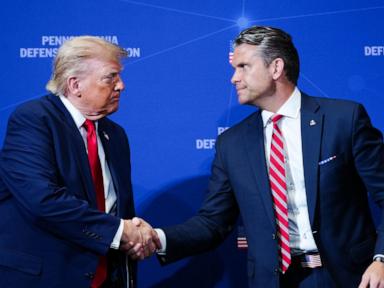
Silence.
When the commander-in-chief steps up to a bank of microphones on a Tuesday afternoon and declares he has "every intention" of keeping his Secretary of Defense, the sound that echoes loudest is not the applause of his allies, nor the outrage of his critics, but the sudden, sharp intake of breath from three million people who wear the uniform or draw a paycheck from the Department of Defense.
To the casual observer scrolling past a push notification on a cracked phone screen, those four words—every intention to keep—look like standard Washington boilerplate. Just another day in the capital. Just another politician standing behind his pick while the cable news chyrons scream in shades of crimson and navy.
They are wrong.
Behind those words sits the heaviest desk in the world, a mahogany expanse inside the E-Ring of the Pentagon where every signature moves aircraft carriers across oceans, authorizes midnight raids in nameless valleys, and decides whether a twenty-two-year-old from Ohio comes home in a pressurized cabin or a flag-draped transfer case. When President Donald Trump plants his feet and announces that Pete Hegseth isn't going anywhere, he is not merely making a personnel decision. He is drawing a bright, unforgiving line through the center of American military tradition, testing how much institutional friction the world’s most powerful fighting force can absorb before the gears begin to grind.
The Architecture of the E-Ring
To understand why a single sentence from the Oval Office sends tremors from Fort Bragg to the South China Sea, you have to step away from the television cameras and picture the fluorescent-lit hallways of the Pentagon at five in the morning.
Imagine a hypothetical figure—let’s call him Colonel Marcus Vance, a twenty-four-year logistics officer whose knees ache when it rains in Northern Virginia and whose walls are covered in plaques from dusty bases you couldn't find on a tourist map. Marcus doesn't care about cable news hits. He doesn't care about book deals, culture-war soundbites, or who won the afternoon press briefing. Marcus cares about whether the spare turbine blades for the F-35 fleet will arrive in Yokosuka before typhoon season, and whether the chain of command above him is predictable enough that he can stake his career—and his soldiers' lives—on the orders coming down the pipe.
For decades, the Pentagon operated like a massive, multi-ton flywheel. Presidents came and went, bringing different philosophies, different budgets, and different wars. Yet the Secretary of Defense almost always served as a shock absorber between the raw, chaotic electricity of partisan politics and the rigid, apolitical machinery of the armed forces. Think of men like Robert Gates, Jim Mattis, or Lloyd Austin—figures whose resumes were built over forty years inside sprawling bureaucracies, navigating four-star egos and trillion-dollar supply chains.
Pete Hegseth arrived at that desk from an entirely different universe.
A decorated combat veteran of Iraq and Afghanistan, yes, a former Army National Guard major who knows what dust tastes like in Samarra and what weight body armor puts on a man’s shoulders. Yet his path to the pinnacle of military power bypassed the traditional proving grounds of three- and four-star command, running instead through the bright lights of a weekend television studio. That contrast is the exact reason his tenure has been a lightning rod from the very first hour—and why every rumor of his potential departure carries the weight of a constitutional stress test.
Why the Rumor Mill Never Stops
Washington loves a palace intrigue story almost as much as it loves an expense-account steak, and the whispers around Hegseth’s survival didn't appear out of thin air. They grew out of a relentless collision between an outsider’s mandate and an insider’s fortress.
When a president taps a media-savvy disruptor to overhaul what he views as a bloated, overly bureaucratic defense establishment, friction isn't an accident. It is the entire point. Hegseth entered the building promising to strip away social initiatives, refocus the military purely on lethality, and shake up a senior officer corps that he and the president frequently criticized. Predictably, the building pushed back—not with public mutinies, because uniformed officers don't do that, but with the slow, suffocating inertia that only a five-sided concrete labyrinth can muster.
Leaks began to drip into the press. Questions mounted over management style, internal vetting, staffing shakeups, and whether an executive whose primary management experience involved advocacy groups and television production could steer an agency with an annual budget exceeding $850 billion. Every few weeks, the familiar DC chorus started humming the same tune: How long until the president cuts him loose?
After all, history offers a clear warning label for anyone serving at the pleasure of Donald Trump. During his first term, the revolving door at the top of the national security apparatus spun fast enough to generate its own weather system. Jim Mattis resigned over Syria. Mark Esper was fired via tweet after clashing over the use of active-duty troops during domestic protests. Acting secretaries filled the void like understudies reading lines off a clipboard while the theater burned.
That history is why Trump’s flat declaration—that he has "every intention" of keeping Hegseth—lands with such a heavy thud. It signals that the president views the attacks on his defense secretary not as legitimate warnings about competence or stability, but as an extension of the exact political warfare he has spent a decade fighting.
The Invisible Stakes of Unconditional Backing
Let’s be honest about something most pundits won't admit: from the outside, watching a president double down on a embattled cabinet chief looks simple, almost cinematic. Loyalty rewarded. Enemies defied. End of scene.
Inside the building, the reality is infinitely messier and far more nerve-wracking.
Consider what happens the morning after the president makes that statement. Inside the Pentagon, thousands of senior civil servants and uniformed officers who were quietly hedging their bets—slow-walking controversial directives, waiting to see if the political winds would shift before committing their signatures—suddenly realize the floor isn't going to open up beneath the Secretary’s office. The temporary storm has become the permanent climate.
In one sense, that clarity is what any military organization craves. Ambiguity is poison in a chain of command. If foreign adversaries in Beijing, Tehran, or Moscow believe the American Secretary of Defense is a lame duck packing his boxes, deterrence weakens by the hour. Adversaries test weak seams; they probe gray zones when they think the decision-maker in Washington is distracted by his own political survival. By planting his flag firmly behind Hegseth, Trump eliminates the immediate doubt about who speaks for the Commander-in-Chief.
Yet that same certainty carries a sharp, hidden edge.
When a cabinet secretary’s survival depends entirely on personal loyalty to the president rather than broad institutional confidence or bipartisan Senate backing, the gravitational pull inside the building shifts. The incentive to deliver uncomfortable truths—the kind of grim intelligence assessments or logistical warnings that presidents hate hearing—shrinks. Nobody wants to be the general who walks into the room and says, Mr. Secretary, the timeline won't hold, the ships aren't ready, and the strategy has a hole in it, when the entire culture rewards alignment over friction.
I remember talking years ago with a retired Pentagon planner who had lived through the early, chaotic months of the Iraq surge. He described what happens when top leaders treat every internal objection as disloyalty. People don't revolt, he told me. They just stop raising their hands. They write narrower memos. They bury the bad news on page forty-seven of an appendix nobody reads. And six months later, when a crisis hits at three in the morning, the people at the top discover they have been flying blind in a cockpit where someone taped over the warning lights.
Between the Foxhole and the Flagpole
To dismiss Hegseth’s appeal entirely, however, is to miss the very real nerve he touches among millions of veterans and active-duty troops who feel alienated from the top brass.
Spend enough time around enlisted soldiers and junior officers—the folks eating lukewarm eggs out of cardboard trays at four in the morning before a cold-weather jump—and you will hear a remarkably consistent refrain. They look up at the four-star generals testifying before Congress in crisp, ribbon-covered uniforms, speaking in smooth, sanitized consultant-speak about "holistic force integration" and "multi-domain synchronization," and they feel a million miles away from the people making the rules.
They remember the botched withdrawal from Kabul in 2021. They remember watching chaotic images of desperate civilians clinging to the fuselage of a C-17 while senior leaders insisted the operation was an extraordinary success. They remember the recruitment shortfalls that left platoons understaffed and overworked, forcing young sergeants to do the jobs of three people while Washington argued over terminology.
When Hegseth steps up to a podium and talks plainly—sometimes bluntly, sometimes provocatively—about warfighting, standards, and putting the guy in the foxhole ahead of the bureaucracy in the beltway, a massive segment of the rank-and-file nods along. To them, he isn't a television host playing dress-up. He is one of the few people in a suit who has actually worn their boots, carried a rifle in the desert, and remembers what the military is supposed to be for when all the PowerPoint slides are turned off.
That is the paradox sitting at the center of this entire drama. The very traits that make institutional Washington break out in hives—his bluntness, his outsider status, his willingness to treat bureaucratic norms like speed bumps—are the exact traits that make him indispensable to Trump’s political vision and deeply resonant with a frustrated base of veterans.
What Happens When the Music Stops
So where does a "firm intention" actually leave us?
If you have watched Washington long enough, you know that presidential backing is bulletproof right up until the exact second it isn't. History is littered with cabinet officials who enjoyed the "full confidence" of the Oval Office on a Tuesday and were cleaning out their desks by Friday afternoon. In politics, promises of permanence are always written in pencil, subject to the brutal math of midterms, sudden scandals, or a foreign crisis that exposes a fatal flaw in real time.
Yet betting on Hegseth’s imminent demise misunderstands the second-term Trump playbook. In his first administration, Trump often bowed to conventional pressure, replacing outsiders with establishment figures who promised to steady the ship—only to find those very figures leaking against him, writing tell-all books, or blocking his instincts. He learned a hard, unforgiving lesson from those years: once you feed a cabinet member to the media wolves, the wolves don't go home full. They just move on to the next target on your roster.
Keeping Hegseth isn't just about Hegseth. It is about proving that the old rules of Washington attrition no longer apply—that a sustained campaign of negative headlines, anonymous leaks, and partisan outrage cannot force the president’s hand.
Back in our hypothetical hallway in the E-Ring, Colonel Marcus Vance closes the browser tab on his desktop monitor, takes a slow sip of bitter black coffee, and pulls a thick folder of Pacific fuel-reserve projections toward the center of his blotter. The speeches will keep happening upstairs. The cameras will keep flashing on the South Lawn. The pundits will keep counting days on a calendar that only exists in their own heads.
Down on the second floor, the fluorescent lights hum, the printers spit out another stack of classified logistics manifests, and the machinery keeps turning—because whether the man in the big office stays for four years or four more weeks, the ships are already at sea, and nobody gets to hit pause on the ocean.


