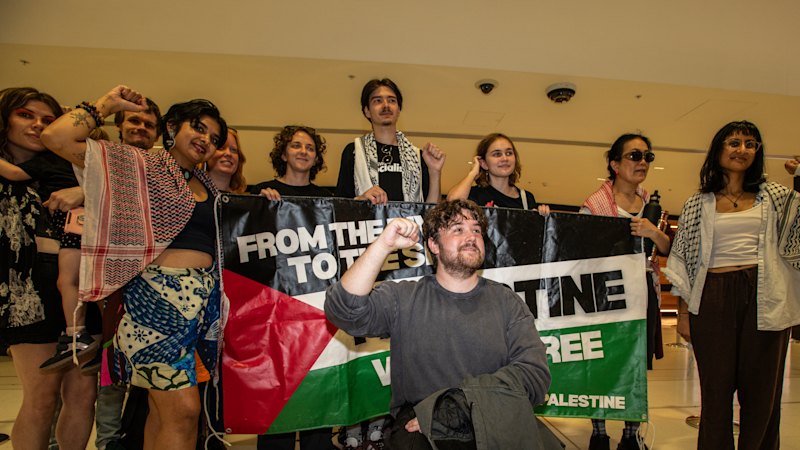
The release of six Australian nationals from Israeli detention marks the end of a physical ordeal but the beginning of a massive political headache for Canberra. These individuals, detained during a high-seas confrontation involving a Gaza-bound aid flotilla, were caught in the crosshairs of a military blockade and a desperate humanitarian mission. Their return to Australian soil follows intense behind-the-scenes negotiations and a public outcry that tested the limits of the nation’s "unshakeable" alliance with Israel. While the immediate crisis of their imprisonment has passed, the event has exposed deep fractures in how the Australian government protects its citizens abroad when their activism clashes with the strategic interests of powerful allies.
The logistics of their release involved a rapid deportation process from Ela Prison, followed by a coordinated flight path through Istanbul. This was not a simple act of clemency. It was a calculated move to de-escalate a diplomatic standoff that was becoming increasingly untenable for both Jerusalem and Canberra. The Australian government, while relieved, now faces the difficult task of addressing the legality of the blockade and the treatment of its citizens without alienating a core security partner.
The Mechanics of a Maritime Confrontation
To understand why these six Australians ended up in an Israeli prison, one must look at the specific legal and military frameworks governing the Mediterranean blockade. Israel maintains that its naval blockade is a necessary security measure to prevent the smuggling of weapons into Gaza. Activists, including the six Australians, argue the blockade constitutes collective punishment and a violation of international law.
When the flotilla refused to change course for the port of Ashdod, Israeli naval commandos boarded the vessels. What followed was a chaotic sequence of events that resulted in injuries, detentions, and a frantic scramble by the Department of Foreign Affairs and Trade (DFAT) to establish contact. The Australians involved were not mere tourists; they included journalists, photographers, and long-time human rights advocates. Their presence on the ships was a deliberate choice to use their citizenship as a shield, a gamble that only partially paid off.
The detention process in Israel is a streamlined machine. Once the activists were processed at the border, they were moved into the prison system under administrative holds. For the Australian consular staff, the challenge was twofold. They had to ensure the physical safety of the detainees while simultaneously navigating an Israeli legal system that moves with clinical efficiency when dealing with "security threats."
Consular Protection or Political Convenience
There is a recurring tension in Australian foreign policy between the duty of care for citizens and the preservation of geopolitical relationships. In this instance, the government's response was criticized as being too slow and too deferential to the Israeli narrative.
- Initial Silence: For the first 24 hours, official statements were vague, focusing on "seeking clarification" rather than demanding access.
- The Power Gap: Unlike the United States, Australia lacks the sheer diplomatic weight to force immediate concessions without offering something in return.
- The Media War: The families of the detainees became the primary drivers of the narrative, using local media to pressure the Foreign Minister into more assertive action.
This incident highlights a harsh reality for any Australian traveling into conflict zones for advocacy. The "Blue Passport" offers a degree of protection, but it is not an all-access pass to immunity. When a citizen’s actions directly oppose the military operations of a friendly nation, the Australian government’s first instinct is often to manage the fallout rather than champion the cause.
The Humanitarian Argument versus State Security
The Australian detainees maintained that their cargo consisted strictly of medical supplies, building materials, and food. From their perspective, the mission was a moral imperative. However, from a state security perspective, the flotilla was a provocation designed to break a legal maritime boundary.
This clash of worldviews is where the investigative trail gets murky. Israeli intelligence claimed that certain elements within the flotilla had ties to extremist organizations, a claim the Australian participants vehemently deny. To date, no evidence has been produced linking the six Australian detainees to any illegal group. They were, by all accounts, motivated by the humanitarian crisis in Gaza, yet they were treated with the same severity as combatants.
The psychological toll of the detention cannot be ignored. Reports from the released Australians describe sleep deprivation, limited access to legal counsel, and the constant pressure to sign "voluntary" deportation waivers. Signing these papers is often the only way out, but it also functions as a legal admission that the individual entered the country—or its waters—illegally, effectively banning them from returning for years.
Tracking the Diplomatic Backchannel
The release was not the result of a single phone call. It was the product of a multi-layered diplomatic effort involving Turkey, which acted as a primary transit hub, and various international NGOs that kept the pressure on the United Nations.
Australia’s role was largely reactive. The government had to balance the demands of a vocal domestic constituency—many of whom were horrified by the images of the raid—with the need to maintain a functional relationship with the Israeli defense establishment. Internal memos suggest that the priority was "swift resolution without public escalation." In plain English, get them out fast before the public protests get too large to control.
This "quiet diplomacy" is the preferred method for the Australian government, but it leaves the public in the dark about what promises were made to secure the release. Did Australia agree to tone down its criticism of the blockade? Was there a trade-off regarding future voting patterns at the UN? These are the questions that remain unanswered, hidden behind the "commercial-in-confidence" veil of high-level statecraft.
The Legal Gray Zone of International Waters
A major point of contention that the competitor's coverage failed to explore is the location of the interception. If the boarding occurred in international waters, as the activists and several legal experts claim, then the detention of the Australians was an act of state-sponsored kidnapping under maritime law. If it occurred within the blockaded zone, Israel’s actions have more legal standing under the San Remo Manual on International Law Applicable to Armed Conflicts at Sea.
The six Australians were caught in this legal vacuum. Because the Australian government refused to take a definitive stand on the legality of the interception location, the detainees were left without a strong legal defense. They were processed as illegal immigrants despite never intending to enter Israel proper. This is a recurring tactic used to bypass the complexities of international maritime law; by bringing the detainees to Israeli soil, the state resets the legal clock in its own favor.
Australian Media and the Narrative of the Activist
The way this story was framed in the Australian press reveals a lot about the country's internal politics. One side of the media portrayed the detainees as "naive troublemakers" who should have known better than to sail into a war zone. The other side saw them as "heroes of conscience" standing up against an illegal siege.
Lost in this binary was the actual experience of the detainees. One of the released Australians, a seasoned journalist, was reportedly stripped of his equipment and footage. This is a direct attack on the freedom of the press, yet it received far less attention than the broader political debate. When a state can seize the work of a foreign journalist with impunity, it sets a dangerous precedent for every Australian reporter working in a hostile environment.
The government’s failure to demand the return of confiscated media equipment is a quiet admission of weakness. It suggests that while the life of a citizen is worth a diplomatic effort, their professional integrity and the "truth" they captured are negotiable.
The Role of Domestic Politics
The timing of the release was also influenced by the domestic political calendar in Australia. With an election cycle always on the horizon, the government could not afford a prolonged "hostage" situation involving popular local figures. The pressure from independent MPs and the Greens was mounting, threatening to turn the detention into a major parliamentary debate.
By securing the release when they did, the major parties managed to neutralize the issue before it could become a campaign liability. This is the cynical side of consular work: it is often as much about domestic optics as it is about the welfare of the person in the cell.
The Long-Term Impact on Australia-Israel Relations
The release of the "Gaza Six" does not mean return to business as usual. It has left a bitter taste for many in the Australian public who feel the government was too timid. Conversely, some in the pro-Israel lobby feel the government should have more forcefully condemned the activists for their "provocation."
The Australian government now finds itself in a precarious position. It must continue to support Israel’s right to security while acknowledging the growing evidence of a humanitarian catastrophe in Gaza. This event has forced a level of scrutiny on the blockade that Canberra would have preferred to avoid.
The reality of 21st-century diplomacy is that individuals can now force the hands of governments. By putting their bodies on the line, these six Australians bypassed the traditional channels of statecraft and forced a direct confrontation between two allies. The government’s response was a masterclass in risk aversion, but it has done little to address the underlying issues that led to the flotilla in the first place.
The Reality for Future Activists
If there is a lesson to be learned from the detention and release of these six individuals, it is that the Australian government will prioritize the stability of its alliances over the ideological missions of its citizens. Consular assistance is a safety net, but it is not a support system for political activism.
Those who plan to follow in the footsteps of the Gaza flotilla should expect a similar pattern:
- Interception and detention by a superior military force.
- A period of diplomatic silence as Canberra assesses the political cost.
- A negotiated release that requires the signing away of legal rights.
- A return home to a polarized public and a government that wants to move on as quickly as possible.
The return of these six Australians is a victory for their families, but for the state of international law and the role of the independent observer in conflict zones, it is a draw at best. The blockade remains. The diplomatic tensions remain. And the next time an Australian citizen decides to sail into contested waters, the script will likely be exactly the same.
The blue passport is a powerful tool, but it cannot navigate the deep waters of Middle Eastern geopolitics without hitting the rocks of state interest. For the six who returned, the journey ended in an airport lounge in Melbourne or Sydney. For the millions in Gaza and the diplomats in Canberra, the journey has no end in sight.
Travelers and activists must realize that when they step onto a boat headed for a blockade, they are stepping out of the protection of the law and into the realm of political trade-offs. You might get home, but you won't get home on your own terms.