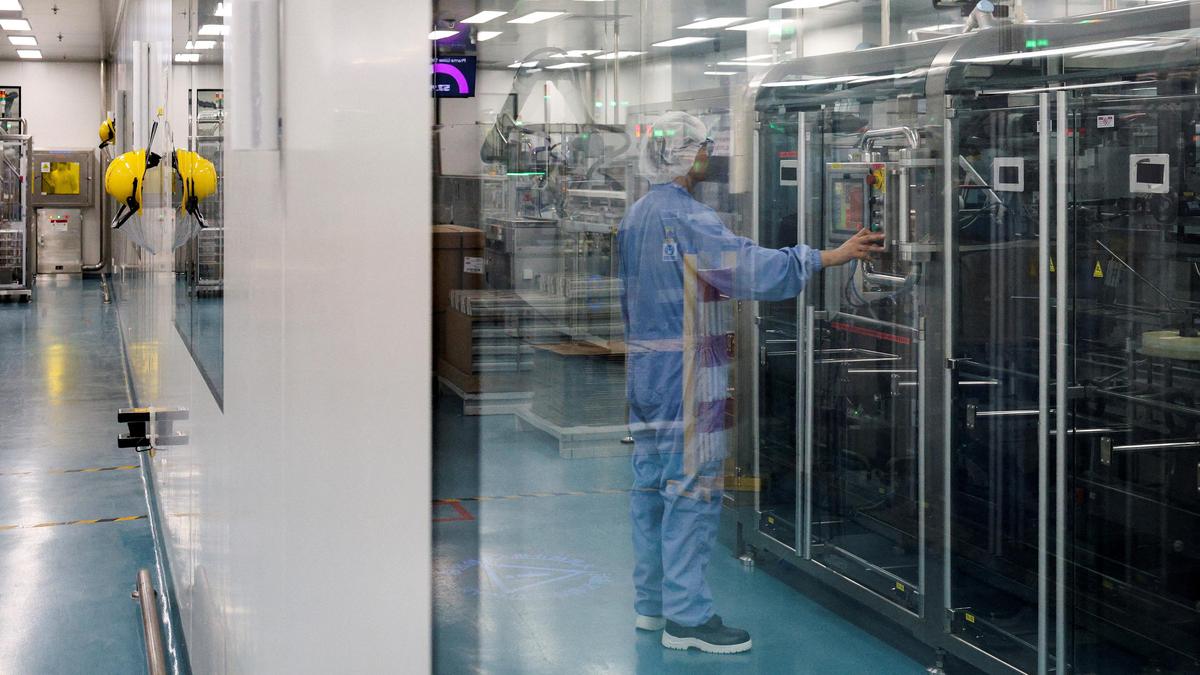
The coffee in the paper cup has gone cold, but Zhang doesn't notice. He is staring at a digital display on the wall of his small electronics assembly firm in Dongguan, a city once dubbed the "World’s Factory." For three decades, this patch of southern China has lived by a singular, rhythmic heartbeat: the thrum of conveyor belts and the hiss of pneumatic presses. But this May, the rhythm skipped.
The numbers released by the National Bureau of Statistics (NBS) are clinical. They tell us that the Manufacturing Purchasing Managers’ Index (PMI) fell to 49.5 in May. To an economist, that number is a data point. To Zhang, it is the sound of silence. In the binary language of the PMI, anything above 50 represents growth. Anything below 50 is a contraction. It is the line between a thriving community and a desperate one.
Zhang’s factory isn't just a building; it’s a nervous system. When his orders for circuit boards drop, the noodle shop across the street sells fewer bowls of zhajiangmian. The landlord who rents out dormitory bunks to migrant workers starts to worry about his own mortgage. The "invisible stakes" of a slowing Chinese economy aren't found in a spreadsheet. They are found in the tightening grip a father has on his wallet as he walks past a toy store.
The Ghost in the Machine
The slowdown in May wasn't supposed to happen this way. Earlier in the spring, there was a flicker of hope. Export numbers looked decent. Beijing was pushing a "New Productive Forces" initiative, pouring capital into high-tech manufacturing, electric vehicles, and green energy. The idea was simple: if the old drivers of growth—like the crumbling property market—are failing, let the factories save us.
But you cannot manufacture your way out of a demand crisis if no one is buying.
Consider the dilemma of the global consumer. In London, New York, and Sydney, interest rates have remained stubbornly high. The "post-pandemic" splurge is over. People are repairing their old phones instead of upgrading to the newest model. This cooling of global desire travels across the oceans, through the shipping lanes of the South China Sea, and lands right on the loading docks of the Pearl River Delta.
When the world stops clicking "Buy Now," the machines in Dongguan stop spinning. The May PMI data showed that new export orders contracted for the first time in three months. It’s a sobering realization that China’s massive industrial capacity is currently running headlong into a wall of global indifference and rising protectionist barriers.
The Property Shadow
We often speak of the "economy" as a singular beast, but it is more like an ecosystem. In China, the tallest tree in that ecosystem—the property sector—has been rotting for years. For the average Chinese family, 70% of their wealth is tied up in real estate. When developers like Evergrande and Country Garden stumbled, the psychological floor fell out from under the middle class.
Imagine you are a middle-manager in Shanghai. You’ve watched your apartment's value stagnate or drop for the first time in your life. You don’t feel rich anymore. Even if you have a job, you aren't going to buy a new car or a luxury watch. You save. You hunker down.
This domestic "coldness" is why the factory slowdown is so chilling. Beijing hoped that by subsidizing the supply side—making more stuff, more efficiently—they could offset the pain of the housing bust. But the May data suggests a mismatch. The factories are ready to produce, but the households, both at home and abroad, are hesitant to consume.
The Human Arithmetic
Let’s look at the numbers through a different lens. The 49.5 reading is the first contraction in three months, following a brief expansion in March and April. Economists call this a "choppy recovery." To the workers, it feels more like a treadmill that keeps changing speed without warning.
- Production: Dropped to 50.8 from 52.9. It's still growing, but the momentum is fading fast.
- New Orders: Slid to 49.6. This is the indicator of future health. If there are no new orders, the production numbers will inevitably follow them into the red.
- Employment: Remained in contraction territory. Factories aren't just slowing down; they are thinning out.
There is a specific kind of anxiety that comes with a shrinking workforce. It starts with the "temporary" suspension of overtime. For many migrant workers, overtime isn't a bonus—it’s the entire reason they left their rural villages. Without those extra hours, the math of city life no longer works. They pack their bags. They head back to the farm. And when they leave, they take their spending power with them, creating a feedback loop of slowing activity.
The Policy Tightrope
Beijing is not sitting idly by. In recent weeks, the government has unveiled its most "robust" (to use a term they love) plan yet to save the property market, including lowering down payments and urging local governments to buy up unsold apartments. They are trying to perform surgery on a moving target.
The problem is the lag. Policy takes time to filter down to the street level. In the meantime, the factory data serves as a real-time pulse check. And the pulse is weak.
Some argue that we are witnessing the growing pains of a "Great Rebalancing." China is trying to move away from being the world’s low-cost workshop and toward becoming a high-tech superpower. This transition was never going to be "seamless." It was always going to be messy, painful, and filled with friction. The May slowdown is the sound of that friction.
The Weight of Uncertainty
What makes this moment particularly difficult is the lack of a clear "enemy" to fight. During the pandemic, the enemy was the virus and the lockdowns. Once they were lifted, the path seemed clear. Now, the enemy is more ethereal: it is a lack of confidence.
Confidence is a ghost. You can’t build a factory for it, and you can’t mandate it through a Communist Party decree. It is built through years of predictable growth and shattered in a few months of instability.
For the global market, China’s slowdown isn't just a local issue. It affects the price of copper in Chile, the sales of luxury goods in Paris, and the stability of supply chains in California. We are all tethered to that 49.5 number, whether we like it or not.
Beyond the Spreadsheet
The sun sets over the industrial parks of the south, casting long shadows across rows of silent shipping containers. The evening shift begins, but the gates aren't as crowded as they were two years ago. There is no "cliff" here, no sudden collapse. Instead, there is a gradual ebbing away of energy.
Zhang finally finishes his cold coffee. He looks at his phone, checking for an email from a client in Europe that hasn't arrived. He wonders if he should tell his staff to take an extra day off next week. He wonders if this is a temporary dip or the beginning of a long, quiet winter.
The data says the factory activity slowed in May.
But if you stand on the floor of a factory in Dongguan, you don't need a PMI report to tell you that the air feels different. You can feel it in the stillness of the assembly lines and see it in the eyes of the shopkeepers waiting for customers who don't come. The world’s factory is taking a breath, and the whole world is holding its own in response, waiting to see if the next heartbeat will be stronger, or if the silence is here to stay.
The machines are still there, polished and ready. The power is on. The workers are waiting. All that's missing is the spark of a reason to begin.

