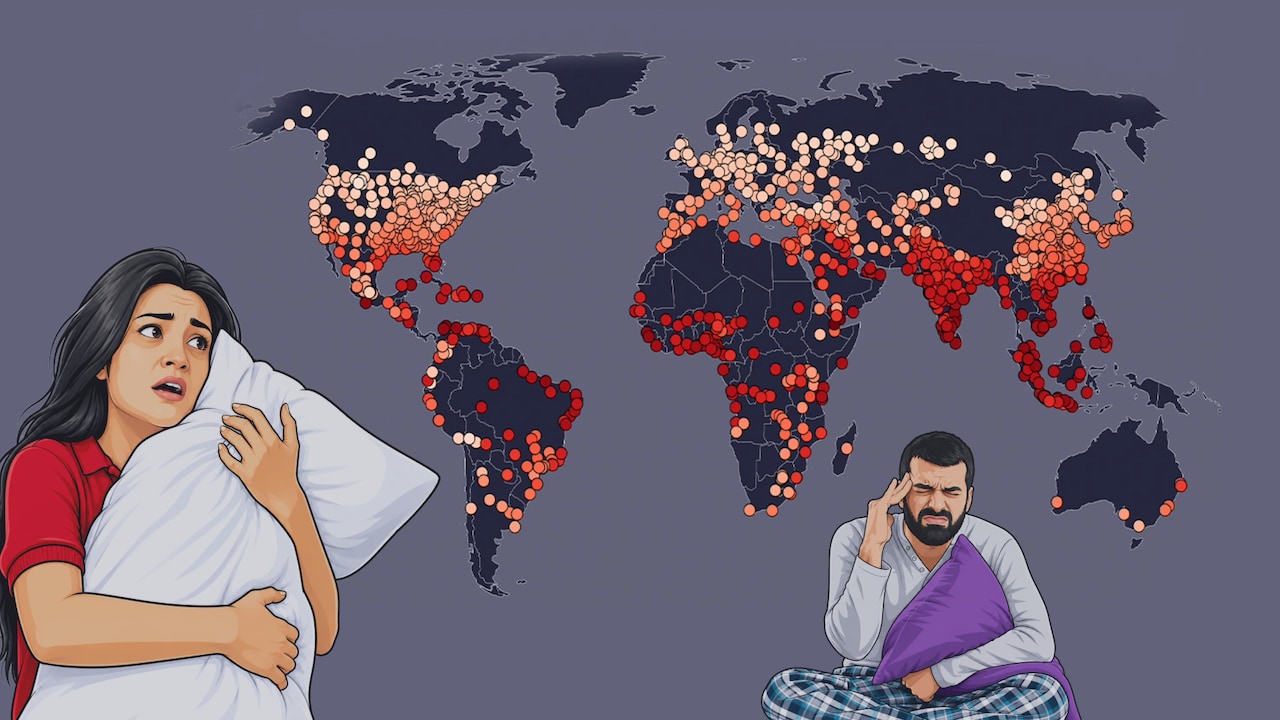
You toss. You turn. You flip the pillow to find the cool side, but there isn't one. The air feels heavy, thick, and suffocating. It's 3:00 AM in Chennai, and the fan is just pushing warm air around the room. If this sounds familiar, you aren't alone. You're part of a massive, quiet crisis sweeping across the planet.
Climate change isn't just about melting glaciers or intense afternoon heatwaves anymore. It has officially invaded our bedrooms.
A global study by the research organization Climate Central reveals a disturbing truth: rising nighttime temperatures are robbing people of precious rest. Globally, the average person lost roughly 56 hours of sleep annually between 2020 and 2025 because of hot nights. But if you live in India, the reality is much harsher. India has emerged as a primary global hotspot for climate-driven sleep loss, with some regions losing nearly double the global average.
We need to talk about why this is happening, who is getting hit the hardest, and how you can protect your sleep when the thermostat refuses to drop.
The Science of Why Warm Nights Wreck Your Body
Your body relies on a natural biological clock called the circadian rhythm. To fall asleep and stay asleep, your core body temperature needs to drop by about one to two degrees Fahrenheit. When the sun goes down, your body naturally sheds heat by sending blood to your skin.
But when the air outside stays hot and humid, that heat transfer stalls. Your body can't cool itself down.
Instead of slipping into deep, restorative sleep, your heart rate stays elevated. You spend the night in a state of light, fragmented sleep, waking up repeatedly without even realizing it. The result? You wake up feeling like you barely slept at all.
This isn't just about feeling tired or grumpy the next day. Chronic sleep deprivation is a massive blow to your health. Over time, losing consistent rest weakens your immune system, disrupts your metabolic health, and shoots your stress hormones through the roof. Medical experts have long linked poor sleep to increased risks of cardiovascular disease, diabetes, anxiety, and depression.
Mapping India’s Sleep Deficit
The numbers coming out of India’s cities are staggering. Southern India is bearing the brunt of this environmental tax on health.
Residents of Chennai are losing an astonishing 93 hours of sleep every single year because of nighttime heat. That is nearly four full days of rest completely wiped out. Puducherry isn't far behind at 92 hours, followed closely by Kerala and Andhra Pradesh at roughly 88 hours per person.
Look at how major cities stack up annually:
- Chennai: 93 hours lost
- Mumbai: 84 hours lost
- Kolkata: 80 hours lost
- Bengaluru: 67 hours lost
- Delhi: 66 hours lost
What's wild is what's happening to cities traditionally known for milder weather. Take Bengaluru. Historically, it was the city people escaped to for cool breezes. Now, climate change has hit Bengaluru's sleep cycles harder than any other Indian metro, tacking on an extra eight hours of annual sleep loss directly caused by global warming.
Densely packed urban areas suffer from the concrete jungle effect, technically known as the urban heat island effect. All daytime heat gets trapped by asphalt roads, concrete buildings, and high-rise apartments. When night falls, these structures act like giant radiators, slowly leaking heat back into the air and keeping city temperatures dangerously high long after midnight.
The Inequality of the Thermostat
Let’s be completely honest here: heat hits differently depending on your bank account.
If you have a modern inverter air conditioner running in a sealed bedroom, you can artificially create the perfect sleep environment. But millions of people don't have that luxury. Globally, only about 35% of households own an air conditioner. In developing regions and low-income neighborhoods, that number drops drastically.
For families living in crowded housing with tin roofs or poor ventilation, there is simply no escape from the heat. Even when people do own AC units, soaring electricity bills and frequent power grid failures mean they can't always run them.
The data shows that the elderly, women, and low-income households face a vastly higher burden of sleep deficit. Older adults are particularly vulnerable because our bodies become less efficient at regulating temperature as we age. It's a textbook example of how environmental shifts exacerbate social inequalities.
How to Reclaim Your Rest Without Cranking the AC
You can't fix global carbon emissions before bedtime tonight, but you can take immediate control of your micro-environment. If you're struggling to get deep sleep during hot spells, stop relying entirely on a standard ceiling fan that just circulates warm air. Try these practical adjustments instead.
Cross-Ventilate Creatively
If you don't have AC, running a fan directly over your bed isn't enough when the room is a hotbox. You need to force the hot air out. Place a box fan facing outward through an open window to blow the hot air out of the room. Open another window on the opposite side of the house to draw cooler nighttime air inside.
Optimize Your Bedding
Get rid of synthetic sheets, polyester blends, and heavy mattresses that trap body heat. Switch to 100% breathable cotton, linen, or bamboo sheets. If your mattress retains heat, place a thick woven cotton blanket or a specialized cooling topper over it to allow air to pass beneath your body.
Master the Pre-Sleep Cool Down
Take a lukewarm shower right before climbing into bed. Don't make it freezing cold. Cold water shocks your system and actually causes your core temperature to rise as your body tries to protect itself. Lukewarm water opens your pores and stimulates blood flow to the skin, accelerating heat loss.
Hydrate Intentionally
Drink a glass of cool water before bed, but keep a thermal flask of ice water right next to your nightstand. If you wake up sweating in the middle of the night, drinking a few sips of ice-cold water will immediately help lower your internal core temperature from the inside out, making it easier to drift back to sleep.
The warming trend isn't slowing down, and our nights will likely keep getting stickier. Waiting for the weather to change isn't an option. Prioritizing these small, physical tweaks to your evening routine is the best way to protect your health, your sanity, and your sleep.
India Loses Up To 91 Hours Of Sleep A Year provides an excellent video breakdown detailing how these rising nighttime temperatures are directly impacting public health across major Indian metros.