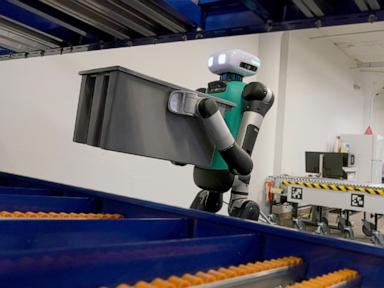
The public market debut of Agility Robotics through a $2.5 billion merger with Churchill Capital Corp XI marks the transition of bipedal automation from speculative venture capital to structured enterprise asset management. While superficial analysis treats this transaction as a generalized validation of artificial intelligence, the underlying mechanics dictate a far narrower reality. This is an explicit economic calculation mapping hardware unit economics, manufacturing capacity constraints, and liability boundaries against systemic labor deficits.
To evaluate whether a $2.5 billion valuation holds structural integrity, analysts must isolate the capital structure, the unit-level unit economics, and the physical deployment bottlenecks that dictate actual floor productivity. The valuation is not a derivative of pure software-style margins; it is an industrial capitalization model anchored by a $620 million gross cash injection—including a $200 million private investment in public equity (PIPE) led by manufacturing entity Foxconn—designed to subsidize the capital-intensive scale-up of Agility's Digit v5 platform.
The Cost Function of Mobile Automation
The commercial viability of bipedal robotics rests on a singular financial metric: Fully Burdened Cost per Operating Hour. Enterprise logistics buyers do not purchase physical hardware based on technological novelty; they benchmark mobile automation directly against the human fully burdened wage, which typically ranges from $25 to $35 per hour in domestic fulfillment centers.
The structural cost function of a humanoid platform comprises three fixed and variable vectors:
- Amortized Capital Expenditure: The baseline cost of manufacturing the hardware unit divided by its operational lifespan. For the upcoming Digit v5, hitting target metrics requires an operating life of at least 20,000 hours.
- Operating and Maintenance Overhead: The direct variable expenses associated with battery depletion cycles, preventative mechanical maintenance, component replacement (primarily joint actuators and end-effectors), and the localized compute infrastructure required for physical processing.
- Fleet Management Ratio: The labor cost of human operators overseeing the autonomous fleet. Early-stage deployments often operate at a 1:1 or 1:2 ratio (one human monitoring two robots), which completely negates the labor cost arbitrage. True economic viability requires scaling this ratio beyond 1:20 through advanced fleet-orchestration software.
Agility’s preliminary financial disclosures reveal an operating loss trajectory that reflects these capital-intensive dynamics. Operating expenses escalated from $71 million in 2024 to approximately $111 million in 2025, driven by a cash burn rate hovering near $100 million annually. This operational posture indicates that current unit production is far below the minimum efficient scale required to achieve positive gross margins on the hardware layer alone.
The Operational Bottleneck of Bipedal Geometry
The core engineering thesis separating Agility from competitors like Tesla (Optimus) or Figure AI centers on structural pragmatism over anthropomorphic fidelity. Form follows function on the fulfillment floor, and mimicking human anatomy creates compounding mechanical inefficiencies.
The architectural differences dictate distinct operational outcomes:
[Human Form: Forward-Facing Knees] -> High Joint Stress during Payload Descent
[Digit Form: Reverse-Articulated Legs] -> Direct Vertical Force Distribution to Chassis
The reverse-articulated, birdlike leg architecture utilized by Digit optimizes for vertical payload distribution rather than human-like locomotion. Traditional anthropomorphic designs with forward-facing knees introduce severe rotational force vectors at the knee and hip joints when picking up payloads from floor level. By reversing the structural geometry, Agility ensures that the weight of a standard 35-pound tote transfers directly down the structural framework of the leg, minimizing joint torque and reducing actuator thermal overload.
The same principles govern the choice of end-effectors. Humanoid platforms attempting to utilize five-fingered, multi-articulated human hands introduce unnecessary failure points into high-frequency industrial environments. Every additional degree of freedom in a robotic hand increases the probability of electromechanical component failure. Digit’s utilization of specialized grippers optimizes for the uniform geometry of standard warehouse totes, transforming a complex manipulation problem into a highly repeatable mechanical clamping sequence.
The Scaling Ledger and Contractual Backlogs
A critical risk factor embedded within the transaction structure is the definition and reality of Agility's forward order book. Initial filings highlight more than $300 million in committed, multi-year bookings for the Digit v5 platform, spearheaded by an unnamed customer contract for 1,000 units over a three-year horizon.
Experienced industrial analysts recognize that a "committed booking" in a hardware scale-up environment is rarely a guaranteed revenue event. These contracts are historically governed by strict service-level agreements and operational milestones.
- Mean Time Between Failures (MTBF): The contract terms frequently dictate that the hardware platform must achieve an MTBF exceeding several hundred operational hours before scaling from low-volume pilot phases to full fleet deployment. If early-production units exhibit frequent joint alignment or sensory drift issues, the buyer retains the contractual right to halt or defer subsequent unit deliveries.
- Throughput Parity: Mobile robots must achieve minimum cycle-time thresholds. If a bipedal unit moves a tote at half the speed of a human worker, the real estate footprint required to house the fleet doubles, introducing an ancillary facility overhead cost that erodes the primary labor arbitrage.
- Cooperative Safety Integration: The transition from restricted, human-fenced pilot zones to open-floor collaboration represents a profound regulatory and operational barrier. Agility’s integration of the newly announced NVIDIA Halos safety framework represents an attempt to solve this via software-defined proximity protection. However, if real-world latency in the safety loop causes frequent, conservative emergency-stop triggers, facility throughput degrades sharply.
Strategic Matrix of the Humanoid Market
The competitive environment is bifurcated by distinct strategic philosophies. Assessing Agility requires mapping its operational reality against both capital-rich generalists and low-cost manufacturing competitors.
| Strategic Vector | Agility Robotics (Digit v5) | Silicon Valley Capital Plays (Figure, Neura) | Low-Cost Manufacturing (Unitree, AgiBot) |
|---|---|---|---|
| Primary Architectural Focus | Task-specific optimization (Tote movement, reverse-leg geometry) | Generalized Physical AI (Multi-task capability, human anatomy) | Hardware commoditization (Mass-manufactured components, rapid reproduction) |
| Go-To-Market Anchor | Focused logistics pilots (GXO, Amazon, Toyota) | High-valuation private financing rounds ($7B - $39B valuations) | Open developer platforms and rapid commercial industrial scaling |
| Core Operational Moat | Documented real-world operation hours (65,000+ commercial hours) | Advanced neural net models and multimodal interaction | Aggressive supply-chain integration and low baseline cost functions |
The data indicates that while Figure AI commands an elite private valuation of $39 billion based on the theoretical long-tail value of generalized physical intelligence, Agility has optimized exclusively for the immediate logistics bottleneck. Moving more than 100,000 totes in live commercial operation at facilities like GXO Logistics provides a real-world testing loop that pure software simulators cannot replicate.
Systemic Constraints on the Humanoid Ecosystem
The execution risk for Agility over the 24-month horizon following the closing of the SPAC deal is concentrated in factory scaling rather than algorithmic development. Building a capital-efficient supply chain for bipedal hardware requires resolving distinct macroeconomic and microeconomic structural dependencies.
The primary limitation is the global supply chain for specialized high-torque actuators and harmonic drives. Standard industrial arms rely on highly consolidated precision component manufacturers. Humanoid platforms require a vastly higher density of lightweight, high-output motors per unit. The current industrial supply chain cannot support the production of hundreds of thousands of bipedal units annually without massive capital investment in specialized component fabrication lines. This explains the strategic rationale of anchoring the public offering with Foxconn, shifting the execution risk from domestic assembly to a partner capable of institutionalizing complex hardware supply chains.
The second structural bottleneck resides within localized compute limitations. Running complex balance loops, visual perception models, and real-time path-planning algorithms simultaneously demands significant onboard power. This creates a direct engineering trade-off: increasing onboard battery capacity adds mass, which exponentially increases the energy required for locomotion, thereby accelerating battery degradation. Platforms that rely heavily on edge-compute processing must navigate a rigid ceiling governing maximum operating runtime per charge cycle.
Definitive Capital Strategy
The capital injection from this public listing provides Agility with a distinct window of liquidity to systematically transition from high-cost low-volume manufacturing to automated assembly lines. To defend its current $2.5 billion valuation against both low-cost commoditization from overseas manufacturers and deep-pocketed software generalists, the strategic imperative is clear.
Agility must decline the temptation to expand Digit’s operational scope into consumer or complex service sectors. The capital must be deployed to drive down component-level costs, build out the fleet-management software architecture to maximize the human-to-robot operational ratio, and fulfill the 1,000-unit backlog under strict execution milestones. The public markets will judge this asset not on the theoretical future of autonomous intelligence, but on predictable, auditable reductions in the fully burdened cost per moved tote.