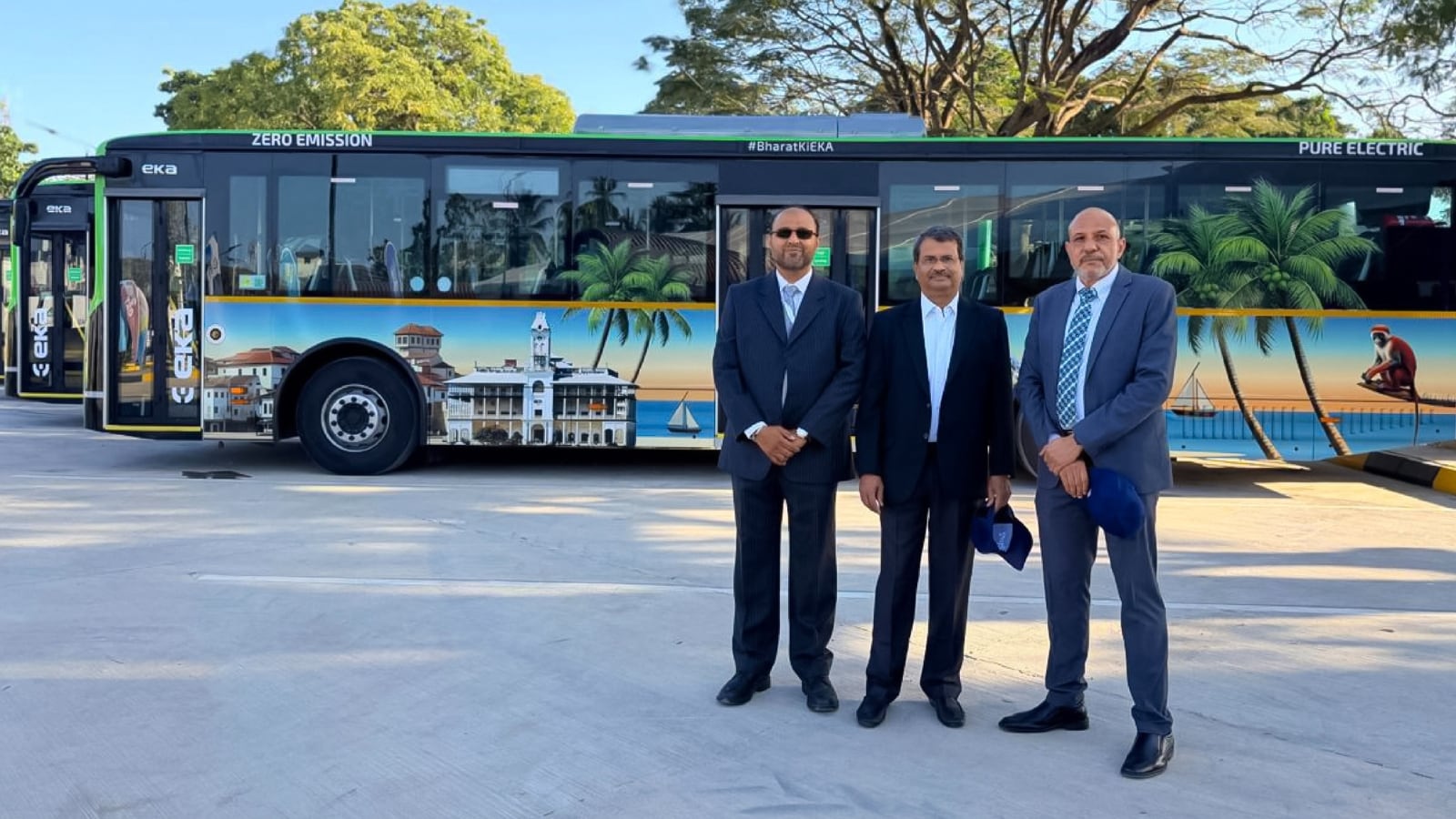
On July 23, 2026, President Hussein Ali Mwinyi of Zanzibar stood alongside diplomatic envoys and private sector executives to flag off 15 high-capacity electric buses manufactured by Pune-based EKA Mobility. Commercial operations commence on August 1, marking the first phase of an initial 35-unit order that aims to expand to 150 zero-emission vehicles by the end of the year.
The headline numbers sound like standard corporate press release material, but the underlying mechanics tell a far more complex story. Public transport across East Africa has historically been a graveyard for foreign fleet experiments. Western transit conglomerates routinely offer over-engineered, prohibitively expensive vehicles, while low-cost imports from competing markets often break down under intense heat, dusty roads, and inconsistent power grids. By securing a foothold in Zanzibar through a tripartite deal involving Global Rapid Transport and the Zanzibar Social Security Fund, EKA Mobility is testing whether Indian commercial vehicle engineering can crack a market that has frustrated international rivals for decades.
This rollout represents more than a localized transit upgrade. It is a direct challenge to established global monopolies in developing nation public infrastructure.
The Reality Behind Zanzibar Electric Fleet Rollout
Electric buses do not run on goodwill or green press releases. They depend on brutal operating economics, kilowatt-hour math, and relentless daily abuse from unpaved suburban arteries.
Zanzibar's public transit network previously relied almost entirely on informal, privately operated mini-buses known as daladalas. These diesel vehicles operate with minimal regulation, low upfront capital requirements, and zero structural safety guarantees. Replacing a decentralized web of independent owner-operators with a centralized, state-backed electric fleet requires an immense transformation of urban logistics.
The initial batch of 12-meter buses deployed by EKA features specialized modular chassis designs and software integration designed to monitor performance in real time. However, rolling out 15 buses onto asphalt is the easiest part of the process. The true test lies in scaling that operational footprint tenfold to 150 units within five months.
To achieve that scale, Zanzibar must build out charging hubs, train technicians who have spent decades fixing mechanical diesel engines, and establish a steady supply chain for specialized high-voltage components. The Zanzibar Social Security Fund (ZSSF) is backing the effort alongside Global Rapid Transport (GRT), demonstrating that sovereign institutional capital is stepping in to shoulder the financial exposure. Without local pension funds taking equity and credit risks, high-capacity fleet electrification in emerging economies remains stuck on the drawing board.
How Modular Engineering Undercuts Traditional Heavyweights
For decades, European manufacturers dominated high-end commercial transit exports across the Global South. Their strategy was simple: sell premium vehicles engineered for European autobahns at exorbitant prices, then charge massive premiums for specialized replacement parts. When those vehicles inevitably failed under rougher operating conditions, local municipalities were left with dead fleets and crippling debt.
Indian automakers are taking the exact opposite path.
Instead of building heavy, monolithic vehicles that require specialized factories and expensive tooling, developers like EKA use modular platform architecture. By reducing the overall number of structural components and utilizing lightweight composite materials, these chassis lower manufacturing overhead while keeping total vehicle weight to a minimum.
Less weight directly translates to lower energy consumption per kilometer. When an e-bus uses less power per trip, operators can deploy smaller battery packs, cutting the single most expensive line item in electric vehicle production.
Consider a practical financial comparison in commercial fleet purchasing.
Hypothetical Example: A standard European 12-meter electric transit bus often carries an upfront price tag of roughly $450,000 to $500,000, driven by heavy frame construction and proprietary sub-assemblies. An equivalent modular bus built in India using localized supply networks can be delivered for approximately $200,000 to $250,000 while maintaining comparable passenger capacities and battery range targets.
That capital expenditure gap changes everything for municipal transit authorities in developing nations. A transit authority operating on tight annual budgets cannot justify buying 20 European buses when the same capital outlay secures 40 or 50 modular Indian units.
Battery Economics and the Battle Against African Tropical Heat
Tropical climates kill lithium-ion batteries. High ambient temperatures, paired with constant heavy-duty fast charging and air conditioning draw, trigger rapid thermal degradation if thermal management systems are improperly calibrated.
Zanzibar’s environment features high humidity, salt-laden coastal air, and consistent temperatures hovering around 30 degrees Celsius year-round. Operating a 12-meter electric bus loaded with up to 80 passengers under these conditions requires specialized cooling algorithms and heavy-duty structural insulation.
The vehicles deployed in this expansion utilize liquid-cooled battery chemistry paired with intelligent software that actively throttles power draw based on cell temperatures and road elevation. Furthermore, the telemetry software collects operational data every second, transmitting cell-level health metrics back to central engineering hubs.
If a single battery cell begins to overheat or show voltage imbalances during a suburban route, fleet managers receive immediate automated alerts before catastrophic pack failure occurs. This continuous software monitoring is what separates modern commercial EV deployments from the failed pilot projects of the early 2010s.
Yet hardware and software represent only half of the operating equation. The physical power network behind the chargers remains the ultimate bottleneck.
| Operational Factor | Traditional Fleet Setup | EKA Mobility Zanzibar Deployment |
|---|---|---|
| Primary Power Source | Imported Marine Diesel | Island Grid + Dedicated Substation Charging |
| Chassis Construction | High-Weight Stamped Steel | Modular Lightweight Platform Architecture |
| Maintenance Model | Reactive Mechanical Repairs | Predictive Telemetry & Local Technical Training |
| Funding Mechanism | Municipal Debt Outright | Sovereign Capital (ZSSF) + GRT Fleet Management |
| Fleet Scale Target | Uncontrolled Informal Expansion | 15 Vehicles (Current) to 150 Units (Year-End) |
Grid Infrastructure Realities and the Financing Elephant in the Room
Zanzibar's electricity grid relies heavily on a submarine cable system connected to the Tanzanian mainland, supplemented by local generation. Drawing hundreds of kilowatts of sudden, high-voltage power from a regional distribution grid to charge a fleet of 150 buses will cause localized voltage drops if not managed with absolute precision.
The success of this 150-bus expansion hinges entirely on smart charging scheduling.
Buses cannot simply plug into unmanaged 150kW fast chargers simultaneously during peak evening hours when residential electricity demand spikes. Doing so would destabilize regional transformers. Instead, the charging operations must operate on staggered, off-peak schedules, drawing energy late at night when general grid demand drops.
Financing these support systems requires creative capital structuring. Local institutional backers, such as the Zanzibar Social Security Fund, are not stepping into this deal out of pure environmental altruism. They expect solid, predictable yield.
Electric transit fleets offer predictable cash flow because operational costs per kilometer are significantly lower than diesel equivalents, provided the vehicles stay on the road. Diesel prices in East Africa fluctuate wildly based on global oil markets, supply chain choke points, and currency devaluation. Electricity costs, by contrast, remain relatively stable and controllable under state utility agreements.
By locking in operational expenditure predictability, municipal transit projects become bankable assets. Pension funds can safely back the initial vehicle procurement, knowing that daily fare collection combined with low running costs will service the debt over a ten-year amortization cycle.
The Geopolitical Chessboard of Commercial Transit In East Africa
For the past fifteen years, Chinese state-owned enterprises dominated African infrastructure expansion under various bilateral lending programs. From highways and railways to municipal diesel bus fleets, Chinese manufacturing was the default choice for African leaders seeking rapid development.
That monopoly is breaking down.
India is aggressively positioning its domestic automotive sector as a direct alternative for industrial partnerships across the Indian Ocean rim. Backed by export incentives, financial partnerships, and strategic diplomatic engagement—evidenced by the presence of India's High Commissioner to Tanzania at the Zanzibar launch—Indian original equipment manufacturers are carving out significant market share.
Indian commercial EV manufacturers hold two distinct competitive advantages over Western and Chinese rivals:
- Frugal Engineering Heritage: Indian vehicles are designed from inception to survive poor road surfaces, extreme dust, heavy overloads, and high heat conditions similar to those found across Sub-Saharan Africa.
- Total Cost of Ownership Focus: Indian manufacturing costs are low enough to challenge Chinese pricing while offering open, adaptable software and maintenance frameworks rather than closed, vendor-locked ecosystems.
Chinese manufacturers have historically struggled with long-term spare parts availability in smaller African markets once initial supply contracts expire. EKA Mobility is countering this historical vulnerability by integrating local technical training directly into its commercial agreement. By training local mechanics in vehicle software, high-voltage safety, and chassis repairs alongside GRT and ZSSF, the company creates an embedded ecosystem that makes fleet maintenance self-sustaining on the island.
The Long Road to 150 Vehicles
Rolling out 15 buses is an impressive public relations milestone, but expanding that number to 150 by the end of the year requires flawless execution across manufacturing, shipping, grid integration, and daily farebox collection.
If the Zanzibar project succeeds, it will serve as the template for mid-sized island nations and regional metropolitan areas across Africa, South Asia, and Latin America. If it struggles with grid failures, battery degradation, or operational downtime, critics will use it as proof that commercial electric transit remains unviable outside wealthy Western and East Asian cities.
The outcome will not be decided by corporate announcements or political ceremonies. It will be decided on the hot, humid streets of Zanzibar, one kilometer at a time, as drivers turn the key on August 1 and put Indian engineering to the ultimate real-world test.
.png)