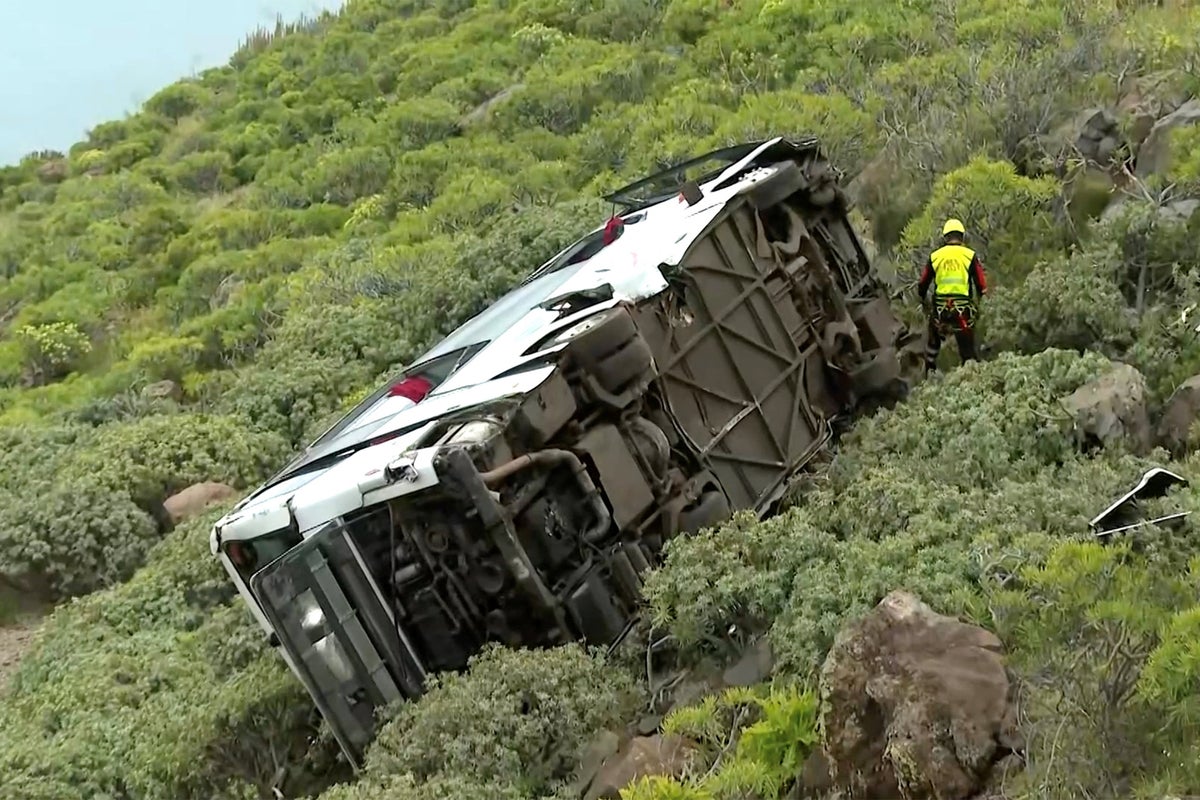
The fatal excursion bus crash in Gran Canaria on April 11, 2026, represents a systemic failure across three critical domains: mechanical maintenance protocols, topographical infrastructure resilience, and the demographic vulnerability of tour participants. When a vehicle carrying approximately 30 passengers—predominantly senior citizens—exits a roadway and descends into a ravine, the event is rarely the result of a single isolated error. It is the culmination of a "Swiss Cheese" model of failure where safety layers align their holes. Understanding the mechanics of this incident requires moving beyond the casualty count to analyze the kinetic energy involved in road departures and the specific survival variables of high-occupancy vehicles on volcanic terrain.
The Kinematics of Road Departure in High-Altitude Terrain
The primary cause of fatalities in ravine-plunge scenarios is not the initial impact, but the deceleration forces applied to passengers during vertical or near-vertical descent. On the GC-200 and similar arterial routes in the Canary Islands, the road geometry includes high-frequency hairpin turns and steep gradients.
When a coach weight exceeding 12,000 kilograms loses lateral friction or braking capacity, the resulting momentum creates a trajectory that standard Armco barriers are frequently unequipped to deflect.
Structural Integrity and Rollover Protection
Modern coach buses are designed under the ECE R66 regulation, which dictates the strength of the "survival space" during a rollover. However, these regulations often assume a roll onto a flat surface. In the Gran Canaria incident, the descent into a ravine introduces multi-axis impacts.
- The Survival Space Collapse: If the bus strikes the ravine floor roof-first, the vertical load can exceed the structural capacity of the pillars (A, B, and C).
- Secondary Projectiles: In tourist coaches, unpinnable items such as luggage, walkers, and medical equipment become high-velocity projectiles within the cabin during a tumble.
- Ejection Risks: Despite mandatory seatbelt laws in the EU for coaches, compliance among tourist populations remains inconsistent. An unbelted passenger in a 77-year-old demographic faces a near-zero survival probability during a multi-rotation roll.
Demographic Vulnerability and Trauma Response
The death of a 77-year-old British national and the injuries sustained by 27 others highlight a specific risk profile inherent to the "silver tourism" market. The Canary Islands serve as a primary hub for retirees, a demographic with specific physiological constraints that complicate both the accident outcome and the subsequent rescue operation.
Frailty and Injury Severity Score (ISS)
The Injury Severity Score (ISS) provides a framework for predicting mortality based on anatomical damage. In younger populations, the body can often compensate for blunt force trauma through high cardiovascular reserve. In the elderly, pre-existing conditions and the use of anticoagulants (blood thinners) turn minor lacerations into life-threatening hemorrhages.
The skeletal density of a 70-plus demographic is significantly lower, leading to "flail chest" injuries and pelvic fractures from seatbelt pretensioners or impact forces that a younger passenger might survive with only bruising.
Triage Logistics in Remote Topography
The geography of Gran Canaria presents a "Golden Hour" bottleneck. The time elapsed between the crash and the first surgical intervention is the single greatest predictor of survival.
- Extraction Complexity: Removing 30 victims from a ravine requires specialized high-angle rescue teams.
- Airlift Capacity: With 27 injured, the local helicopter emergency medical services (HEMS) face an immediate resource exhaustion.
- Trauma Center Proximity: Transporting critically injured seniors over winding mountain roads back to Las Palmas or similar hubs adds significant physiological stress to unstable patients.
The Maintenance and Oversight Audit Trail
Investigating the "why" behind the plunge requires a forensic audit of the vehicle’s telematics and maintenance history. Transit companies operating in the Canary Islands face unique environmental stressors that accelerate vehicle depreciation and part failure.
Thermal Stress and Brake Fade
The constant elevation changes on the islands demand heavy reliance on retarders and friction brakes. Continuous downhill descent generates immense thermal energy. If the brake fluid reaches its boiling point (vapor lock) or the pads glaze, the driver loses the ability to modulate speed. Analysts must determine if the vehicle was equipped with an electromagnetic retarder and whether it was functional at the time of the descent.
Operational Pressure and Driver Fatigue
The tourism sector operates on high-volume, low-margin cycles. This creates a hidden risk function where drivers may be pushed toward the upper limits of their "Hours of Service" (HoS) regulations. While digital tachographs track driving time, they do not track the quality of rest or the cumulative cognitive load of navigating high-risk terrain repeatedly in high-heat conditions.
Strategic Mitigation for High-Risk Transit
The recurrence of bus accidents in mountainous tourist regions suggests that current safety benchmarks are insufficient for the specific variables of volcanic geography and elderly passenger profiles.
Infrastructure Hardening
Replacing standard guardrails with high-containment "H4b" level barriers on identified high-risk curves would prevent the majority of ravine entries. These barriers are designed to redirect vehicles up to 38 tons, effectively turning a potential plunge into a localized collision.
Mandatory Telemetric Oversight
Tour operators should be required to implement real-time brake temperature monitoring and lane-departure warning systems that are hard-coded to trigger an external alert to the transport authority. Relying on the driver as the sole failure-prevention mechanism in a complex system is a fundamental design flaw.
Age-Specific Safety Briefings
Current safety protocols on tourist coaches are often treated as formalities. There is a clear need for "Active Safety Participation" for senior travelers, emphasizing the use of high-tension seatbelts and the securing of heavy carry-on items that contribute to internal cabin trauma during a roll.
The investigation must pivot from "driver error" to a comprehensive analysis of the vehicle’s mechanical history and the road's structural deficiencies. Only by quantifying the failure of the barrier systems and the thermal limits of the braking assembly can future high-occupancy fatalities in the region be prevented. Operators must immediately audit all fleet vehicles utilized for high-altitude excursions, prioritizing the replacement of any unit lacking secondary independent braking systems. High-containment barrier installation on the GC-200 and similar routes should be reclassified from a maintenance task to a critical life-safety necessity.