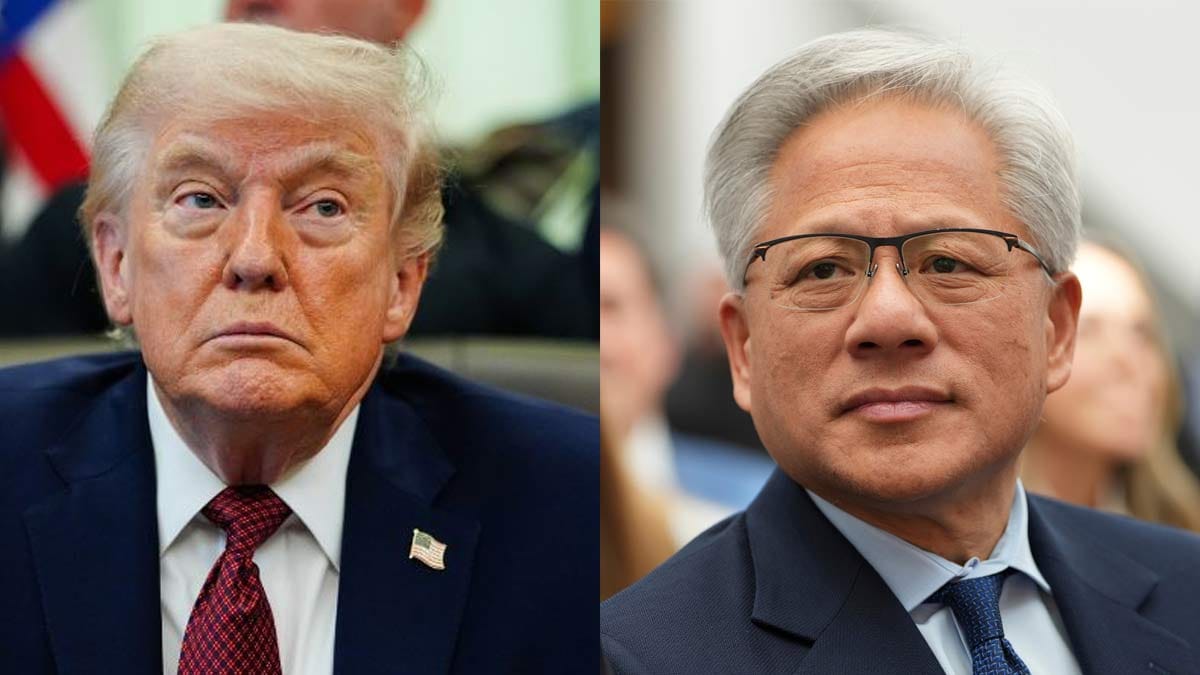
Alice Huang is not a secret agent pulled from a Cold War thriller. She is a Taiwan-born academic and policy specialist whose name became the focal point of an intense geopolitical storm surrounding Nvidia chief executive Jensen Huang. The controversy erupted when political commentators, online sleuths, and competing advocacy groups began scrutinizing her connections to Chinese scientific institutions, her professional overlap with Western technology policy circles, and the broader question of whether personal and academic networks around Silicon Valley's most valuable chipmaker pose a national security risk.
To understand why a relatively low-profile researcher suddenly became the center of a global espionage debate, you have to look past the viral social media threads. You have to look at the mechanics of modern semiconductor warfare.
The Anatomy of a Viral Accusation
The modern internet does not wait for a federal indictment before rendering a verdict. When rumors linking Alice Huang to alleged technology transfer risks began circulating, they followed a familiar, predictable pattern. An obscure academic paper or conference attendee list surfaces on an investigative forum. A commentator highlights a shared surname or a past institutional affiliation in Beijing or Taipei. Within forty-eight hours, algorithmic outrage transforms a complex policy debate into a binary accusation of treason.
Let us separate the verifiable reality from the fever-dream speculation.
In the semiconductor industry, the surname Huang is as common as Smith in London or Müller in Berlin. Jensen Huang, born in Tainan, Taiwan, has built Nvidia into the undisputed engine of global artificial intelligence. Because Nvidia sits at the exact chokepoint of modern military and economic power, anyone sharing a surname, an alma mater, or a conference stage with its leadership becomes an immediate target for scrutiny.
Alice Huang’s professional trajectory mirrors that of hundreds of cross-strait and trans-Pacific scholars who built careers during an era when scientific collaboration between the United States, Taiwan, and mainland China was actively encouraged by Washington. During the 2000s and early 2010s, joint research initiatives, cross-border talent exchanges, and dual-affiliation fellowships were standard operating procedure. They were seen as engines of global innovation, not vectors of espionage.
The rules changed overnight. What was once praised as international academic cooperation is now retroactively audited as a potential intelligence vulnerability.
Why Nvidia Is the Ultimate Intelligence Target
Espionage follows value. During the nineteenth century, spies stole textile loom designs and tea cultivation secrets. During the twentieth, they hunted nuclear physics calculations and aerospace blueprints. Today, the single highest-value target on earth is the architecture, software stack, and supply chain behind Nvidia’s graphics processing units.
Consider the stakes. Advanced AI models cannot be trained at scale without clusters of high-end accelerators. CUDA, Nvidia’s proprietary software platform, locks developers into its hardware ecosystem with a grip that competitors have spent fifteen years failing to break. If an adversary state wants to close the artificial intelligence gap, it does not merely need to buy chips on the gray market. It needs to understand the roadmap, the packaging techniques, the interconnect bottlenecks, and the software optimizations years before they hit the commercial market.
This reality places Jensen Huang in an impossible position.
On one side sits the United States government, tightening export controls every few months to prevent advanced silicon from reaching Chinese military and research labs. On the other side sits the brutal economic truth that China historically accounted for roughly a fifth to a quarter of Nvidia’s data center revenue. Navigating that divide requires constant diplomacy in Washington, Taipei, and Beijing.
Every handshake becomes a headline. Every trip to Asia invites breathless commentary about divided loyalties. When a figure like Alice Huang enters the frame—whether through policy advisory roles, academic panels, or tangential industry connections—critics immediately look for a backchannel. They ask whether soft-power networks are being used to bypass hard-power export restrictions.
How Modern Tech Espionage Actually Works
Public imagination remains stuck in the 1980s. People picture trench coats, dead drops in rainy parks, and microfilms hidden inside hollowed-out coins.
Real industrial espionage in the semiconductor sector looks nothing like that. It is tedious, bureaucratic, and almost entirely legal until the exact moment a file crosses a firewall.
To understand how intellectual property actually moves across borders, consider a hypothetical example. Imagine a mid-level design engineer working on high-bandwidth memory interfaces in Santa Clara. A boutique consulting firm based in Singapore reaches out via LinkedIn, offering five thousand dollars for a two-hour phone call to discuss "general industry trends in thermal management." The engineer accepts. The questions start broad, then slowly narrow toward proprietary testing tolerances. No secret documents change hands. No server is hacked. Yet over six months, twenty similar calls with twenty different engineers allow a foreign state-backed entity to reconstruct a competitor's entire manufacturing yield strategy.
This is the gray zone where counterintelligence agencies spend ninety percent of their time. It relies on talent recruitment programs, venture capital fronts, and academic workshops rather than traditional spies.
Because this threat is real and pervasive, national security hawks view every cross-border personal or institutional link with deep suspicion. When analysts examine the ecosystem surrounding Jensen Huang, they are not necessarily looking for a Hollywood mole. They are looking for structural vulnerabilities—places where informal advisory roles, shared cultural networks, or overlapping board memberships could inadvertently leak strategic intent.
The Dangerous Blur Between Heritage and Espionage
There is an ugly undercurrent to the Alice Huang controversy that few industry insiders want to discuss on the record. It is the quiet revival of ethnic suspicion in American technology corridors.
For decades, the American semiconductor industry was built on the backs of immigrants from Taiwan, Hong Kong, and mainland China. Look at the leadership rosters of the world's most critical chip companies. Jensen Huang at Nvidia. Lisa Su at AMD. Hock Tan at Broadcom. Lip-Bu Tan at Cadence and Intel. Morris Chang, the founder of TSMC, spent decades in Texas before returning to Taiwan to build the foundry that now manufactures the world's most advanced logic chips.
These executives operate within dense, overlapping professional and social networks that span the Pacific. They attend the same alumni associations. They speak at the same engineering symposia. They sit on the same university boards.
When political tensions flare between Washington and Beijing, those exact networks become suspect. Nuance evaporates. A Taiwanese-American researcher with past ties to a mainland university is suddenly painted with the same brush as a state intelligence officer.
Veteran counterintelligence professionals know this is counterproductive. Casting a wide net of suspicion based on heritage or routine academic history does not catch real spies. Instead, it alienates the exact engineers and scientists who form the backbone of Western technological superiority. When top talent feels perpetually under investigation simply for their background or surname, they leave. They return to Taipei, Singapore, or Shanghai, taking decades of institutional knowledge with them.
What Critics Get Wrong About Jensen Huang
The narrative surrounding the controversy often portrays Jensen Huang as either a naive globalist blind to Beijing's ambitions or a calculating mogul playing both sides for shareholder profit. Both caricatures miss the mark.
Huang is a ruthless pragmatist who understands supply chain physics better than almost any politician in Washington. When the U.S. Commerce Department restricted the sale of Nvidia's A100 and H100 chips to China, Nvidia did not defy the government. It immediately engineered compliant, performance-capped alternatives—the A800 and H800, followed later by the H20—specifically designed to fall just below the federal regulatory thresholds.
Washington accused Nvidia of skirting the spirit of the law. Huang countered that if American companies abandon the Chinese market entirely, domestic Chinese competitors like Huawei will simply absorb the revenue, fund their own research, and build an independent ecosystem free of American influence.
It is a cold, unsentimental argument. It treats market share as a national security buffer.
In this high-stakes environment, public controversies over figures like Alice Huang serve as political ammunition. Opponents of Nvidia's continued presence in China use every rumor of compromised networks to argue for total decoupling. Meanwhile, Nvidia's defenders dismiss legitimate counterintelligence questions as partisan smear campaigns. Both sides use the controversy to advance a pre-existing policy agenda, leaving the actual facts buried beneath layers of spin.
The Structural Blind Spots in Corporate Governance
Strip away the sensationalism, and the Alice Huang affair exposes a genuine governance challenge facing every major technology company today.
Silicon Valley grew up on openness. The culture of the Valley celebrates frictionless collaboration, open-source software, and borderless capital. Corporate security teams were historically built to stop cyberattacks and prevent petty theft, not to counter nation-state intelligence services operating through legitimate academic and policy channels.
Today, a company worth trillions of dollars functions as a quasi-sovereign entity. Its product roadmap dictates the balance of military power. Yet its governance structures—how it vets external advisors, how it monitors executive interactions at international forums, how it audits academic grants—often remain stuck in a more innocent era.
When a controversy erupts around an individual connected to the company's orbit, the corporate response is usually silence or a boilerplate denial. That silence creates a vacuum. In the absence of transparent vetting standards and clear public boundaries, speculation fills the void.
Boards of directors at critical technology firms can no longer treat geopolitical risk as an occasional briefing from an outside consultant. It has to be baked into daily operations. That means rigorous, transparent conflict-of-interest disclosures for anyone operating near executive leadership. It means clear firewalls between commercial diplomacy and proprietary engineering. And it means recognizing that in an era of great-power competition, perception carries nearly as much weight as reality.
The Cost of Permanent Suspicion
The controversy surrounding Alice Huang and Jensen Huang will eventually fade from the daily news cycle, replaced by the next viral accusation or export control loophole. The underlying tension, however, is permanent.
We have entered an era where every microarchitecture, every academic citation, and every personal connection in the semiconductor world is viewed through the prism of national survival. The line between a brilliant researcher, a cross-border policy wonk, and a foreign asset has been blurred beyond recognition by political opportunists on both sides of the Pacific.
Demanding accountability and rigorous counterintelligence protection is essential. Allowing baseless speculation and guilt-by-association to dictate technology policy is suicidal. If the West loses its ability to distinguish between actual espionage and the normal friction of global science, it will dismantle its own innovation engine long before a rival ever steals a single blueprint.