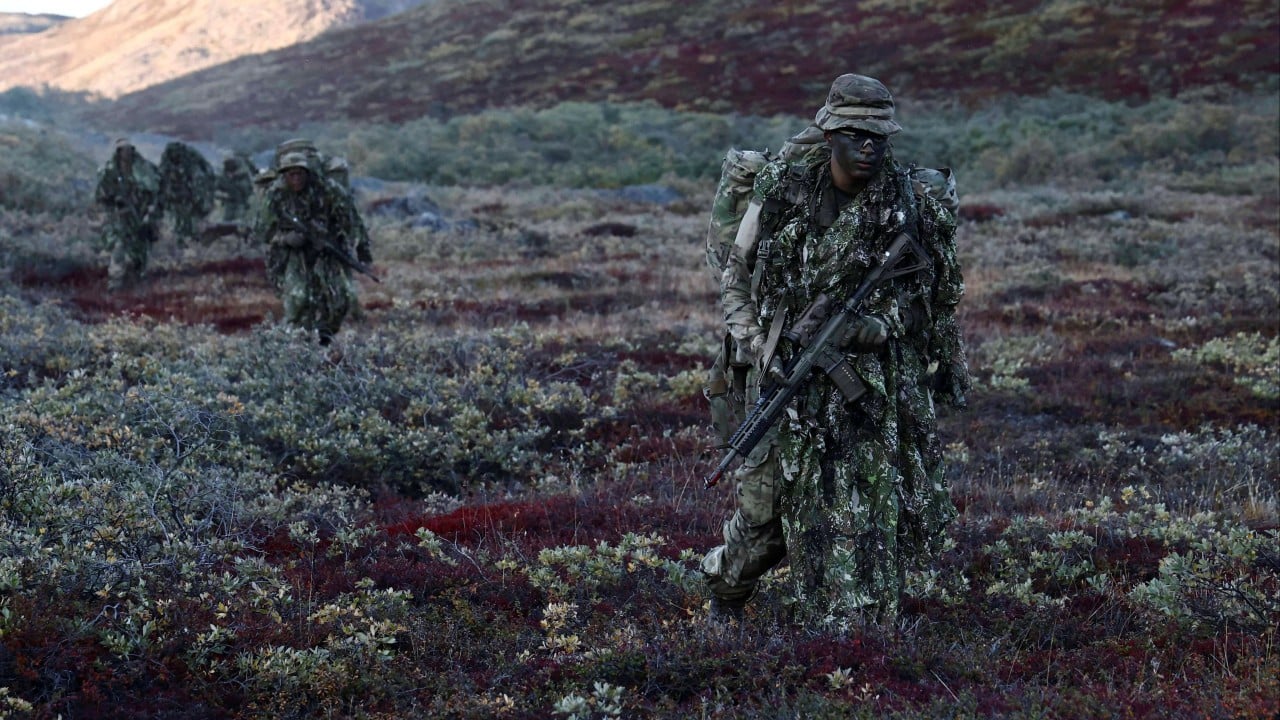
Denmark has officially deployed its first cohort of military conscripts to Greenland, marking a profound shift in Arctic security driven directly by acute geopolitical pressure from Washington and escalating friction with Moscow and Beijing. Around 100 recruits from the Schleswig Foot Regiment landed in Nuuk and Kangerlussuaq as part of Operation Arctic Endurance, operating under a newly expanded 11-month national service model. This move transcends routine military training. Copenhagen is scrambling to establish an undeniable physical footprint on an autonomous island that spent decades under-defended, suddenly caught in the crosshairs of renewed great power competition over polar shipping lanes, critical mineral deposits, and strategic missile corridors.
The deployment follows a tense diplomatic and military standoff earlier this year. Following repeated demands from United States President Donald Trump to acquire the territory, Denmark found itself facing the nightmare scenario of an allied breach. While Washington ultimately backed down from active military threats, the crisis exposed a glaring vulnerability. Decades of post-Cold War complacency left the Kingdom of Denmark completely unequipped to monitor or defend its massive northern asset. Blood bags were hurriedly shipped north during the height of the crisis, and military planners drafted contingency plans to destroy key airstrips to deny them to an invading force.
Copenhagen cannot afford to rely solely on diplomatic goodwill anymore. The decision to inject young conscripts into the harsh, treeless expanses north of the Arctic Circle represents a calculated effort to institutionalize a permanent deterrent posture.
The Reality of the New Conscription Architecture
To understand why 19- and 22-year-old conscripts are suddenly trading temperate forests for the barren rock of Greenland, one must look at the structural overhaul of Denmark's armed forces. Prompted by Russia's invasion of Ukraine and the compounding shocks of transatlantic volatility, the Danish government instituted a sweeping defense agreement. Mandatory national service was made gender-neutral, and the training window was expanded from a brief four months to an intensive eleven months.
The math behind the reform is straightforward. Five months of basic training are followed by six months of active operational service. Without this extension, deploying conscripts outside the Danish mainland was legally and practically impossible. Now, these recruits form an accessible pool of personnel capable of filling out units alongside professional soldiers.
The deployment is modest in scale—roughly 100 soldiers rotating through base facilities and urban checkpoints in Nuuk. Yet the symbolic weight is heavy. Conscripts like 19-year-old David and 22-year-old Anton are performing operational duties that previous generations of trainees only read about in manuals. They are learning Arctic concealment on open terrain where traditional forest camouflage is useless, adjusting to sudden blizzards, and operating supply lines across massive distances with minimal infrastructure.
The Broader NATO Calculus and the Northern Flank
This is not happening in a vacuum. The Greenland deployment feeds directly into Arctic Sentry, a broader NATO mission designed to project alliance unity and counter the heavy military buildup executed by Russia along its northern coastline. Moscow has repeatedly criticized NATO's expanding footprint in the high north, warning that increased operational tempo near the Arctic Circle elevates the risk of unintended escalation.
Concurrently, Beijing’s steady interest in Greenland’s rare earth minerals and polar shipping routes has added urgency to Copenhagen's calculations. While Greenlandic authorities maintain strict control over local resource development—recently pushing back against foreign corporate overreach—the local government must balance economic autonomy with physical security.
Critics within European security circles occasionally dismiss these rotational deployments as politically motivated posturing rather than war-fighting capabilities. A contingent of light infantry armed with standard-issue rifles cannot stop a modern carrier strike group or a specialized amphibious assault. However, military analysts note that the utility of these troops lies in the "tripwire" concept. Having citizens of multiple allied nations and Danish conscripts embedded on the ground ensures that any hostile move against the territory carries an immediate, automatic international cost.
Logistics in the World's Most Hostile Environment
Operating in Greenland requires an entirely different operational mindset. The infrastructure supporting the current rotation is sparse. Kangerlussuaq and Nuuk serve as the primary hubs, but moving troops beyond these points means confronting unpredictable weather, vast distances, and zero natural cover.
Captain Laura Jepsen, a company commander overseeing the deployment, noted that the core objective is hardening the force against extreme cold-weather environments. Equipment freezes. Communications fail. Supply chains break down faster than in any other theater. By rotating conscripts through these conditions early in their service, Denmark is building a permanent institutional memory for Arctic warfare that vanished after the Cold War.
The defense ministry plans to scale up the annual conscript intake significantly over the next few years, aiming for up to 7,500 recruits annually by 2033. A growing fraction of those soldiers will cycle through northern deployments. The ice is melting, opening up new commercial routes and resource fields that every major power wants to control. Denmark has accepted that holding onto Greenland requires more than a flag on a map; it requires boots on the ground, enduring the long, freezing dark.